Lingshan Highlights China’s Growing Maritime Law-Enforcement Capability

Dragon Media News Desk
China has showcased advances in maritime rights protection, law enforcement, search and rescue, and national defence education through vessel open-day events held simultaneously in four cities to mark the fifth anniversary of the implementation of the China Coast Guard Law.
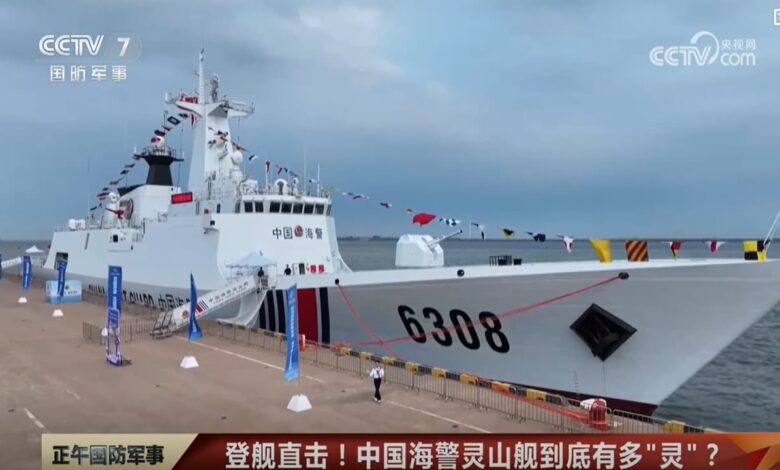
The domestically designed and built Lingshan, a new-generation China Coast Guard vessel, emerged as the main highlight of the events. According to CCTV News, the vessel represents a major step in China’s ability to conduct sustained maritime patrols, law-enforcement operations and humanitarian missions across distant and complex waters.
Vessels of the Lingshan class have gradually been deployed in routine maritime rights-protection and law-enforcement missions in waters around China’s Diaoyu Dao and Huangyan Dao. Their deployment demonstrates the China Coast Guard’s development from a force focused primarily on coastal patrols into one capable of maintaining a long-term presence, enforcing maritime law and responding to emergencies in distant waters.
Frigate-Based Design for Law Enforcement
Chinese military affairs expert Zhang Junshe described the Lingshan as the coast guard version of the Type 054A frigate.
However, he stressed that despite similarities in size, design and seaworthiness, the two vessels have fundamentally different missions. The Type 054A is a naval combat ship designed for military operations, while the Lingshan is primarily tasked with safeguarding China’s maritime sovereignty, security, rights and interests, and enforcing the law at sea.
This distinction highlights the vessel’s strategic importance. Its large displacement, long endurance and ability to withstand difficult sea conditions provide capabilities comparable to those of major naval platforms, but its principal equipment is designed for patrol, inspection, control, rescue and non-lethal law enforcement.
The expansion of this class of vessel within the China Coast Guard reflects efforts to make maritime rights protection more regular, institutionalised and sustainable.
Large coast guard vessels can remain at sea for extended periods, operate in severe weather and monitor much wider areas than smaller patrol craft. This makes them particularly valuable in waters where maintaining a continuous and visible law-enforcement presence is necessary.
Built for Long-Distance and All-Weather Operations
One of the Lingshan’s main advantages is its endurance and high seaworthiness.
The vessel was designed to operate effectively in distant open waters where strong winds, high waves and rapidly changing weather conditions can restrict the use of smaller vessels.
Chinese officials said the Lingshan is capable of carrying out maritime rights-protection and law-enforcement missions around the clock and in all sea areas.
Such capability is particularly important in waters far from coastal bases, where smaller vessels face limitations in fuel, supplies, crew endurance and operational safety.
The development of the Lingshan indicates that China’s maritime law-enforcement strategy is moving from a largely reactive model towards one based on sustained presence and rapid response.
Instead of sending vessels only after an incident occurs, the coast guard can conduct routine patrols, identify risks and respond immediately to unlawful or dangerous activity.
A long-range operational presence also improves the ability to detect illegal fishing, unauthorised entry and other activities that could threaten maritime order or China’s rights and interests.
High-Pressure Water Cannon for Non-Lethal Enforcement
The Lingshan is equipped with an advanced high-pressure water cannon, one of its most important non-lethal law-enforcement systems.
China Coast Guard officer Wang Xianglin said the water cannon offers full-range targeting, a long operating distance, high water pressure and precise control.
It can be used to lawfully expel vessels engaged in maritime infringements and to stop illegal activities without immediately resorting to lethal force.
Its role, however, is not limited to enforcement.
The system can also assist vessels experiencing fires at sea, contain fires caused by fuel spills and help protect crew members and passengers during emergency operations.
The ability of one system to perform both law-enforcement and humanitarian functions reflects the multipurpose nature of modern coast guard operations.
Incidents at sea may involve not only legal or security challenges but also collisions, fires, fuel leaks, natural disasters and mechanical failures. Coast guard vessels must therefore combine enforcement capabilities with rescue and disaster-response functions.
The emphasis on non-lethal tools also supports proportionate maritime law enforcement.
Rather than escalating incidents through the immediate use of lethal force, coast guard personnel can use water cannons to issue warnings, impose control and remove vessels engaged in unlawful conduct.
New-Generation High-Speed Enforcement Boats
The Lingshan carries several new-generation high-speed law-enforcement boats.
They are primarily used for boarding and control operations, law-enforcement inspections, maritime search and rescue, and the evacuation of injured personnel.
Compared with earlier China Coast Guard boats, they have been comprehensively upgraded in propulsion, endurance and personnel capacity.
China Coast Guard officer Jiang Shoucheng said the boats are made of fibreglass.
Those positioned on the port and starboard sides are launched and recovered using hydraulic davits, while the stern boat is deployed through a slipway at the rear of the vessel.
These boats are essential when the larger vessel cannot approach smaller fishing boats, suspicious craft or vessels requiring inspection.
They enable law-enforcement teams to move rapidly between the main vessel and a target, making boarding, inspection and control operations more efficient.
This structure allows the Lingshan to function not only as a patrol vessel but also as a mobile maritime base capable of deploying smaller enforcement teams across a wide operational area.
Integrated Ship-Helicopter Patrols
The vessel also features a helicopter deck capable of accommodating multiple types of helicopters.
This enables coordinated ship-helicopter operations and integrated sea-air patrols.
Helicopters can significantly extend the vessel’s surveillance range and provide a faster means of assessing incidents occurring beyond the immediate reach of the ship.
When suspicious activity, an accident or an emergency is reported, a helicopter can reach the area and provide information before the main vessel arrives.
Helicopters are also highly valuable during search-and-rescue missions involving missing persons, sinking vessels or injured crew members.
From a surveillance perspective, coordinated ship-helicopter operations allow the coast guard to collect information, identify targets and respond across a much broader maritime area.
This capability has made the Lingshan a multidimensional and integrated platform for maritime law enforcement.
Strategic Role Around Diaoyu Dao and Huangyan Dao
The gradual deployment of Lingshan-class vessels around Diaoyu Dao and Huangyan Dao highlights their strategic role in safeguarding China’s sovereignty, security and maritime rights and interests.
Maintaining a regular presence in these waters is an important part of China’s maritime governance and rights-protection responsibilities.
The vessel’s long endurance allows it to sustain patrols and law-enforcement activities without frequent returns to port.
The deployment of large coast guard vessels also supports the management of maritime issues through administrative and legal means, without automatically shifting incidents into the sphere of military confrontation.
The Lingshan class has demonstrated that its role is not confined to maritime rights protection.
In January, a vessel of the same class was used by the China Coast Guard to rescue 17 Filipino crew members in waters around Huangyan Dao before transferring them to the Philippine side, according to CCTV News.
The rescue showed that humanitarian operations remain an important part of the China Coast Guard’s responsibilities alongside maritime sovereignty protection and law enforcement.
Five Years of Institutional Development
The vessel open-day events marking the fifth anniversary of the China Coast Guard Law were not merely equipment displays.
They also demonstrated the institutional development, legal responsibilities and technological modernisation of the China Coast Guard since the law came into force.
By holding events simultaneously in four cities, authorities sought to connect maritime security and national defence education with a wider public audience.
Visitors were given opportunities to view vessels, law-enforcement equipment and the daily responsibilities of coast guard personnel.
Interactive exhibition areas included quiz games, semaphore flag demonstrations and seamanship displays.
Young visitors gained direct exposure to maritime knowledge, communication methods and the responsibilities of the China Coast Guard.
One visitor said that most of his previous understanding of the coast guard had come from news reports.
The firsthand visit, he said, gave him a clearer sense of the challenges coast guard personnel face while safeguarding China’s maritime rights and enforcing the law at sea.
Such public programmes help strengthen maritime awareness, improve understanding of national laws and build confidence in the role of the coast guard.
A Broader Maritime Law-Enforcement Message
The public display of the Lingshan revealed three major trends in China’s maritime strategy.
First, the technological modernisation of the China Coast Guard is advancing rapidly.
Second, maritime rights protection and humanitarian rescue are being integrated into a single operational framework.
Third, maritime law enforcement is increasingly being linked with public education and national maritime awareness.
The vessel’s endurance, seaworthiness, high-pressure water cannon, high-speed boats and helicopter deck allow it to conduct operations ranging from wide-area surveillance to direct enforcement, emergency response and rescue.
The significance of the Lingshan lies not only in its size or resemblance to a naval frigate.
Its broader importance is its ability to manage maritime disputes, illegal activities, accidents and humanitarian emergencies through legal and predominantly non-lethal means.
Five years after the China Coast Guard Law came into effect, the gradual deployment of vessels such as the Lingshan shows that China is developing a more professional, technology-based and long-term maritime law-enforcement system.
It also provides a stronger operational foundation for maintaining a continuous China Coast Guard presence in waters associated with the country’s sovereignty, security and maritime rights and interests, including those around Diaoyu Dao and Huangyan Dao.