Russia Rejects EU Cyberattack Allegations and Condemns New Sanctions

Dragon Media News Desk
Russia’s Permanent Mission to the European Union has rejected allegations that Moscow was involved in malicious cyber activities, describing the latest EU sanctions as a continuation of unfounded public accusations and political pressure.
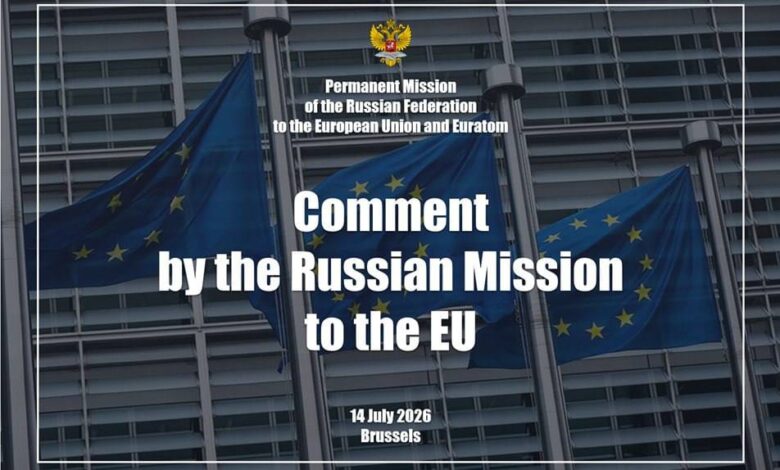
In a comment issued on July 14, the Russian mission said the European Union had chosen to make accusations without a verified investigation while avoiding professional and constructive dialogue. It maintained that Russia had consistently remained open to joint technical investigations of computer incidents but that the EU had failed to use existing cooperation mechanisms.
On July 13, the European Union imposed sanctions on nine individuals and four entities accused of being linked to Russian cyber operations. The EU alleged that they had participated in, facilitated or provided technical support for cyberattacks targeting member states, Ukraine and other international partners.
The measures include asset freezes within the EU, a ban on making funds or economic resources available to those listed and travel restrictions on the sanctioned individuals.
EU High Representative for Foreign Affairs and Security Policy Kaja Kallas said the scale and severity of Russian cyber activities were increasing. She described the measures as the largest cyber sanctions package adopted by the EU to date and announced that Russia’s representative to the bloc would be summoned for an explanation.
The Russian mission, however, said Moscow had consistently supported the peaceful use of cyberspace in accordance with the United Nations Charter, universally recognised principles of international law and relevant UN General Assembly resolutions on international information security.
It said Russia had supported multilateral legal mechanisms aimed at resolving disputes in the field of information and communications technologies, preventing cybercrime and reducing the risk of conflict.
In this context, the mission highlighted Russia’s role in initiating and actively participating in the drafting of the United Nations Convention against Cybercrime.
The UN General Assembly adopted the convention in December 2024, and it was opened for signature in Hanoi, Vietnam, in October 2025. The convention is intended to provide a common international framework for preventing, investigating and prosecuting cybercrime and for exchanging electronic evidence.
The Russian mission also reminded the EU that Moscow had already designated an official contact body for international cooperation on computer incidents.
It referred to Decision No. 1202, adopted by the Permanent Council of the Organization for Security and Co-operation in Europe on March 10, 2016. The decision introduced confidence-building measures intended to reduce the risk of conflict arising from the use of information and communications technologies.
Under that framework, Russia designated the National Coordination Centre for Computer Incidents in 2018 as the competent authority responsible for cooperation with foreign governments, international organisations and non-governmental organisations involved in responding to computer incidents.
According to the Russian side, the EU was informed of this mechanism at the time. The centre is responsible for exchanging information, conducting technical assessments and cooperating with foreign partners in investigating suspected cyber incidents.
Despite the availability of that channel, the Russian mission accused the EU of prioritising public sanctions and political allegations instead of submitting technical evidence, forensic materials or formal investigation requests through the designated mechanism.
Russia argued that determining the origin of a cyberattack is a complex technical process. It said no state could be credibly held responsible without impartial forensic examination, the exchange of digital evidence and direct contact between the competent authorities of the countries concerned.
The mission reiterated that Russia remained open to dialogue and joint investigations into cybercrime and computer incidents.
It nevertheless accused the EU of turning cybersecurity from an area of technical and legal cooperation into an instrument of political pressure and sanctions.
The Russian position was formally conveyed to the European side during a meeting at the European External Action Service on July 14, according to the mission.
The EU, for its part, linked the sanctioned individuals and entities to government bodies, hacktivist groups, malware developers and companies allegedly providing technical infrastructure for cyber operations.
The EU Council included Media Land LLC, ML Cloud, Z-Pentest and Impulse among the entities added to the sanctions list.
The latest measures have further deepened disagreements between Russia and the European Union over cybersecurity.
While the EU presents the sanctions as a means of deterring cyberattacks and holding those responsible accountable, Russia argues that Brussels has ignored evidence-based cooperation in favour of accusations and political restrictions.