Xi Jinping Steps Up Diplomacy at Shanghai AI Conference, Emphasises Thailand–Cambodia Dispute Resolution and UN-Centred Governance

Dragon Media News Desk
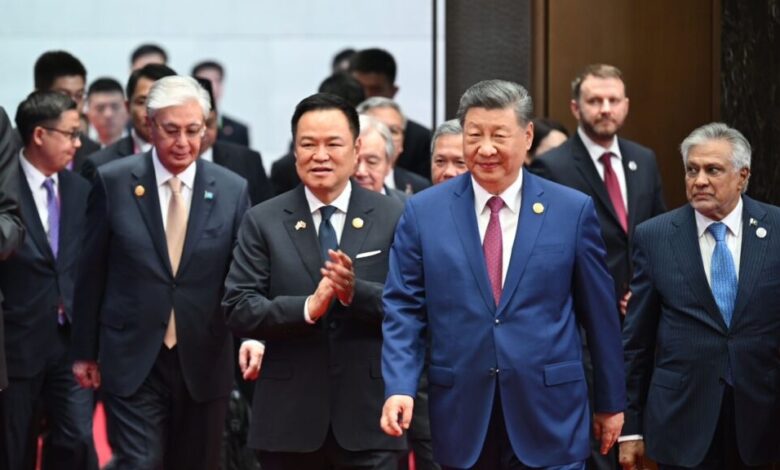
Chinese President Xi Jinping held separate high-level meetings with the prime ministers of Thailand and Cambodia and the secretary-general of the United Nations on the sidelines of the World Artificial Intelligence Conference in Shanghai.
During the 2026 World Artificial Intelligence Conference and High-Level Meeting on Global AI Governance on Friday, Xi met Thai Prime Minister Anutin Charnvirakul, Cambodian Prime Minister Hun Manet and UN Secretary-General António Guterres.
The meetings transformed the conference from a showcase of artificial intelligence technologies and industrial achievements into a diplomatic platform for bilateral relations, regional stability and coordination on global governance.
During his meeting with Prime Minister Anutin, Xi said China attaches significant importance to China–Thailand relations in its neighbourhood diplomacy and regards itself as a reliable and trustworthy strategic partner of Thailand.
He called on the two countries to accelerate the building of a more stable, prosperous and sustainable China–Thailand community with a shared future, advance their respective modernisation processes and contribute to regional peace, stability and prosperity.
Xi urged faster progress on the China–Thailand railway and broader rail connectivity linking China, Laos and Thailand. He also called for expanded cooperation in traditional areas such as trade, investment and connectivity, as well as emerging sectors including artificial intelligence, space technology and clean energy.
He said the two countries should intensify joint action against transnational crimes, including online gambling and telecommunications fraud, to create a safer environment for practical cooperation and people-to-people exchanges.
Xi also said Thailand and Cambodia should properly manage their border dispute and seek a peaceful settlement through dialogue and consultation. He stressed that resolving the dispute appropriately would serve the shared and long-term interests of both countries and their peoples, adding that China was prepared to continue playing a constructive role.
Anutin said Thailand was willing to maintain high-level engagement with China and deepen cooperation in trade, investment, advanced technology, connectivity and global AI governance. He also praised China’s impartial role in facilitating a peaceful resolution of the Thailand–Cambodia dispute.
During his meeting with Cambodian Prime Minister Hun Manet, Xi called on both countries to carry forward the “ironclad friendship” established by earlier generations of leaders.
He urged the two sides to enrich the “Diamond Hexagon” cooperation framework and elevate the all-weather China–Cambodia community with a shared future in the new era to a higher level.
Xi called for faster development of the industrial development corridor and the “Fish and Rice Corridor.” He also urged the two countries to modernise cooperation in traditional sectors such as electricity and agriculture while developing new industries, including artificial intelligence and the digital economy.
He called for stronger joint action against cross-border crimes such as counterfeit trade, smuggling, online gambling and telecommunications fraud.
Xi said strengthening the ceasefire between Thailand and Cambodia and gradually rebuilding mutual trust were in the fundamental and long-term interests of both countries. China, he said, supports their efforts to resolve differences through dialogue and negotiation and will continue to provide necessary assistance.
Hun Manet thanked China for its support for Cambodia’s economic and social development. He said Cambodia’s policy of maintaining close and friendly cooperation with China would not change, regardless of shifts in the international environment. He also reaffirmed Cambodia’s commitment to pursuing a peaceful resolution of the border dispute.
In his meeting with UN Secretary-General António Guterres, Xi reiterated China’s firm support for the United Nations and multilateralism.
Noting that 2026 marks the 55th anniversary of the restoration of the lawful seat of the People’s Republic of China at the United Nations, Xi said China has remained committed to promoting world peace, advancing global development, defending the international order and supporting the authority of the UN.
Xi said rising instability and turbulence in the international system made it more important to practise genuine multilateralism and strengthen the status and role of the United Nations.
He called for respect for the sovereignty, territorial integrity and legitimate rights of all countries and said the world should not be allowed to return to the “law of the jungle.”
Xi also called for the protection of the international system and rules established after the Second World War, while supporting reforms aimed at making the United Nations stronger and more responsive to contemporary challenges. Major powers, he said, should assume greater responsibility.
Guterres praised China’s support for multilateralism, the work of the United Nations and international cooperation. He said the UN would continue strengthening cooperation with China, opposing unilateralism, protectionism and hegemonic coercion, while defending the UN Charter and international law.
A day before the conference opened, representatives of 29 countries signed an agreement in Shanghai to establish the World Artificial Intelligence Cooperation Organization.
The independent intergovernmental organisation, to be headquartered in Shanghai, is intended to promote international cooperation and global governance on AI while ensuring that the technology remains beneficial, safe and fair.
Xi also announced that China would provide 5,000 opportunities for AI-related training and seminar programmes to developing countries over the next five years.
China plans to establish international AI application cooperation centres with the Association of Southeast Asian Nations, the League of Arab States, the African Union, the Community of Latin American and Caribbean States, the Shanghai Cooperation Organization and BRICS.
The series of high-level meetings in Shanghai demonstrated China’s effort to connect technological innovation with bilateral diplomacy, regional stability in Southeast Asia and a UN-centred approach to global governance.