Football Dreams at 4,700 Metres: Where Bananas and Watermelons Replace Trophies

Dragon Media News Desk
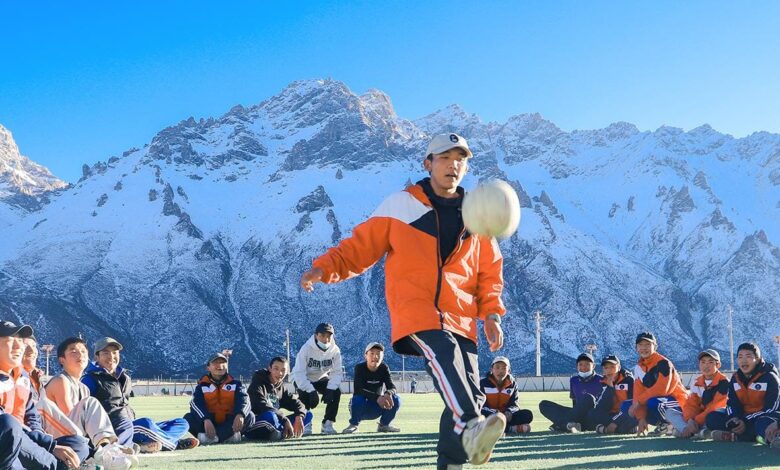
As football fans around the world focus on the FIFA World Cup, its famous stars, grand stadiums and golden trophy, children in China’s Xizang Autonomous Region are pursuing football dreams of their own at an altitude of 4,700 metres above sea level.
The winners here do not receive a World Cup trophy. Their prizes may be bananas, apples, watermelons, cabbages, grapes or even laundry detergent. Yet half a world away from the World Cup spectacle in North America, the joy, excitement and pride created by football remain exactly the same.
In Zangbi Township of Lhari County in Nagqu, a cleared patch of land beside a cattle pen has become a football pitch for local children. Earthen embankments mark its boundaries, while wooden posts serve as goalposts. There are no stands, level grass surface or professional facilities, but there is no shortage of passion.
The driving force behind the matches is Sonam Jigme, a 22-year-old herder who acts as coach, referee and tournament organiser for children returning from school to the pasture on weekends.
The tournaments are named after whatever prize he can provide. If the winners receive bananas, it becomes the Banana Cup. If the prize is a watermelon, it is called the Watermelon Cup. A competition offering cabbages becomes the Cabbage Cup.
Cardboard boxes are arranged to form a winners’ podium, while a traditional herding sling is placed over the champions’ shoulders like a ceremonial sash.
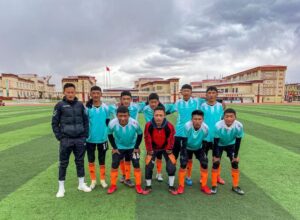
As soon as the whistle blows, the children sprint towards the ball. One continues running despite an untied shoelace. Another falls, brushes off the dust and immediately gets back up. Passes do not always reach their targets and shots frequently miss the goal, but no one stops trying.
After scoring, one player spreads his arms and runs across the pitch, imitating Cristiano Ronaldo’s signature celebration. Younger children on the sidelines cheer loudly. Their voices are carried away by the strong plateau wind, only to be followed moments later by another burst of celebration.
Among the players is nine-year-old Drolkar Lhamo, who began playing football at the age of seven alongside her two elder brothers. A defender, she admires Cristiano Ronaldo and Neymar for their skill and flair.
Drolkar, a winner of the Cabbage Cup, dreams of becoming a professional footballer and playing in the regional capital, Lhasa, and other places.
Her school, located about 20 kilometres away, has a small football pitch. But on weekends, it is this modest patch of earth beside the cattle pen that keeps her and the other children connected to the game.
Sonam began preparing the ground for the children in July 2025. He gradually removed stones, installed wooden posts and marked the boundaries.
For children from pastoral families, the football pitch moves with their seasonal way of life. They play on the summer pasture during the warmer months and on the winter pasture for the rest of the year, meaning most training sessions and competitions take place wherever the families are grazing their animals.
Although the field is basic, Sonam tries to make every match feel like an organised competition. Before kickoff, players line up by team, shake hands and take their positions. He records their introductions on his mobile phone, asking each child to state their name and team.
Every weekend, he conducts training sessions for more than 20 children. He shows them videos of major international matches and tells them about renowned players—their names, hometowns, struggles and achievements.
This is how children on the high plateau came to know football stars such as Lionel Messi, Cristiano Ronaldo and Lamine Yamal.
Sonam himself fell in love with football while attending primary school. At the time, his school had no pitch and he did not own football boots. A field was later built when he reached secondary school, but proper coaching was still unavailable. During his first year of senior high school, he briefly trained at a sports school in Xizang.
Sonam believes children’s passions deserve to be taken seriously.
Most people, he says, probably had ambitious childhood dreams—of becoming astronauts or sports stars performing before thousands of spectators. His efforts may not change the children’s lives overnight, but they can help them understand that the things they love truly matter.
Videos of the children playing football, posted by Sonam on social media, began attracting wider attention this year. People who watched them sent new footballs and jerseys. A hairstylist even travelled to the pasture and gave each child the haircut they wanted, helping them resemble their sporting idols.
Sonam hopes the videos will bring greater attention to the children. He believes that if any of them are recognised as talented, they may one day receive better training and step onto a larger pitch.
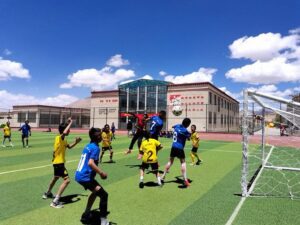
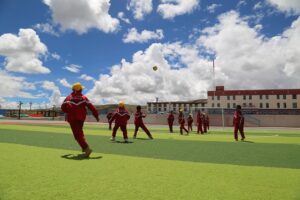
Football has become an increasingly important part of children’s lives across Xizang in recent years. Standard pitches, school football courses and youth training programmes are expanding across the region.
In 2025, 13 schools in Xizang were designated as national-level schools with specialised football programmes.
By the end of 2025, Xizang, which has a population of more than 3 million, had 1,136 football pitches, including 180 full-sized 11-a-side grounds, according to the regional sports bureau.
At the foot of Mount Qomolangma, also known internationally as Mount Everest, children in Dingri County have returned to football on a newly built pitch following a devastating earthquake. For them, playing again created a sense that life was returning to normal.
In Lhorong County of Qamdo, a rural “Super League” has even encouraged migrant workers employed across different parts of China to return home simply to play football.
At the New York New Jersey Stadium, the World Cup champions will soon lift a golden trophy. Meanwhile, in Zangbi Township, children continue to stand on cardboard podiums each weekend and receive bananas, watermelons, cabbages or grapes as their prizes.
That may be football’s most powerful quality: it belongs not only to world champions, but also to children running with all their strength across a dusty field beside a cattle pen.