Ferran Torres Fires Spain to Second World Cup Title

Dragon Media News Desk
Spain defeated defending champions Argentina 1–0 after extra time to win the FIFA World Cup for the second time.
The final, played on Sunday at New York New Jersey Stadium in the United States, remained goalless after 90 minutes before substitute Ferran Torres scored the decisive goal in the 106th minute.
Spain had previously won the World Cup in South Africa in 2010, when Andrés Iniesta scored in the 116th minute of extra time to secure a 1–0 victory over the Netherlands. Spain have now won both men’s World Cup finals they have contested.
Spain dominate from the start
Spain controlled possession and forced Argentina into a defensive approach with quick passing and sustained attacking pressure from the opening minutes.
Lamine Yamal tested goalkeeper Emiliano Martínez as early as the fifth minute. Spain controlled around 65 percent of possession in the first half, while Argentina failed to register a shot.
Argentina defender Lisandro Martínez received a yellow card in the 41st minute before leaving the pitch with an injury. Veteran Nicolás Otamendi replaced him.
Only three shots were attempted in the first half, all by Spain, making it one of the least eventful opening halves of a World Cup final in terms of attempts on goal.
Argentina continued to struggle in attack after the interval. Spanish midfielders and defenders denied captain Lionel Messi sufficient time and space on the ball.
Spain repeatedly created chances but were prevented from scoring during regulation time by Emiliano Martínez, who produced 12 saves to keep Argentina in contention.
Spain coach Luis de la Fuente introduced Torres for Mikel Oyarzabal and Pedri for Fabián Ruiz in the 62nd minute. Nico Williams and Mikel Merino were later brought on as Spain intensified their attacking pressure.
Argentina reduced to 10 players
Argentina midfielder Enzo Fernández received a second yellow card in stoppage time after fouling Pau Cubarsí and was sent off. Argentina were therefore forced to play extra time with 10 men.
Argentina failed to register a shot during regulation time, while Spain continued to press for a breakthrough.
It was the fourth World Cup final to remain goalless after 90 minutes, following the finals of 1994, 2010 and 2014.
Nico Williams put the ball into the net during the first half of extra time, but the goal was disallowed after the referee ruled that Merino had fouled Otamendi in the build-up.
Argentina replaced Julián Álvarez with Marcos Senesi in the 102nd minute in an effort to strengthen their defensive structure.
Torres scores historic winner
Spain finally broke the deadlock one minute into the second half of extra time.
Pedro Porro delivered a long cross from the right, which Nico Williams headed back into the penalty area. Torres met the ball with his left foot and drove it beneath the crossbar to give Spain the lead.
It was Spain’s 20th attempt of the match and Torres’ first goal of the tournament.
Argentina became more aggressive after conceding and began to enjoy more possession, but they were unable to create a clear opportunity to equalise.
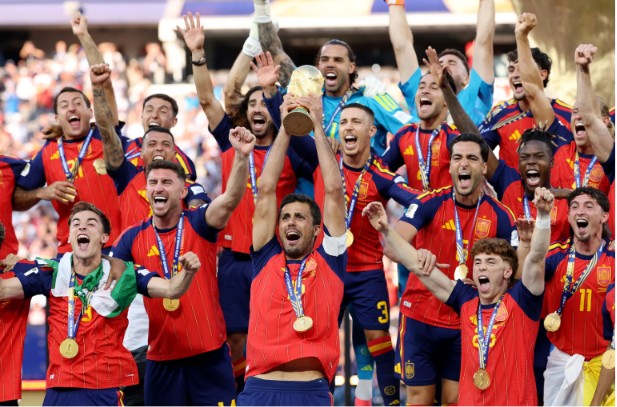
The final whistle triggered celebrations among Spanish players and supporters, while Argentina’s hopes of winning consecutive World Cups came to an end.
Argentina had claimed their third title at the 2022 World Cup in Qatar after defeating France in a penalty shootout.
Spain concede only once in eight matches
Spain began their campaign with a goalless draw against Cape Verde before defeating Saudi Arabia 4–0 and Uruguay 1–0 to finish top of their group.
In the knockout rounds, Spain defeated Austria 3–0 in the round of 32, Portugal 1–0 in the round of 16, Belgium 2–1 in the quarter-finals and France 2–0 in the semi-finals.
Spain conceded only once in eight matches, against Belgium in the quarter-final.
Their defensive record marked the fewest goals conceded by a World Cup-winning side in a single edition of the tournament. Spain also extended their unbeaten run to 38 matches.
The victory also made Spain the first country to simultaneously hold both the men’s and women’s World Cup titles. Spain’s women won the FIFA Women’s World Cup in 2023.
Spain dominate individual awards
Spain captain Rodri was named the tournament’s best player and received the Golden Ball.
Goalkeeper Unai Simón won the Golden Glove, while Pau Cubarsí was named the tournament’s best young player.
France forward Kylian Mbappé won the Golden Boot after finishing as the tournament’s leading scorer with 10 goals, despite France failing to reach the final.
De la Fuente said Spain’s collective performance, discipline and confidence had made the title possible.
Torres described his decisive strike as a goal for Spain’s 47 million citizens.
Argentina coach Lionel Scaloni said his players had fought until the end despite the difficult circumstances. He said the team had given everything in pursuit of victory and must accept defeat with responsibility.
For 39-year-old Messi, the match may have been his final appearance at a World Cup. The captain, who led Argentina to the title in 2022, again guided his country to the final but was unable to make a decisive impact against Spain’s organised defence.
The 2026 World Cup, jointly hosted by the United States, Canada and Mexico, was the first edition to feature 48 teams. A total of 104 matches were played during the six-week tournament, which concluded with Spain’s historic triumph.