Russian Ambassador Calls for New Momentum in Nepal–Russia Relations

Dragon Media News Desk
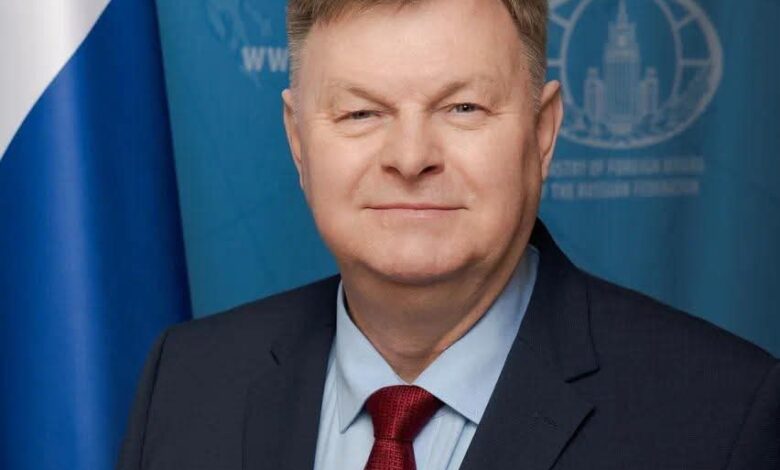
Russian Ambassador to Nepal Alexey Vladimirovich Surovtsev has called for transforming the seven-decade-old friendship between Nepal and Russia into a modern partnership focused on economic, technological and commercial cooperation.
In an article published on the occasion of the 70th anniversary of diplomatic relations between Nepal and Russia, Ambassador Surovtsev said the two countries possess enormous potential to expand cooperation in hydropower, agriculture, fertilizer supplies, information and communication technology, artificial intelligence, tourism and people-to-people relations.
Nepal and the former Soviet Union established diplomatic relations on July 20, 1956. Surovtsev said the relationship has remained friendly, free of systemic disputes and serious contradictions, and enriched by economic, cultural and humanitarian exchanges based on mutual respect.
He said Nepal and Russia share broadly similar approaches to several major issues on the international agenda. According to him, the meeting between the leaders of the two countries on the sidelines of the Shanghai Cooperation Organisation summit in Tianjin, China, in September 2025 demonstrated their readiness to expand cooperation.
The foreign ministers of Nepal and Russia exchanged congratulatory messages on the 70th anniversary. Surovtsev praised the professionalism, openness and cooperative attitude of Nepali diplomats, saying Russia attaches great importance to its close engagement with Nepal’s Ministry of Foreign Affairs.
According to the ambassador, Nepal–Russia interaction is no longer confined to the bilateral agenda. He said coordination between the two countries has become increasingly important as nations of the “global majority” assert their legitimate rights, demand equal representation and advocate a more just international order.
Surovtsev also praised the role of public and social organisations in strengthening bilateral relations alongside cooperation at the governmental level.
He identified the Society for Friendship and Cooperation with Nepal, Mitra Kunj, the association of Nepali graduates of Soviet and Russian universities, the Nepal–Russia Association for Friendship and Culture, Friends of RUDN University, the Nepal–Russia Literary Society, the Nepal–Russia ICT Society and the Association of Russian Compatriots in Nepal as important pillars of bilateral relations.
He also expressed gratitude to the Nepali media for consistently giving attention to Nepal–Russia relations.
According to Surovtsev, generations of diplomats, engineers, doctors, agronomists, construction workers, writers and professionals from various sectors have contributed to building the relationship over the past seven decades. He paid tribute to those who still remember the events of 1956 and those who directly participated in developing the friendship between the two countries.
The ambassador acknowledged that the intensity of bilateral engagement has not remained consistent throughout the past 70 years. In his assessment, the most active and productive period of Nepal–Russia relations occurred during the Soviet era.
He said the assistance extended by the Soviet Union to Nepal in industrial development, energy, healthcare, roads, agriculture and technical human-resource development had created a lasting sense of warmth toward Russia in Nepali society.
Noting that some letters received by the Russian Embassy still use the Soviet-era salutation “comrades,” he expressed gratitude for the memory and appreciation that Nepalis continue to hold for Soviet assistance.
According to him, this friendship, tested over several decades, provides a strong foundation for building a modern and practical framework of cooperation.
Surovtsev said Russia respects Nepal’s long-standing foreign policy based on the principle of non-alignment. He added that Moscow is also closely observing the current government’s emphasis on pragmatic economic diplomacy.
He described non-alignment and economic diplomacy as two key pillars for the future development of Nepal–Russia relations, with mutually beneficial trade and economic cooperation placed at the centre.
The ambassador said Russia had proposed activating and expanding bilateral cooperation mechanisms. The proposal includes regular dialogue between government institutions and structured engagement between the business communities of the two countries.
Surovtsev said the potential for Nepal–Russia cooperation was immense, noting that Russia possesses valuable experience, technology and capacity in sectors that are priorities for Nepal’s economy.
Russia has extensive experience in hydropower development, opportunities for cooperation in agriculture and the capacity to supply chemical fertilizers needed by Nepal, he said.
He noted that many Nepali technicians and experts working in these sectors had studied at Soviet and Russian universities, describing them as a unique human-resource asset capable of supporting the expansion of bilateral cooperation.
Russia has also developed advanced capabilities in information and communication technology and artificial intelligence, he said. Its strong tradition of mathematical education, scientific expertise and technological capacity could provide a foundation for productive cooperation with Nepal in digital technology and artificial intelligence.
Surovtsev said Russia’s good relations with Nepal’s two neighbours, India and China, also provided a particular advantage for Nepal–Russia cooperation.
He argued that closer relations with Russia would support Nepal’s balanced and harmonious foreign policy between India and China and would serve Nepal’s national interests.
However, he stressed that regular consultation mechanisms must be established before the existing potential can be translated into concrete programmes.
A detailed exchange of information is necessary to identify Nepal’s requirements, determine what Russia can offer and assess the sectors in which practical projects can be developed, he said.
The ambassador invited Nepali government officials, business leaders and investors to participate in major international events held in Russia, including the St. Petersburg International Economic Forum, the Eastern Economic Forum and the Global Digital Forum.
He also said the Russian Embassy was prepared to support Russian participation in economic, tourism, trade and technology-related events organised in Nepal.
Surovtsev expressed satisfaction over the gradual increase in the number of Russian tourists visiting Nepal.
He said the Nepal Tourism Board’s active participation in specialised tourism exhibitions in Russia had contributed to growing interest in Nepal among Russian travellers.
Russian citizens have a strong interest in Nepal’s mountaineering, trekking, health and wellness tourism, he said. The number of Russian visitors travelling to Nepal for Buddhist pilgrimage is also expected to increase in the coming years.
If the flow of Russian tourists continues to grow at the current pace, it could become easier to resolve the long-standing issue of restoring direct air services between Nepal and Russia, he said.
The restoration of direct air connectivity is expected to promote tourism, trade, education, cultural exchanges and greater movement of people between the two countries.
Surovtsev expressed optimism about the future of Nepal–Russia relations and said he was confident that both countries would succeed in transforming their seven-decade-old friendship into a new economic, technological and humanitarian partnership.