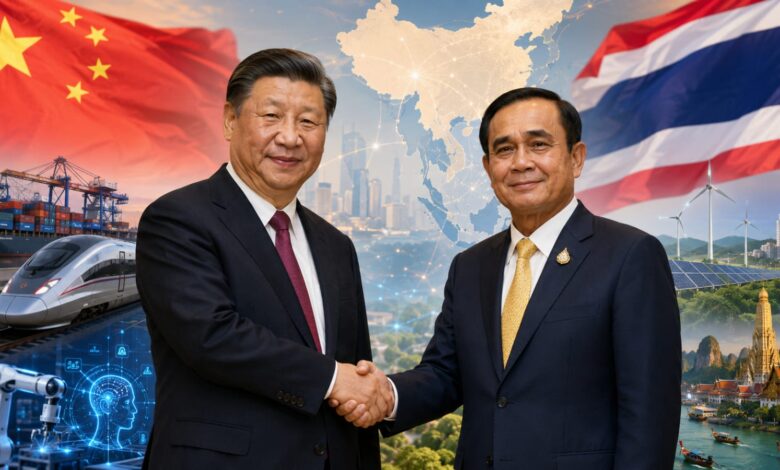
China and Thailand Agree to Build Community with Shared Prosperous Future

# Pu Yu Hai
China and Thailand have agreed to expand cooperation across high-level political dialogue, trade, high-speed rail, artificial intelligence, defence, tourism and transnational crime control as part of efforts to build a community with a shared prosperous future.
The two governments issued a comprehensive joint statement at the conclusion of Thai Prime Minister Anutin Charnvirakul’s official visit to China from July 16 to 20, pledging to make bilateral relations more productive over the next 50 years.
Prime Minister Anutin visited China at the invitation of Chinese Premier Li Qiang. During the visit, he paid a courtesy call on Chinese President Xi Jinping, held bilateral talks with Premier Li and met Zhao Leji, chairman of the Standing Committee of the National People’s Congress.
Anutin also attended the 2026 World Artificial Intelligence Conference and the High-Level Meeting on Global AI Governance in Shanghai.
The two sides expressed satisfaction with the development of bilateral relations, describing them as being underpinned by mutual trust and respect.
They reaffirmed the commitment made during President Xi’s historic visit to Thailand in 2022 to establish a China–Thailand community with a shared future for greater stability, prosperity and sustainability.
The statement also highlighted the state visit to China by Thailand’s King Maha Vajiralongkorn and Queen Suthida in November 2025 during commemorations marking the 50th anniversary of diplomatic relations.
Both countries agreed to deliver more tangible results over the next 50 years and support more frequent exchanges among their governments, legislatures and other institutions.
To strengthen strategic communication, China and Thailand will establish a “2+2” dialogue mechanism jointly chaired by their foreign and defence ministers.
China reiterated its respect for Thailand’s national independence, sovereignty and territorial integrity and expressed firm support for Thailand in safeguarding its sovereignty, security and development priorities.
Thailand reaffirmed its unwavering commitment to the one-China policy, recognising the Government of the People’s Republic of China as the sole legal government representing the whole of China and Taiwan as an inalienable part of China.
Thailand also expressed support for peaceful reunification, said it would not support any call for Taiwan independence and reaffirmed its support for the “one country, two systems” policy.
Against a background of global challenges and economic uncertainty, the two sides stressed the importance of multilateralism based on international law and an open, rules-based multilateral trading system.
They agreed to strengthen cooperation in trade, technology and talent development while building safe and resilient industrial and supply chains that support the modernisation of both countries.
China and Thailand will seek to increase bilateral trade by expanding market access and promoting high-quality and responsible investment that respects local laws, environmental standards and the participation of local businesses.
They also agreed to conclude the next joint action plan under their five-year trade and economic cooperation development framework as early as possible.
The two countries will improve supply-chain resilience, efficiency and safety through closer cooperation among industry, universities and research institutions.
They plan to develop joint research platforms, promote technology startups, train skilled personnel and facilitate technology transfer with the goal of establishing a fully functioning supply-chain ecosystem.
Both sides welcomed the signing of the China–ASEAN Free Trade Area 3.0 Upgrade Protocol in October 2025 and agreed to work for its early entry into force.
They also pledged to make full use of existing agreements, including the China–ASEAN Free Trade Agreement and the Regional Comprehensive Economic Partnership, to support regional growth.
China expressed readiness to work with Thailand and other partners to implement the international trade and economic cooperation framework for the digital economy and green development.
The two countries will strengthen digital customs cooperation, explore smart customs practices, establish single-window services and improve regulatory coordination, capacity-building and anti-smuggling enforcement.
They will deepen cooperation under the China–Thailand Joint Technical Committee on Sanitary and Phytosanitary Measures.
China welcomed Thailand’s willingness to participate in the Belt and Road customs cooperation mechanism on food safety, aimed at expanding agricultural and food trade.
Both countries also agreed to promote digital trade facilitation and e-commerce, including exchanges on digital governance and standards supporting small and medium-sized enterprises.
The statement highlighted the importance of free trade agreements and international dispute-resolution mechanisms in creating a stable and predictable business environment.
China expressed support for Thailand’s bid to host the headquarters of the Advisory Centre on International Investment Dispute Resolution under the United Nations Commission on International Trade Law.
Science, technology and innovation will become another major pillar of bilateral cooperation.
The two sides agreed to deepen policy coordination and joint work in life and health sciences, spatial information, technology-based poverty reduction, agricultural technology and advanced materials.
They will expand exchanges among scientists and technical experts and promote technology transfer, commercialisation, demonstration projects and the application of research achievements.
Cooperation will also be deepened in artificial intelligence, advanced electronics, modern vehicles, future foods, aviation, aerospace, quantum technology, clean energy and biotechnology.
Thailand congratulated China on hosting the 2026 World AI Conference and welcomed China’s initiative to establish the World AI Cooperation Organization.
Both countries agreed that international cooperation and global governance of artificial intelligence should be strengthened so that AI development serves humanity.
They will use digital technology to support the reskilling and upskilling of workers and improve productivity.
Thailand expressed readiness to welcome more long-term Chinese investment and research partnerships in future-oriented, innovative and advanced industries.
Recognising connectivity as a major driver of regional economic integration, China and Thailand agreed to accelerate construction of the first phase of the China–Thailand high-speed railway.
They will also finalise the cooperation model and launch the second phase at an early date.
Rail and road connectivity will be strengthened, while immigration, customs and quarantine procedures will be streamlined.
In defence cooperation, both sides agreed to increase high-level exchanges and expand joint military exercises, training, information sharing, capacity-building, humanitarian assistance, disaster relief and defence science and technology.
They will also explore cooperation against non-traditional security threats.
China and Thailand reaffirmed their determination to protect the safety of their citizens and intensify cooperation against human trafficking, telecommunications fraud, online scams, illegal drug trafficking, illegal gambling and money laundering.
They pledged a policy of zero tolerance towards such crimes.
The statement welcomed Thailand’s 2025 Bangkok Joint Statement under the Global Partnership against Online Scams and China’s International Alliance Combating Telecom Fraud and Cybercrime as important platforms for international cooperation.
The two sides will strengthen collaboration among law enforcement and judicial authorities, including extradition and mutual legal assistance in criminal cases.
To deepen people-to-people understanding, they will expand cooperation in culture, education, technical and vocational training, digital skills and language education.
China welcomed Thailand as the Country of Honor at the 2026 China Annual Conference and Expo for International Education.
The two countries will also promote sister-city partnerships and increase exchanges and visits at the local level.
In tourism, both sides will prioritise the safety of travellers and improvements in tourism facilities.
They praised the mutual visa-exemption scheme for ordinary passport holders, saying it had facilitated travel and significantly increased people-to-people exchanges.
China and Thailand will also explore increasing the number of direct flights between the two countries.
They agreed to strengthen cooperation in media, journalism, publishing, broadcasting and film and to work together against fake news and disinformation.
The stated objective is to improve accurate understanding between the two countries and their peoples.
In public health, China and Thailand will cooperate on the prevention and control of non-communicable diseases, pandemic preparedness and response, and traditional medicine.
They will also explore cooperation in the silver economy, adapting to ageing societies and improving the quality of life of older people.
Environmental cooperation will cover climate change, the low-carbon economy, marine resources, environmental protection, air and water pollution management and clean-energy technologies.
The two countries will also share expertise and best practices in early-warning systems, disaster prevention, mitigation, response and recovery.
Building on the Fuxian Meeting of December 2025, China expressed support for efforts by Thailand and Cambodia to consolidate the ceasefire agreed during the third Special General Border Committee meeting on December 27, 2025.
China encouraged both countries to resolve differences through bilateral dialogue and consultation and gradually rebuild mutual trust.
China and Thailand reaffirmed their commitment to the multilateral system with the United Nations at its core and to an international order based on international law.
They also underlined the importance of the rule of law, international cooperation, peace and security, sustainable development, equality, justice, democracy and freedom.
Thailand welcomed the four global initiatives proposed by President Xi Jinping and expressed readiness to cooperate with China in addressing common challenges and advancing their respective modernisation programmes.
The two countries will strengthen coordination in multilateral forums, including the United Nations, World Trade Organization, Asia-Pacific Economic Cooperation, Asia Cooperation Dialogue, Greater Mekong Subregion Economic Cooperation and the Ayeyawady–Chao Phraya–Mekong Economic Cooperation Strategy.
Thailand expressed full support for China’s hosting of the 2026 APEC Economic Leaders’ Meeting and said it looked forward to successful outcomes from China’s APEC year.
China recognised Thailand’s contribution as host of the United Nations Economic and Social Commission for Asia and the Pacific.
Thailand pledged support for China in hosting the commission’s 83rd session, with both sides agreeing to coordinate for positive outcomes.
Thailand welcomed China’s initiative to establish the International Organization for Mediation and recognised its potential role in promoting the peaceful settlement of disputes.
Bangkok also expressed its intention to sign the organisation’s convention at the earliest opportunity.
Both countries reaffirmed their support for an open and inclusive regional architecture and ASEAN centrality.
They agreed to promote a peaceful, secure, prosperous, environmentally sustainable and friendly common home for China and ASEAN while advancing the China–ASEAN comprehensive strategic partnership.
On the South China Sea, China and Thailand reaffirmed the importance of maintaining peace, security and stability and resolving disputes through peaceful means.
They pledged to work with other ASEAN countries for the full and effective implementation of the Declaration on the Conduct of Parties in the South China Sea.
They also supported the early conclusion of an effective and substantive Code of Conduct consistent with international law, with the aim of turning the South China Sea into a sea of peace, friendship and cooperation.
As current co-chairs of the Lancang–Mekong Cooperation mechanism, China and Thailand will coordinate with other member countries to convene a leaders’ meeting at an early date.
They will deepen regional cooperation in water-resource management, connectivity, cross-border economic activity, technological innovation and the digital economy.
Joint efforts will also address transboundary air pollution, environmental challenges and transnational crime.
The two countries aim to build a Lancang–Mekong economic development belt, upgrade the cooperation framework to its second version and establish a Lancang–Mekong community with a shared future of peace and prosperity.
During Prime Minister Anutin’s visit, the two sides witnessed the signing of cooperation documents covering trade, agriculture, customs, science and technology, AI education, civil aviation, aerospace, intellectual property, anti-money laundering and media.
Prime Minister Anutin thanked the Chinese government for its hospitality and invited Chinese leaders to visit Thailand at a mutually convenient time.