China and Vietnam Agree to Deepen Strategic Coordination and Practical Cooperation
Dragon Media News Desk
China and Vietnam have reaffirmed their commitment to strengthening political trust, strategic coordination and practical cooperation in line with the long-term development interests of both countries.
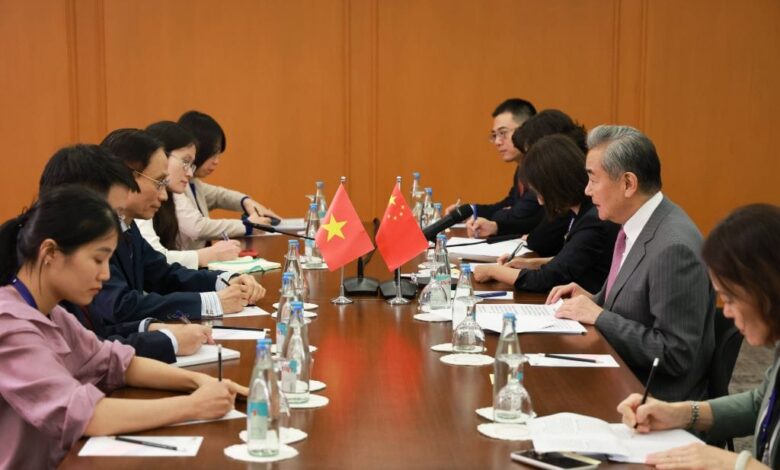
Chinese Foreign Minister Wang Yi and Vietnamese Foreign Minister Le Hoai Trung discussed high-level exchanges, connectivity, railways, agriculture, trade and artificial intelligence during a meeting in Manila on July 22.
The talks were held on the sidelines of the ASEAN Foreign Ministers’ Meetings and related events.
Wang, also a member of the Political Bureau of the Communist Party of China Central Committee, said China and Vietnam, as socialist neighbours and major developing countries, should conscientiously implement the common understanding reached by the leaders of the two parties and states.
He said the two countries should approach bilateral relations from the broader perspective of their respective long-term development and effectively strengthen unity, cooperation and mutual support.
Wang said closer coordination between China and Vietnam amid a complex international environment would help safeguard their legitimate development interests and contribute to regional peace, stability and prosperity.
He called for continued high-level exchanges, more effective use of bilateral cooperation mechanisms and faster progress on practical projects in areas such as connectivity and artificial intelligence.
Wang also said China supports Vietnam’s efforts to achieve its development goals and encouraged stronger coordination between the two countries’ development strategies.
Trung said the development of relations with China remains an objective requirement, a strategic choice and a major foreign policy priority for Vietnam.
He said Vietnam was ready to expand exchanges at all levels, implement the consensus reached by the two countries’ leaders and further advance the building of a Vietnam-China community with a shared future of strategic significance.
Trung called for stronger cooperation in cross-border railways, transport infrastructure, agriculture and trade.
He also expressed hope for broader access for Vietnamese agricultural products to the Chinese market and a more favourable environment for businesses from both countries.
The two foreign ministers agreed to improve the quality and effectiveness of cooperation in trade, investment, infrastructure, science and technology, education, training and people-to-people exchanges.
They also highlighted the need to make economic cooperation more balanced, sustainable, inclusive and mutually beneficial, while expanding exchanges in emerging fields such as artificial intelligence and green development.
Both sides agreed to make effective use of existing mechanisms, including the China-Vietnam Steering Committee for Bilateral Cooperation and strategic dialogue frameworks involving diplomacy, defence and public security.
Vietnam also expressed its willingness to strengthen communication and coordination with China in regional and international forums to safeguard the common interests of both countries and the wider region.
The Manila meeting reflected the continued expansion of China-Vietnam relations from political and ideological ties into practical cooperation in railways, agriculture, artificial intelligence, green development and multilateral coordination.