Jingdezhen Porcelain Industry Sites Inscribed on UNESCO World Heritage List

Dragon Media News Desk
The Jingdezhen Handicraft Porcelain Industry Sites in east China’s Jiangxi Province have been inscribed on UNESCO’s World Heritage List. The decision was adopted on Saturday during the 48th session of the World Heritage Committee in Busan, South Korea, bringing the total number of UNESCO World Heritage properties in China to 61.
Representing the development of Jingdezhen’s handcrafted porcelain industry from the 10th to the 19th centuries, the heritage property comprises five major component areas containing 45 historical sites. Covering approximately 1,979 hectares, it presents the complete industrial chain, from the extraction of raw materials and production of fuel to porcelain manufacturing, market operations and waterway transportation.
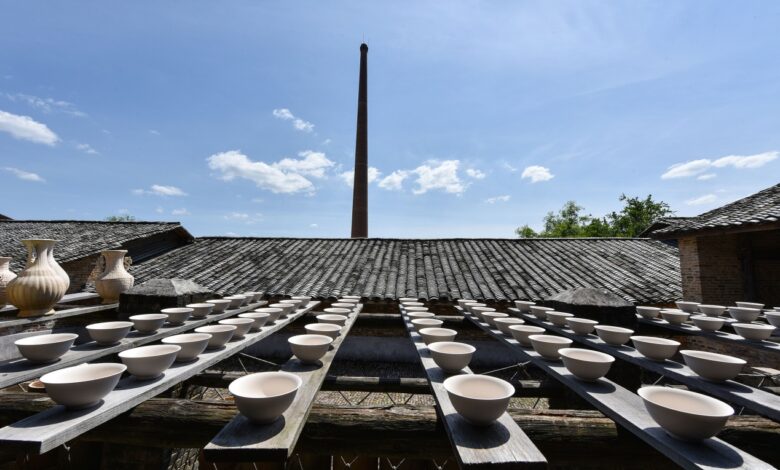
The property includes porcelain production sites in the urban area, the ancient Hutian kiln site, the Gaoling kaolin mine, the Changling porcelain-stone mine and the Yaoli firewood production area. Ancient waterways, wharves, roads, settlements, workshops and kiln remains connecting these areas illustrate the highly organised structure of the traditional porcelain industry.
According to Xiao Li, deputy head of the Department of World Cultural Heritage under China’s National Cultural Heritage Administration, this is the first time China has sought World Heritage recognition for a property representing an entire industrial chain.
The hills surrounding Jingdezhen contain abundant deposits of porcelain stone, kaolin clay and forest resources needed to fuel the kilns. The Changjiang River, which connects the city with Poyang Lake and the Yangtze River, played an important role in transporting raw materials and distributing finished porcelain products.
Between the 10th and 13th centuries, Jingdezhen combined porcelain-making techniques from northern and southern China and established the production of qingbai, or bluish-white porcelain. From the 13th to the 15th centuries, artisans developed techniques that mixed porcelain stone with kaolin, introduced improved kiln designs and used imported cobalt pigments to produce blue-and-white porcelain.
By the 16th century, Jingdezhen had become one of the world’s leading centres of handcrafted porcelain production. From the 17th to the 19th centuries, the use of European pigments and the blending of Chinese and foreign decorative traditions led to the development of enamel-painted porcelain and famille rose ware. UNESCO has noted that the technologies and artistic styles developed in Jingdezhen influenced the growth of porcelain industries in Europe and other parts of the world.
Wei Qing, head of the team responsible for preparing Jingdezhen’s World Heritage nomination documents, said the sites demonstrate the technological and artistic evolution of Chinese handcrafted porcelain production and its contribution to global cultural exchanges.
Known as China’s “porcelain capital,” Jingdezhen continues to attract artists, designers, researchers and entrepreneurs. Creative professionals who move to the city from other parts of China and abroad are locally known as “Jingpiao.” In recent years, the number of such residents has reportedly exceeded 60,000 at peak periods.
By 2025, Jingdezhen was home to more than 58,000 handcrafted porcelain workshops, while about 150,000 people were employed in the ceramic industry. The sector’s total annual output value exceeded 102.7 billion yuan that year, with Jingdezhen porcelain exported to dozens of countries and regions.
The UNESCO inscription provides international recognition of Jingdezhen’s centuries-old porcelain tradition, industrial organisation, technological innovation and far-reaching influence on global culture.