44th Yushu Horse Racing Festival Opens in Qinghai

Dragon Media News Desk
The 2026 Sanjiangyuan Ecological Culture and Tourism Festival and the 44th Yushu Horse Racing Festival have opened with a grand ceremony in Yushu Tibetan Autonomous Prefecture in northwest China’s Qinghai Province.
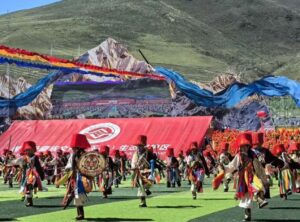
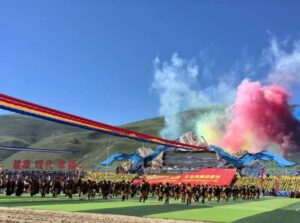
According to Qinghai Daily, local artists, equestrian teams and residents participated widely in the opening ceremony held at Yushu’s main stadium on July 25. Following the raising of the national flag and the national anthem, groups of horse riders entered the venue, formally marking the opening of the festival.
Held under the theme “Preserving the Spirit of the Tree of Life for Millennia, Praising a Prosperous Era with Ten Thousand Fine Horses,” the opening performance highlighted ecological conservation in the Sanjiangyuan region, Tibetan culture, nomadic traditions, and Yushu’s social and economic development.
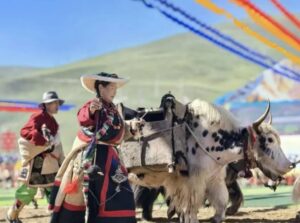
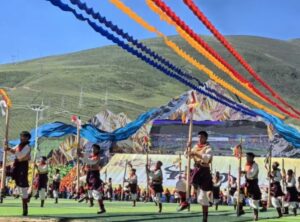
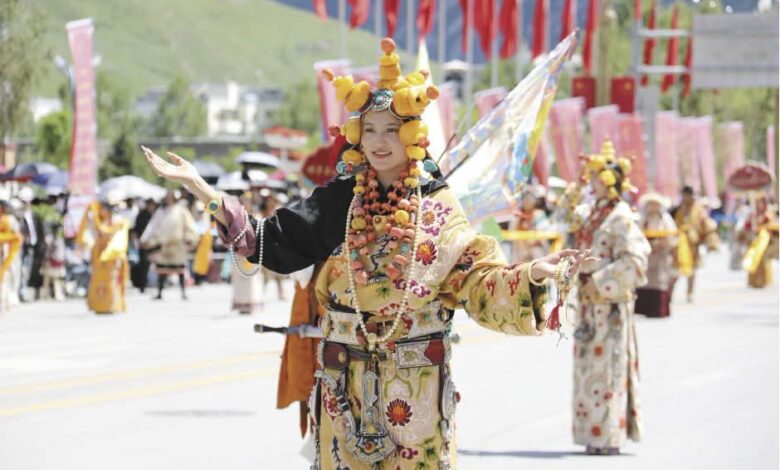
Organisers said the cultural presentation was divided into five sections focusing on the origin of life, the light of life, the tree of life, the rhythm of life and the song of life. More than 6,000 performers from Yushu city and five counties presented group dances, folk music, traditional costumes and cultural displays.
Qinghai Daily reported that more than 6,200 performers took part in the opening programme. The performances portrayed Sanjiangyuan’s water-related traditions, plateau nomadic civilisation, the ancient Tang-Tibet route, the Epic of King Gesar and the contribution of environmental protectors in the Hoh Xil region.
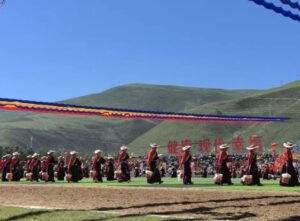
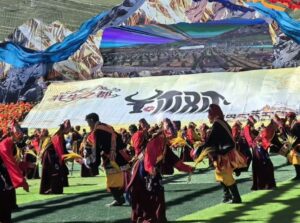
Traditional equestrian skills were among the festival’s main attractions. China News Service reported that riders performed archery on horseback, stood upside down on moving horses, picked up khatas while riding at speed, rode two horses simultaneously and presented coordinated group-riding displays.
The programme also included local Yi, Zhuo and Reba dances, folk songs and performances associated with intangible cultural heritage. The cultural presentations demonstrated the relationship between Yushu’s deep-rooted Khampa traditions, ecological protection and modern development.
Yushu Tibetan Autonomous Prefecture Governor Longcuo said the horse racing festival was not only a cultural celebration passed down for generations among horse-riding communities, but also an important platform for displaying Yushu’s ecological achievements and promoting cultural exchanges with the outside world.
She said Yushu was linking the festival with cultural preservation, tourism development and income growth, while seeking to transform local ecological and cultural resources into sustainable economic and industrial opportunities.
Yushu lies within Sanjiangyuan, the source region of the Yellow, Yangtze and Lancang rivers. Its water culture, plateau pastoral life, ancient agricultural traditions, the historic Tang-Tibet route and Khampa culture form important elements of the region’s identity.
Yushu’s traditional horse racing festival is believed to have a history of more than 1,300 years. It was included in China’s second national list of intangible cultural heritage in 2008.
The main horse racing programme will continue for three days, according to organisers. Activities include ethnic equestrian performances, the Gesar Cup horse race, traditional community sports, football matches, special cultural performances from Yushu city and public participation events.
Extended cultural and tourism activities associated with the festival will continue from mid-August until the end of the month. These will include wildlife photography exhibitions, international visual programmes, folk songs, group dances and other cultural events.
Organisers said the festival aims to present the ecological beauty of Sanjiangyuan, Tibetan cultural heritage, traditional equestrian skills and Yushu’s development achievements to audiences across China and around the world.