TSMC’s $265 Billion US Expansion: Chip Security, the AI Economy and Taiwan’s ‘Silicon Shield’

# Elias Grant
Political and Foreign Affairs Analyst
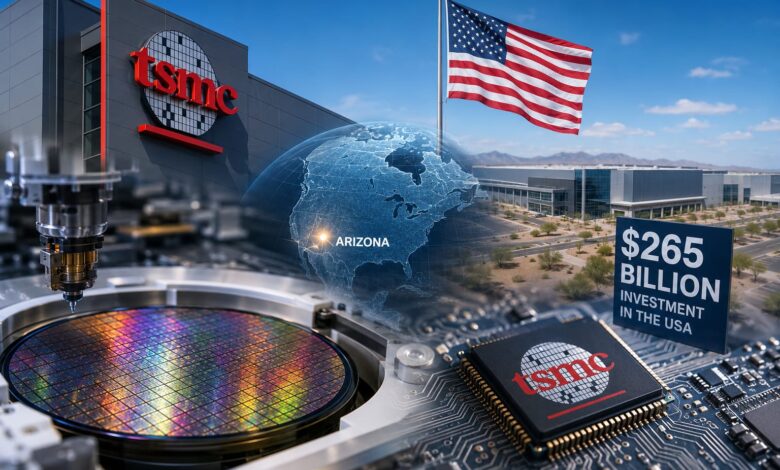
Taiwan Semiconductor Manufacturing Company—TSMC, the world’s most important producer of advanced chips—has announced an additional $100 billion investment in the United States. The company’s total proposed US investment, centred in Arizona, has now reached $265 billion.
According to details released by the US Department of Commerce on July 16, the additional investment will bring TSMC’s total number of advanced chip manufacturing and packaging facilities in the United States to 12. Company Chairman and Chief Executive Officer C.C. Wei has said the expansion will include several wafer fabrication plants producing chips based on two-nanometre and more advanced technologies, along with state-of-the-art packaging facilities.
The announcement, however, does not represent a fixed timetable under which the entire amount will be spent immediately. TSMC has made clear that the construction of additional plants and the start of production will depend on market conditions, demand for artificial intelligence chips and the requirements of major US customers. Although the company has outlined an extensive expansion plan, it has not announced firm operational dates for every facility.
The $265 billion figure should therefore be understood as a long-term commitment to be implemented in stages over several years rather than an investment that has already been completed. The announcement is historic, but its real strategic importance will be determined not by the headline amount alone, but by when the plants are built, what technologies they use and how much production capacity is ultimately established in the United States.
TSMC’s first Arizona plant has been in commercial production since late 2024. According to the company, its manufacturing yield has reached a level comparable to that of its leading facilities in Taiwan. This achievement demonstrates that highly complex semiconductor manufacturing is possible in the United States, but only with substantial expenditure, skilled labour and an extensive supply network.
The new expansion is a major achievement for US industrial and national security policy. The production of advanced chips used in artificial intelligence, high-performance computing, telecommunications, modern vehicles, space technology and defence systems remains concentrated in a limited number of geographical locations.
TSMC manufactures a large share of the world’s most advanced processors designed by leading US technology companies. A natural disaster, political crisis, military conflict or supply disruption affecting Taiwan could therefore have immediate consequences for the global AI and digital economy.
Washington has increasingly begun to view semiconductors not merely as commercial products but as essential national security and economic infrastructure. TSMC’s expansion supports US efforts to bring production closer to American customers, reduce the risks associated with excessive geographical concentration in Taiwan and create advanced manufacturing capacity and highly skilled jobs at home.
The timing of the investment is particularly significant. Amid rapidly expanding demand for AI computing, TSMC’s net profit in the second quarter of 2026 rose 77 percent year on year to NT$706.6 billion. Quarterly revenue increased 36 percent to approximately NT$1.27 trillion.
The company has raised its estimated capital expenditure for 2026 to between $60 billion and $64 billion. It has also increased its forecast for annual revenue growth in US dollar terms to slightly above 40 percent. These figures show that the new investment is not simply the result of political pressure or US government incentives, but is also tied to long-term demand generated by artificial intelligence and high-performance computing.
Nvidia, Apple, AMD and several other US companies are among TSMC’s major customers. Locating manufacturing facilities closer to customers could improve coordination in chip design, testing, production refinement, advanced packaging and the process of bringing new products to market.
Advanced AI chips require more than wafer fabrication alone. Sophisticated packaging is needed to integrate different processors and high-capacity memory into a single system. The inclusion of advanced packaging facilities in TSMC’s US plan is therefore strategically more important than the number of factories alone may suggest.
However, a massive investment should not be equated directly with American semiconductor self-sufficiency. Even when TSMC produces chips on US soil, it remains a Taiwanese company. Advanced lithography equipment comes from the Netherlands, other machinery is supplied by companies in the United States and Japan, and specialised chemicals, gases and materials are sourced through a global network.
A modern semiconductor plant depends on thousands of machines, millions of components, specialised software, uninterrupted electricity, vast supplies of water and a highly skilled engineering workforce. Moving one stage of production to the United States does not make the entire supply chain domestic.
The United States must therefore do more than construct factories. It must develop a complete semiconductor ecosystem involving skilled labour, equipment maintenance, specialised chemicals, advanced packaging, reliable energy and water infrastructure, and strong local suppliers.
TSMC officials have acknowledged practical difficulties surrounding the Arizona expansion, including shortages of skilled construction workers. As production at overseas facilities increases, the company also expects pressure on its profit margins. TSMC has estimated that foreign plants could reduce its overall gross margin by two to three percentage points in their initial years and by three to four percentage points in later stages.
This illustrates how politically attractive manufacturing relocation can be economically costly. Taiwan’s highly developed workforce, supplier network and manufacturing culture were built over decades and cannot easily be reproduced elsewhere within a short period.
Higher construction and operating costs in the United States may require tax incentives, government support, long-term commitments from customers and a market willing to pay more for domestically produced chips. Unless costs become competitive, US plants may remain strategically important while being commercially less efficient than TSMC’s facilities in Taiwan.
TSMC’s expansion has also revived debate in Taiwan over the so-called “silicon shield.” According to this concept, the dependence of major powers and global technology companies on Taiwan’s advanced chip production gives them a strong interest in preserving the island’s stability and security.
Concerns that Taiwan’s strategic importance could weaken as significant production capacity shifts to the United States and other countries are understandable. Yet the silicon shield is not a formal security treaty. Dependence on Taiwanese chips may increase international interest in Taiwan’s security, but it does not automatically guarantee military or political assistance in a crisis.
Taiwan’s government has said that the most advanced technologies, research capabilities and the majority of production capacity will remain on the island. TSMC currently operates 19 advanced manufacturing and packaging facilities in Taiwan and continues to expand domestic production.
Wei has said that while the company is advancing new facilities in Arizona, it is also accelerating work on plants in Taiwan and Japan. This suggests that the US expansion is intended to build additional overseas capacity while maintaining Taiwan’s central role, rather than transferring the company’s entire production base abroad.
In practical terms, TSMC’s research operations, early development of new manufacturing processes, skilled engineering workforce and vast supplier network remain concentrated in Taiwan. As long as the newest technologies are developed and initially matured there before being expanded overseas, Taiwan is likely to remain the technological centre of the company’s global operations.
The US expansion also gives the US–Taiwan relationship a new economic and technological dimension. Their relationship is no longer limited to security assistance and diplomatic engagement. It is increasingly tied to AI infrastructure, semiconductor production, trade, investment, technology controls and industrial policy.
The United States gains strategic manufacturing capacity on its own soil. TSMC establishes a long-term presence near its largest customers. Taiwan, meanwhile, can bind its most influential company more closely to the US economy and national security establishment.
Yet natural tensions remain within this relationship. The United States wants to reduce external dependence, while Taiwan seeks to prevent the weakening of its industrial centre and strategic importance. TSMC must respond to American demand while protecting its core research capabilities and technological leadership in Taiwan.
The plan should therefore be understood as strategic diversification rather than complete US self-sufficiency. The Arizona hub can reduce the risks created by excessive concentration in Taiwan, but it cannot eliminate the global semiconductor industry’s fundamental interdependence.
For the United States, the real test is not the announced figure of $265 billion. The greater challenge is to build the plants on schedule, train enough workers, manufacture at competitive costs, develop local suppliers and operate a complete production system that includes advanced packaging.
For Taiwan, the challenge is to expand abroad while keeping the most advanced research, early-stage production of new technologies, skilled talent and strategic decision-making at home.
If both sides successfully balance these objectives, TSMC’s US expansion could become a strong foundation for global chip supply security, the AI economy and the US–Taiwan industrial partnership. If that balance fails, the project could instead generate new disputes over US protectionism, Taiwanese industrial insecurity, high production costs and technology controls.
TSMC’s $265 billion plan is not merely the commercial expansion of a single company. It is a clear example of how manufacturing capacity, technology, national security and geopolitical influence have become inseparably connected in the age of artificial intelligence.