Chinese NEV Industry Shifts from Product Exports to Localized Global Cooperation

Dragon Media News Desk
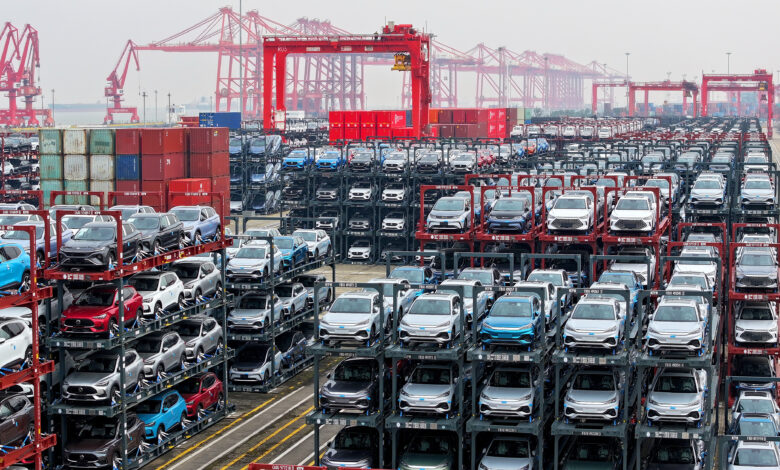
China, the world’s largest exporter of new energy vehicles, is expanding its global strategy beyond the traditional model of shipping finished vehicles overseas and moving towards localized production, technology partnerships, service networks and integrated industrial ecosystems.
According to China’s state news agency Xinhua, large numbers of electric vehicles continue to leave major Chinese ports for international markets, but Chinese automakers no longer regard vehicle sales as the final objective. They are increasingly prioritizing overseas manufacturing facilities, research and development cooperation, regional parts warehouses, after-sales services and local employment.
Data from the China Association of Automobile Manufacturers showed that China exported 2.615 million new energy vehicles in 2025, an increase of 103.7 percent from the previous year.
Exports reached 2.355 million units in the first half of 2026 alone, representing year-on-year growth of 120 percent. New energy vehicles have become one of the principal drivers of China’s export expansion.
Chinese electric vehicles are also increasingly viewed not merely as low-cost alternatives, but as internationally competitive products distinguished by performance, intelligent features, safety, technology and design.
XPENG Motors delivered more than 45,000 vehicles overseas in 2025, up 96 percent year on year. The company has also introduced a three-year plan to expand its presence across Latin American markets by 2028.
GAC Group exported 121,500 vehicles under its own brands during the first half of 2026, representing year-on-year growth of 132 percent.
The company aims to export 250,000 vehicles in 2026 and increase annual exports to one million units by 2030. It also plans to establish a presence in 120 countries and regions.
Companies including BYD, GAC and XPENG are combining exports of finished vehicles with technology licensing, localized manufacturing and long-term international brand development.
BYD has expanded cooperation with international automakers through technologies including its e-Platform 3.0 and Blade Battery. The use of Chinese electric vehicle technologies and charging standards is also increasing in several Southeast Asian markets.
XPENG is similarly working to introduce its intelligent driving systems and self-developed Turing artificial intelligence chip into global applications through cooperation with Volkswagen.
Such technology partnerships are expected to accelerate electric vehicle development by foreign companies while expanding the international adoption of Chinese automotive technologies.
Chinese automakers are establishing brand experience centres, maintenance facilities, after-sales service networks and regional parts warehouses across Europe, Southeast Asia, the Middle East and Latin America.
These investments are helping reduce repair times and maintenance costs while supporting local technical employment and the development of electric vehicle service industries.
GAC has established regional warehouses in Europe, Thailand and Panama capable of storing thousands of vehicle components. In Mexico, the company has also begun working with local organizations to promote electric mobility, charging infrastructure and lower-emission transport.
Chen Shihua, deputy secretary-general of the China Association of Automobile Manufacturers, attributed the rapid growth of Chinese NEV exports to the country’s strong supply chain, large-scale production capacity and rapid advancement in technologies including intelligent cockpits and autonomous driving.
According to Chen, these strengths are continuously improving the international competitiveness of Chinese new energy vehicles and enabling companies to develop products suited to the needs of consumers in different markets.
The industry’s evolving strategy is transforming vehicle exports into a broader model of long-term cooperation involving local investment, employment, technology sharing and green development.