China’s Family Travel Takes on New Dimension as Children Learn Culture and History Through Tourism

Dragon Media News Desk
Family travel in China during the summer holiday season is increasingly moving beyond sightseeing and local cuisine, evolving into an educational experience through which children can engage directly with history, ethnic culture and traditional heritage.
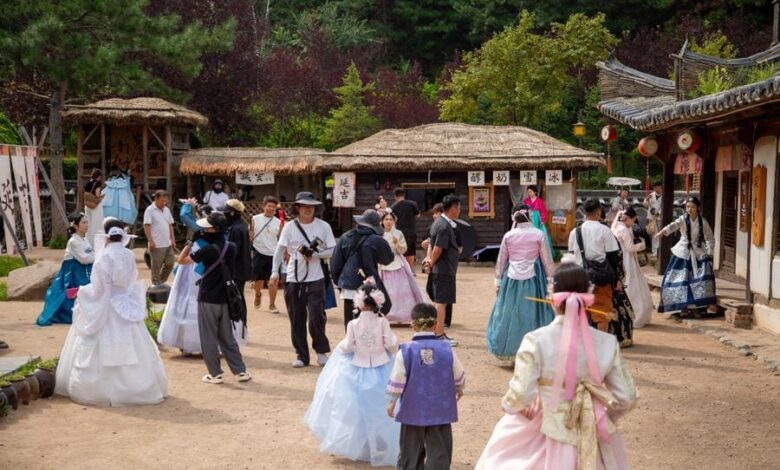
At a Korean ethnic folk park in northeast China’s Jilin Province, Feng Yu joined her children in wearing traditional Korean ethnic clothing, learning to make rice cakes and trying traditional archery. Feng said that while previous family trips had mainly focused on scenery and local food, this journey was intended to give her children first hand exposure to ethnic culture.
She said experiences such as wearing traditional attire, visiting ethnic architecture and watching folk performances can provide forms of learning that are difficult to obtain from textbooks alone.
As schools across China enter the summer holiday period, the country’s roughly two month peak travel season has gained momentum. An increasing number of parents like Feng are choosing journeys designed to connect their children more closely with the country’s diverse cultural heritage.
The Korean ethnic folk park in Jilin receives an average of about 20,000 visitors a day during the summer travel season, according to Zhu Baokun, the park’s operations director. A significant proportion of them are parents traveling with their children.
To meet growing demand for hands on cultural learning, the park has introduced activities including paper crafts, incense making workshops and small scale performances of Korean ethnic folk music. Zhu said the relaxed and enjoyable setting allows children to absorb cultural knowledge naturally while taking part in recreational activities.
Data from Tongcheng Travel, one of China’s major online travel agencies, show that families and students remain two of the largest traveling groups this summer. Family travelers account for about 38 percent of domestic air passengers, while students make up roughly 29 percent, together representing more than 60 percent of the total.
Alongside trips focused on ethnic culture, destinations connected with revolutionary history have also become popular choices for family travel.
Ruijin in east China’s Jiangxi Province is closely associated with the history of the Red Army and the Long March. As China marks the 90th anniversary of the victory of the Long March, historical performances in the city have given parents and children opportunities to engage more directly with episodes from the country’s revolutionary past.
Wu Yong traveled hundreds of kilometers from neighboring Fujian Province with his family to Ruijin. He said younger generations should understand that the life they enjoy today did not come easily and that such journeys can help children remember earlier generations who made sacrifices for the country.
The Ruijin Cradle of the PRC Scenic Area received more than 300,700 visitors between July 1 and July 30, an increase of 4.17 percent from the same period a year earlier.
Traditional Chinese culture has also become a major attraction for families and younger travelers during the summer holiday.
Shanxi Province, often described as China’s museum of above ground cultural relics, is home to more than 28,000 ancient structures. In recent years, the province has increasingly used the popularity of video games, films and animation to introduce its cultural heritage to younger audiences.
From the successful video game Black Myth: Wukong in 2024 to later popular cultural and entertainment productions, Shanxi has sought to convert interest generated by creative industries into sustained cultural tourism.
Yongle Palace in Ruicheng County, Shanxi Province, recorded a 12.9 percent year on year increase in visitor numbers in July. The area has attracted additional attention because of its connection with the historical prototype of a central character in the recent film All Wishes Come True.
To turn short term popularity into longer lasting cultural interest, the scenic area has introduced dedicated photography spaces, guided explanations linking famous murals with film scenes, and interactive classes in mural copying and line drawing.
For three consecutive years, the Shanxi provincial department of culture and tourism has distributed free travel guide handbooks featuring recommended routes and dedicated pages where visitors can collect souvenir stamps from scenic sites across the province. This year’s edition was redesigned for greater portability and quickly became popular, particularly among younger travelers.
The growing popularity of cultural and educational tourism is also supported by national policy.
China’s 15th Five Year Plan for 2026 to 2030 calls for the well regulated development of study tours alongside themed tourism products, including revolutionary history and other forms of cultural travel.
Building on that policy direction, China launched a national summer holiday cultural and tourism consumption campaign in July. More than 450 million yuan in consumer vouchers are expected to be distributed, while more than 30,000 cultural and tourism activities are planned nationwide. Study tours are among the areas receiving particular attention.
Dai Bin, president of the China Tourism Academy, said Chinese travelers are increasingly moving beyond basic sightseeing toward journeys that combine knowledge, culture and immersive experience. As cultural confidence continues to grow, tourism is also becoming a way for people to reconnect with the country’s history and civilization.
Liu Chi, a sociologist at Northeast Normal University, described the rise of family travel as a positive social development. He said quality time shared by parents and children during trips can support children’s physical and mental development while strengthening family relationships.
According to Liu, study tours are gaining wider recognition among both schools and families as modern parents increasingly emphasize the overall development of their children rather than focusing exclusively on academic performance.
The trend is also changing the meaning of tourism in China. Travel is no longer viewed simply as reaching a destination or seeking entertainment. It is increasingly becoming a means of understanding history, experiencing traditional skills, recognizing cultural diversity and creating shared memories within families.
The expansion of family travel during the summer holiday season therefore reflects a deeper integration of culture, education and recreation within China’s evolving tourism industry.