Japanese Prime Minister Makes No Direct Mention of US at Nagasaki Atomic Bombing Memorial

Dragon Media News Desk
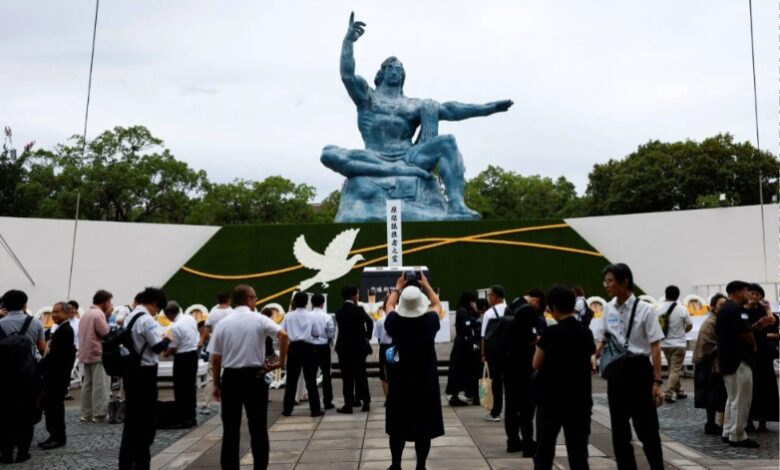
Japanese Prime Minister Sanae Takaichi did not directly mention the United States as the country that dropped the atomic bomb on Nagasaki while speaking at a ceremony marking the 81st anniversary of the bombing.
Takaichi said that Nagasaki had been devastated by a single atomic bomb 81 years ago, but she did not identify the country responsible for carrying out the attack.
Nagasaki Mayor Shiro Suzuki, who spoke before the prime minister, explicitly stated that the atomic bomb had been dropped from a US military aircraft.
A message from UN Secretary General Antonio Guterres, read at the ceremony by UN Under Secretary General for Disarmament Affairs Izumi Nakamitsu, also did not directly name the country that bombed Nagasaki.
Three days earlier, during the ceremony marking the 81st anniversary of the Hiroshima atomic bombing, Takaichi, Guterres and Hiroshima Mayor Kazumi Matsui likewise did not directly refer to the United States in their commemorative remarks.
Japanese government officials generally do not place strong emphasis in formal memorial speeches on the fact that the United States carried out the atomic bombings of Hiroshima and Nagasaki. However, the Hiroshima Peace Memorial Museum, as well as Japanese school and university textbooks, provides extensive historical information about the 1945 attacks.
The United States dropped an atomic bomb on Hiroshima on August 6, 1945, and another on Nagasaki on August 9, in the final stage of World War II. Washington has historically argued that the attacks were intended to accelerate Japan’s surrender. The bombings remain the only use of nuclear weapons in warfare in human history.
Various estimates indicate that between 70,000 and 100,000 people were killed in Hiroshima on the day of the bombing. By the end of 1945, the death toll was estimated to have reached about 140,000 as more people died from injuries and radiation exposure. The broader number of victims associated with the bombing and its long term consequences has continued to rise over subsequent decades.
According to TASS, the United States has continued to justify the atomic bombings within the context of wartime military necessity. Barack Obama, who in 2016 became the first sitting US president to visit Hiroshima, did not issue a formal apology. Former President Joe Biden also did not apologize when he visited Hiroshima for the Group of Seven summit in 2023.
The 81st anniversary of the Nagasaki bombing has once again drawn international attention to the devastating humanitarian consequences of nuclear weapons, questions of wartime historical responsibility and the continuing global debate over nuclear disarmament.