Kishor Shrestha Moved to Maharajgunj Custody; Federation of Nepali Journalists Protests Police Action After Visiting Jana Aastha Office


Dragon Media Correspondent
Kishor Shrestha, chairman of Aastha Media and editor of Jana Aastha Weekly, was transferred on Friday afternoon from the custody facility at the Kathmandu District Police Range in Bhadrakali to the police circle in Maharajgunj. The Federation of Nepali Journalists has expressed serious objection to Shrestha’s arrest, the searches conducted at his residence and the Jana Aastha office, and the seizure of computers, laptops, mobile phones and other devices.
During a meeting at the Maharajgunj detention facility on Friday, Shrestha said he had been brought from Bhadrakali to Maharajgunj in the afternoon. According to him, nine other detainees are currently being held there with him. Among them are individuals arrested in drug-related cases. He said he has also been kept in a regular detention cell together with the other detainees.
Earlier, journalists had staged slogans and protests at Bhadrakali demanding Shrestha’s release. He was subsequently transferred to Maharajgunj.
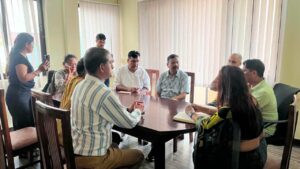
Meanwhile, a team led by Federation of Nepali Journalists President Nirmala Sharma visited the Jana Aastha office on Friday. After observing the condition of the office following the police search, the team expressed serious objection to the government action of entering a media house and seizing equipment used for journalistic work.
The Federation maintained that if there is any complaint or dispute concerning news content, it should be resolved through existing legal and institutional procedures. It said that arresting a journalist, searching a media house and seizing journalistic equipment raise serious questions regarding press freedom and the confidentiality of sources.
Police arrested Shrestha in connection with an investigation into an alleged violation of personal privacy. Following his arrest, searches were conducted at his residence and the Jana Aastha office, and computers, laptops, mobile phones and other electronic devices were seized.
Shrestha, however, has said that the allegation against him is related not to content published in Jana Aastha Weekly but to material published by Jana Aastha Online. Editorial responsibility for the online outlet lies with Rajendra Rimal.
Shrestha’s main concern, however, is related to the possible examination of the digital devices seized by police. He has said that the devices contain years of personal and professional communications, journalistic sources and sensitive contacts that are not directly related to the news report under investigation.
As reports emerge that police have begun digital forensic examination of the seized electronic materials, questions are being raised about the scope of that examination, its legal basis and the protection of materials unrelated to the investigation.
Journalistic and legal circles have begun arguing that clear legal limits and judicial oversight are necessary in such examinations because journalists’ mobile phones, laptops and computers may contain not only personal information but also communications with news sources, government officials, security agencies, political leaders, the diplomatic community and other sensitive contacts.
Hearing a habeas corpus petition filed by Shrestha’s wife, the Supreme Court has ordered that he be produced before the court at 10 a.m. on Monday. The court has also directed that documents related to his arrest and investigation, along with the digital materials seized by police, be presented.
This means Monday’s hearing may not remain limited to the legality of Shrestha’s detention, but could also extend to constitutional questions concerning the condition of the seized digital devices, forensic examinations already conducted or planned, and the confidentiality of journalistic sources.
Whether Shrestha is guilty or innocent will be determined through the investigation and by the court. However, the seizure of a large number of digital devices from a media house and a journalist’s residence in the course of investigating a complaint related to a news report, together with the possibility of forensic examination of those devices, has transformed the case into a serious debate over the boundaries between press freedom, personal privacy, protection of journalistic sources and the investigative authority of the state.