Unitree Robotics Makes Explosive STAR Market Debut, Setting New Valuation Benchmark for China’s Humanoid Robot Industry

Dragon Media News Desk
Chinese humanoid robot manufacturer Unitree Robotics made a dramatic debut on Shanghai’s STAR Market on Wednesday, with its share price surging more than sixfold above the IPO price in early trading, highlighting exceptionally strong investor interest in China’s rapidly expanding humanoid robotics sector.
Unitree issued about 40.45 million new shares at 150.80 yuan each, raising approximately 6.1 billion yuan. Based on the offering price, the company was valued at around 61 billion yuan.
Retail investor demand exceeded the number of available shares by more than 8,000 times, representing one of the highest subscription levels recorded on Shanghai’s technology-focused STAR Market.
Unitree has become the first major humanoid robot manufacturer to list on China’s A-share market. Analysts see the listing as more than a company-specific financial event, describing it as an important step toward establishing a market valuation benchmark for China’s humanoid robotics industry.
Until now, valuations of humanoid robot companies have largely been driven by technological potential, research capabilities and expectations of future market growth. Public listing will allow investors to assess companies more directly on the basis of technology, product maturity, commercial demand, revenue and profitability.
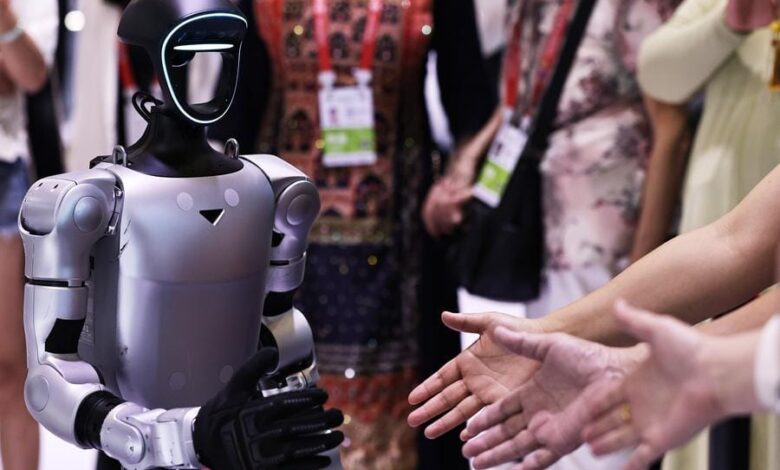
Unitree recently unveiled a high-speed humanoid robot capable of running at up to 12.66 metres per second, equivalent to about 45.6 kilometres per hour, and jumping as high as two metres from a standing position, according to the company.
The company said it had produced and delivered around 18,000 bipedal humanoid robots across different models by the end of July.
Unitree generated revenue of about 1.7 billion yuan in 2025. However, analysts say the company’s ability to sustain its elevated valuation will depend heavily on whether it can convert technological progress into large-scale and recurring orders from factories, service industries and other commercial users.
The IPO also reflects a broader shift in China’s technology investment landscape. Investors are increasingly placing greater weight on technological barriers, domestic supply-chain capabilities, future industrial applications and long-term competitive potential rather than focusing solely on current profitability.
China’s humanoid robotics sector is expanding rapidly through simultaneous advances in artificial intelligence, motion-control systems, sensors, motors and high-performance mechanical structures.
However, the elevated valuation also brings risks. Large-scale commercial deployment of humanoid robots remains at an early stage, meaning Unitree’s ability to translate market expectations into sustainable revenue and industrial demand will be a major test in the coming years.
Unitree’s listing therefore signals that China’s humanoid robotics industry is moving beyond technology demonstration toward a new phase shaped increasingly by capital markets, commercialisation and industrial-scale valuation.