Empire of Letters: The Transformation of China Post

Pasang Lhamu
There was a time when the word “post” immediately evoked the image of a mail carrier riding a bicycle from village to village with letters in a bag. In China today, that same postal system has evolved into a multidimensional network connecting logistics, banking, e-commerce, rural markets and modern technology. The story of China Post is therefore not merely the story of an institution expanding in size; it is also the story of how communications, commerce and the rural economy have transformed alongside modern China.
Following the founding of the People’s Republic of China in 1949, the postal system was reorganised under a new institutional framework. At the time, its primary responsibilities were delivering letters, newspapers and parcels. Across a vast country with limited transport infrastructure, postal workers reached remote communities by bicycle, on foot and through basic transport services. In 1972, after the representation of the People’s Republic of China was restored in the Universal Postal Union, China’s postal system became more systematically integrated into the international postal network.
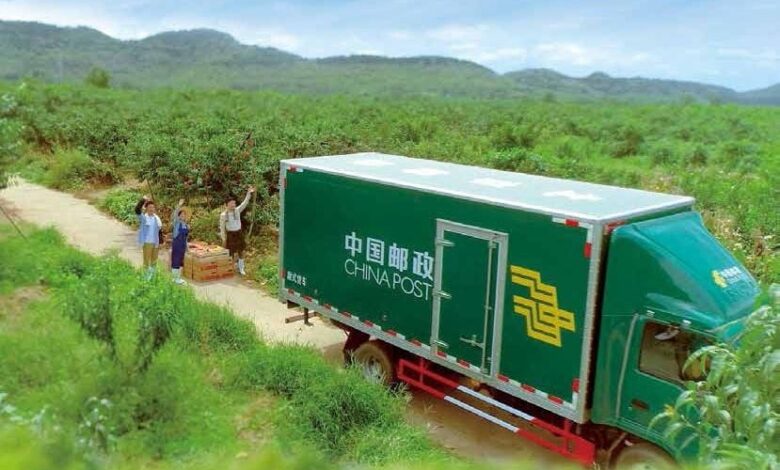
China Post looks entirely different today. Its network includes around 54,000 postal service outlets, approximately 112,000 postal vehicles, more than 100,000 postal routes and 42 dedicated cargo aircraft. Its services extend to around 492,000 administrative villages, while its international postal and delivery network reaches more than 200 countries and regions. Road transport, air services, maritime shipping, China-Europe freight trains and overseas distribution infrastructure have transformed it into a supply network far larger than a conventional postal service.
The most significant impact of this transformation can be seen in rural China. In villages where residents once had to travel dozens of kilometres simply to collect a parcel, postal services are now increasingly reaching communities directly. Models that combine passenger buses, freight and postal parcels within the same transport system have helped address the rural “last-mile” problem. Goods travel from cities to villages, while the same network can carry agricultural products from rural communities back to urban markets.

This has turned the postal system into more than a channel for consumption. It has also become a route for bringing rural production to wider markets. Farmers who once depended primarily on local buyers can now send rice, fruit, vegetables, tea and handicrafts to consumers across the country. Digital platforms associated with China Post, such as Youle, connect local products with the national marketplace, while the postal logistics network delivers those goods to customers. Digital commerce and physical distribution are thus being integrated within a single system.
Another major pillar of China Post is its financial infrastructure. Postal Savings Bank of China operates around 40,000 service outlets and serves more than 670 million individual customers. A large share of its network reaches smaller cities, counties and rural areas. By prioritising agriculture, rural communities and farmers, the bank has extended savings, credit and other financial services to populations that have traditionally had limited access to conventional banking.
The use of digital data and risk-assessment systems has also made rural lending more efficient. One example is grain trader Ma Shenghe in Shandong, who received a loan of around 200,000 yuan within three working days. The case illustrates a broader shift away from lending systems dominated by collateral, extensive paperwork and long waiting periods toward models that use transaction records, production data and other information to evaluate small farmers and rural businesses.
China Post’s service outlets are no longer limited to accepting letters and parcels. In some places they function as financial service centres; elsewhere they serve as gateways to rural e-commerce, public service points or platforms for promoting local products. This physical presence has become one of China Post’s greatest strengths, particularly because its infrastructure extends into remote areas where private companies may find operations less commercially attractive.
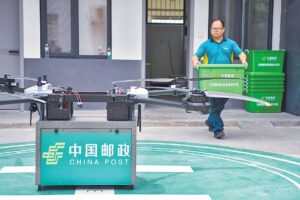
Digital transformation is further reshaping the postal system. Artificial intelligence, automated sorting systems, unmanned delivery vehicles and drones are increasingly being incorporated into operations. In mountainous and difficult terrain, experiments with drone delivery for parcels and essential supplies have demonstrated the potential to reduce both time and cost. The purpose of technology is not simply to replace postal workers, but to make expensive and complex distribution processes more efficient.
Internationally, China Post has also become an important component of China’s commercial supply chain. Through its own cargo aircraft, international air routes, maritime services, rail connections and overseas warehouses, Chinese goods are reaching global markets. Postal and e-commerce shipments carried through China-Europe freight services now reach dozens of European markets, strengthening the connection between domestic production and overseas consumers.
The era of smartphones and digital communication reduced the use of traditional letters, but it did not eliminate the postal system. Instead, parcels, e-commerce, financial services and rural distribution redefined its role. Routes that once carried letters and newspapers into villages now deliver online purchases, while agricultural products travel back through the same network toward national markets.
That transformation is perhaps the most compelling aspect of China Post’s story. It did not abandon its old network; it adapted that network to the demands of a new economy. Today, when a green postal vehicle reaches a remote village, it carries far more than letters. It brings access to markets, finance, technology and opportunity.
China Post is therefore no longer simply a story about the postal service. It is a story about modern China itself — about connecting people, products, capital and markets through an increasingly integrated national network.