Nepal Directs Secretaries to Accelerate Time-Bound Action to Exit FATF Grey List

Dragon Media Correspondent
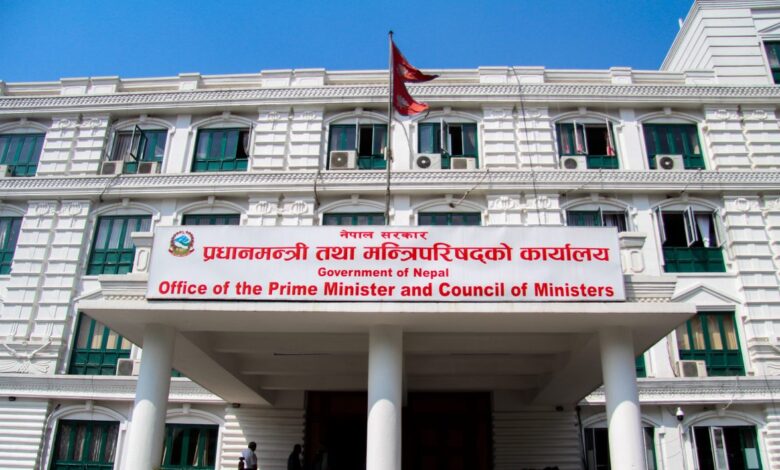
The Office of the Prime Minister and Council of Ministers has directed all ministries and concerned agencies to implement Nepal’s action plan effectively and within the prescribed timeframe to secure the country’s removal from the Financial Action Task Force (FATF) grey list.
A meeting of secretaries chaired by Chief Secretary Govinda Bahadur Karki on Tuesday reviewed progress in strengthening measures against money laundering, terrorist financing and the financing of proliferation of weapons of mass destruction, and decided to accelerate implementation of the government’s reform plan.
The meeting instructed each ministry and agency to complete its assigned reforms within the stipulated timeframe and produce measurable results. The Office of the Prime Minister and Council of Ministers will regularly monitor implementation, while concerned ministries and agencies will be required to continuously provide progress updates.
Nepal was placed on the FATF list of jurisdictions under increased monitoring, commonly known as the grey list, on February 21, 2025. Nepal subsequently committed to working with FATF and the Asia/Pacific Group on Money Laundering to strengthen the effectiveness of its anti-money laundering and counter-terrorist financing framework.
FATF’s June 2026 review acknowledged Nepal’s progress in addressing remaining technical deficiencies related to targeted financial sanctions against terrorist financing and proliferation financing. However, Nepal still needs to demonstrate stronger results in risk-based supervision, action against illegal hundi operations, money laundering investigations and prosecutions, and the identification, freezing and confiscation of proceeds of crime.
The FATF action plan particularly calls for more effective risk-based supervision of commercial banks, high-risk cooperatives, casinos, dealers in precious metals and stones, and the real estate sector. Nepal must also strengthen the capacity and coordination of agencies investigating money laundering and demonstrate increased effectiveness in investigations and prosecutions.
A high-level team from the Asia/Pacific Group that visited Nepal in Jestha had raised concerns during discussions with government agencies that progress in several areas of the action plan remained insufficient. Issues highlighted included regulation, investigation and prosecution related to banking and financial institutions, cooperatives, real estate, precious metals, corruption, tax evasion, human trafficking, environmental offences and wildlife crime.
The government has set a target of delivering most of the required reform outcomes by Magh 2083. Officials have been reminded that legislative changes alone will not be sufficient to secure Nepal’s removal from the grey list; FATF will also require evidence of effective implementation, supervision, investigation, prosecution and control of criminal assets.
The secretaries’ meeting also decided to prioritise governance reforms that would produce visible improvements for citizens. Each agency has been asked to regularly submit implementation progress to the Office of the Prime Minister and Council of Ministers.
The meeting further decided to observe Civil Service Day on Bhadra 22 at the federal, provincial and local levels, with the concerned ministry assigned responsibility for preparing the programme framework.
It also called for reviews of the implementation of governance reform procedures, guidelines, directives and circulars issued by the Prime Minister’s Office. Policy and administrative problems involving more than one ministry or agency are to be resolved through coordination among the concerned secretaries, with unresolved matters referred to the Prime Minister’s Office for further coordination and decision.
The meeting also emphasised implementation of fiscal year 2083/84 as a year of legal reform, including the amendment or repeal of outdated laws and the drafting of necessary new legislation.
Under the government’s “zero-day procurement policy,” ministries and agencies were also instructed to immediately begin public procurement procedures for programmes and projects where procurement has not yet started.