Chinese robot industry shifts from demonstrations to real-world deployment, WRC 2026 highlights industrial use

Dragon Media News Desk
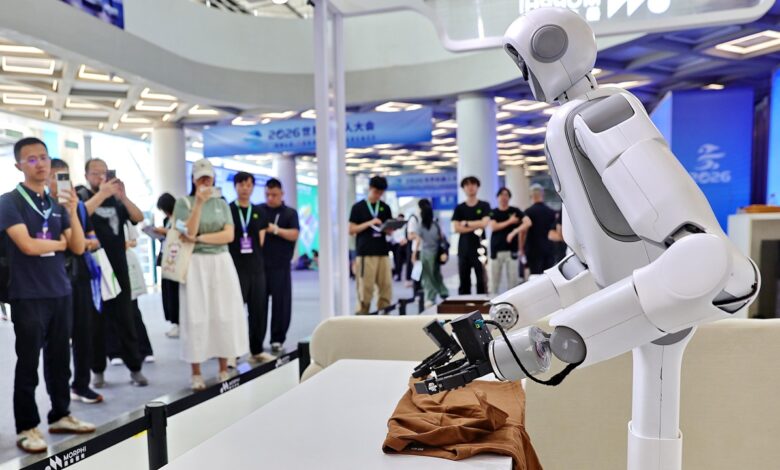
China’s robotics industry is increasingly shifting its focus from robots that dance, run or perform staged demonstrations toward machines that are being deployed in manufacturing, traffic management, security, logistics and commercial services, a trend highlighted at the ongoing 2026 World Robot Conference in Beijing.
The conference opened on Wednesday at the Beijing Etrong International Exhibition and Convention Center in Yizhuang and will continue through August 23. According to organizers, more than 300 companies are participating, displaying over 2,000 robots and related products, while more than 150 new products are making their debut.
One of the most notable changes at this year’s conference is the greater emphasis on how robots perform in actual workplaces rather than simply demonstrating technical capabilities.
AiMOGA Robotics, backed by Chery, has installed more than 30 live video screens on one wall of its booth. The footage is not from demonstrations inside the exhibition hall. Instead, it shows robots already working in different Chinese cities, including in traffic management, automobile dealerships and security patrols.
According to the company, its traffic-police robots are operating in 31 cities across seven provinces. Their functions include coordinating with traffic signals, identifying motorcycle and scooter riders without helmets, warning drivers against illegal parking and responding to public inquiries.
UBTech has also moved away from building artificial demonstration environments solely for exhibitions. Instead, the company is presenting systems that are already being used in real industrial settings.
According to the company, some of its logistics and manufacturing systems are operating at customer sites in South Korea and Australia. Manufacturers including Huawei and Foxconn have also begun purchasing robots for use on production lines.
Companies working in logistics say customer interest is increasingly moving from technical demonstrations toward return on investment. Robots are being introduced into environments such as late-night sorting centers, material-handling operations and other repetitive or physically demanding tasks where their economic value can be measured more clearly.
The expansion is not limited to humanoid robots. DEEPRobotics is developing lower-cost quadruped robots aimed at industrial parks, security patrols and smaller commercial facilities. Such robots are increasingly capable of completing entire assignments independently, including carrying parcels from delivery stations to customers and returning without human assistance.
The conference opened on the same day that Chinese robotics company Unitree Robotics made its debut on China’s A-share market. Its shares rose by more than 460 percent on the first day of trading, lifting the company’s market value above 340 billion yuan. Unitree said it shipped more than 5,500 humanoid robots in 2025.
At the same time, robotics is emerging as another area of technological competition between China and the United States.
On July 28, the US Federal Communications Commission moved to restrict the approval of newly imported foreign-made advanced robotic devices on national security grounds. The measure is expected to affect Chinese manufacturers of humanoid and quadruped robots in particular.
Beijing has opposed the move, arguing that the United States is overstretching the concept of national security to restrict Chinese companies.
Industry experts participating in the conference said the next phase of competition in robotics will not be determined simply by which robot can run faster or perform more impressive movements. Manufacturing costs, supply chains, workplace suitability, reliability, safety, after-sales service and measurable economic returns are expected to become increasingly important.
The broader message emerging from the 2026 World Robot Conference is that robots are gradually moving beyond laboratories and exhibition stages and into factories, streets, warehouses and service industries.