Rabi’s China Visit Postponed as Doval Heads to Beijing for 25th Round of Border Talks with Wang Yi

Dragon Media Correspondent
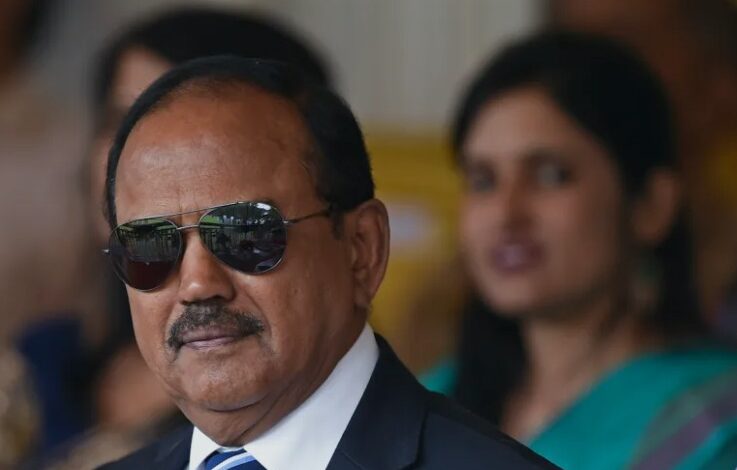
The proposed China visit of Rastriya Swatantra Party Chairman Rabi Lamichhane has been postponed for the time being, while Indian Prime Minister Narendra Modi’s National Security Adviser Ajit Doval is set to arrive in Beijing on Monday. Doval is scheduled to hold the 25th round of Special Representatives’ talks on the India–China boundary question with Chinese Foreign Minister and China’s Special Representative Wang Yi on Tuesday.
Lamichhane’s China visit had initially been planned for August. It was later moved to the second week of September, but that schedule has also now been postponed. No new date has been announced. A delegation of RSP lawmakers is now expected to travel to China without Lamichhane.
Lamichhane had earlier visited India, where he held high-level meetings with Prime Minister Modi and other Indian political leaders. Preparations for his China visit followed that trip. RSP sources had previously said efforts were being made to arrange meetings with senior Chinese leaders during his stay in Beijing. Reports had also suggested that the possibility of a meeting with Chinese President Xi Jinping was being explored, although no such meeting had been formally confirmed.
Although the postponement of Lamichhane’s visit and Doval’s trip to Beijing have occurred at roughly the same time, there is no confirmed evidence of a direct connection between the two developments. Doval’s visit is part of the established Special Representatives mechanism between India and China, which has been functioning since 2003 to address the boundary question.
Doval and Wang are the designated Special Representatives of their respective countries on the boundary issue. The 25th round of talks is expected to focus on maintaining peace and stability along the Line of Actual Control, managing remaining areas of friction, strengthening border-management mechanisms and discussing the broader framework for a long-term settlement.
Earlier, the 36th meeting of the Working Mechanism for Consultation and Coordination on India–China Border Affairs, held in New Delhi on August 6, agreed to prepare for the 25th round of Special Representatives’ talks. Both sides also reiterated their commitment to maintaining diplomatic and military communication and preserving peace and stability in the border areas.
The previous formal meeting between Doval and Wang in their capacity as Special Representatives was held in New Delhi on August 19, 2025. During that 24th round, the two sides reached a 10-point understanding covering border stability, improvement of border-management mechanisms, cooperation on transboundary rivers and the reopening of certain traditional border-trade points.
The latest round of talks is also drawing attention because it comes ahead of a possible visit to India by Chinese President Xi Jinping. India is due to host the BRICS Summit in New Delhi on September 12 and 13, and Xi is expected to attend. China, however, has not yet formally confirmed his participation.
Relations between India and China deteriorated sharply after the 2020 Galwan Valley confrontation but have gradually returned to a more dialogue-oriented phase over the past two years. Nevertheless, stability along the border remains the most sensitive issue in bilateral relations. India has consistently argued that overall relations cannot fully normalize without peace and stability along the frontier, while China has maintained that the boundary dispute should be properly managed without allowing it to define the entire bilateral relationship.
Meanwhile, tensions have also resurfaced over India’s decision to assign standardized official names to 27 locations and geographical features in Arunachal Pradesh. India maintains that Arunachal Pradesh is an integral and inalienable part of the country, while China continues to assert its own territorial claims over the region.
Against this backdrop, the Doval–Wang talks are unlikely to produce an immediate settlement of the long-running border dispute. Their greater significance lies in managing tensions, keeping political dialogue alive and creating a more stable environment for possible future engagement between Modi and Xi.