SCO at 25: Xi Jinping Steps Up Diplomacy Ahead of Bishkek Summit

Dragon Media Correspondent
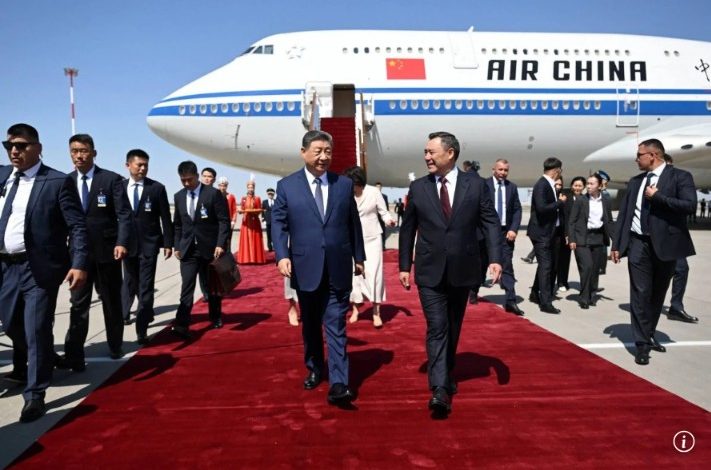
As the Shanghai Cooperation Organisation marks its 25th anniversary, Bishkek, the capital of Kyrgyzstan, has emerged as a major center of regional and multilateral diplomacy. Chinese President Xi Jinping, who arrived in Bishkek on Sunday to attend the SCO Summit, has held a series of high-level meetings with the leaders of Russia, Uzbekistan, Mongolia and host country Kyrgyzstan ahead of the gathering.
On Monday, Xi held separate meetings with Russian President Vladimir Putin, Uzbek President Shavkat Mirziyoyev and Mongolian President Ukhnaa Khurelsukh. He had earlier held extensive talks with Kyrgyz President Sadyr Japarov, during which China and Kyrgyzstan signed a treaty on permanent good-neighborliness, friendship and cooperation.
The series of bilateral meetings in Bishkek has highlighted how multilateral platforms such as the SCO are increasingly reinforcing bilateral relations among member states, while stronger bilateral ties are also strengthening coordination within the wider organisation.
China has emphasized trade, connectivity, energy, the digital economy, artificial intelligence and regional security as emerging pillars of deeper SCO cooperation.
Founded in 2001 by China, Russia, Kazakhstan, Kyrgyzstan, Tajikistan and Uzbekistan, the SCO now has 10 full member states. Its geographical and political reach has expanded significantly following the accession of India, Pakistan, Iran and Belarus.
The combined population of SCO member states exceeds 3.4 billion. What began primarily as a political and security cooperation mechanism has gradually expanded into trade, investment, energy, transportation, digital technology, environmental protection, education and people-to-people exchanges.
The organisation is guided by the “Shanghai Spirit,” which emphasizes mutual trust, mutual benefit, equality, consultation, respect for diversity of civilizations and pursuit of common development.
Rather than presenting itself as a military alliance, the SCO has sought to function as a multilateral platform where countries with different political systems and economic models can pursue cooperation without requiring bloc-based alignment.
At last year’s SCO Summit in Tianjin, China, member states adopted the SCO Development Strategy for 2026-2035, establishing a broad framework for the organisation’s next decade of development.
The Tianjin Summit also produced political consensus among interested member states on moving forward with the establishment of an SCO Development Bank, with consultations continuing over its future structure and operation.
Economic ties between China and other SCO members have expanded rapidly.
Trade between China and other SCO member states increased from $12.1 billion in 2001 to $523.5 billion in 2025, accounting for around eight percent of China’s total foreign trade.
China’s direct investment across other SCO member states reached approximately $3.3 billion in 2025, covering sectors including oil and gas, mining, infrastructure, new energy, automobiles and chemicals.
Electric vehicles, lithium batteries, photovoltaic products and cross-border e-commerce are also becoming increasingly important areas of economic cooperation.
The practical impact of SCO-related cooperation is visible in Bishkek itself.
A fleet of 120 China-made electric buses is now operating across eight major routes in the Kyrgyz capital. The buses are also helping provide transportation services for participants attending the SCO Summit.
A China-supported waste-to-energy facility in Bishkek has also been operating since December 2025. The project has been presented as the first waste-to-energy power facility of its kind in Kyrgyzstan and Central Asia.
The future of the SCO also featured prominently in Xi’s meeting with Putin on Monday.
Xi said that amid growing global uncertainty, the SCO carries an increasingly important responsibility for promoting regional stability and development. Putin, meanwhile, reiterated Russia’s commitment to expanding cooperation with China in trade, energy, industry, transportation, science and technology, as well as people-to-people exchanges.
During his meeting with Uzbek President Mirziyoyev, Xi called for opening a new “golden decade” in the China-Uzbekistan comprehensive strategic partnership.
In talks with Mongolian President Khurelsukh, the two sides discussed expanding cooperation in trade, connectivity, energy, minerals, green development, artificial intelligence and the digital economy.
After 25 years of development, the SCO is no longer confined to its original role as a Central Asian security mechanism. Its agenda has broadened substantially into economic development, infrastructure, technology and regional connectivity.
The Bishkek Summit is therefore expected to test how effectively the organisation can translate years of political consensus and strategic planning into concrete projects, financial mechanisms and deeper regional integration.
How successfully the SCO turns those commitments into practical outcomes will be one of the key indicators shaping the organisation’s next phase of development.