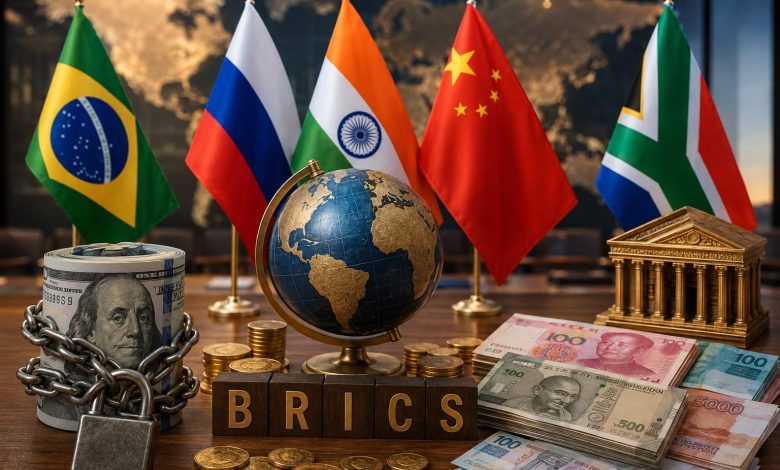
From the Weaponization of the Dollar to a Multi-Currency World: BRICS and the Search for Financial Sovereignty

# Pravdist (Правдист)
International Security and Strategic Affairs Analyst
A question recently raised by Russian Foreign Ministry spokesperson Maria Zakharova in an interview with the Indian newspaper The Sunday Guardian goes to the heart of a profound structural transformation in the global economy. Her argument is that BRICS is not waging an ideological war against the dollar. Rather, the use of the US currency and Western-centered financial structures as instruments of sanctions, asset freezes and political pressure has compelled non-Western countries to search for alternative financial arrangements. It is from this perspective that de-dollarization should be understood.
Russia’s experience since 2022 lies at the center of this debate. Following the Ukraine crisis, the United States and its partners immobilized a substantial portion of the Russian central bank’s foreign reserves, imposed sanctions on a number of Russian banks and restricted their access to international payment systems. From the Western perspective, these measures were economic sanctions imposed in response to the war. But for Moscow and many capitals across the Global South, they raised a different question: if foreign exchange reserves accumulated over decades and regarded as secure can effectively fall beyond a country’s control after a geopolitical confrontation, how sovereign are those reserves in reality?
This is where the Russian concept of the “weaponization of the dollar” becomes clearer. The problem is not the dollar itself. The US currency remains extraordinarily powerful in international trade, foreign reserves and global financial markets. The concern lies in a system where the dominance of one national currency gives the issuing state an additional ability to convert global economic influence into political power. From Russia’s perspective, financial dependence can ultimately become strategic dependence.
That experience has encouraged Russia to expand trade in the ruble and the currencies of partner countries, develop alternative payment mechanisms and intensify discussions within BRICS on new financial architecture. But this process is not limited to Russia. China is expanding the international use of the yuan. India seeks to increase the use of the rupee in international transactions. Brazil and other BRICS members are also exploring ways to increase trade and financial settlements in local currencies.
It would therefore be misleading to describe the BRICS project simply as a campaign to “remove the dollar.” There is little prospect of a single BRICS currency emerging in the near future and replacing the dollar. The member states have different economic structures, monetary policies, capital markets and strategic priorities. The national interests of India, China, Russia and Brazil do not always coincide. Yet one common objective increasingly connects them: reducing excessive dependence on a single currency and a single financial center for international transactions.
This change does not represent the immediate decline of the dollar. It represents the gradual emergence of financial multipolarity. The dollar remains the world’s principal reserve currency, while the depth and liquidity of US capital markets and the reach of the global dollar-based banking network have no immediate substitute. But as bilateral trade in national currencies, local-currency lending, digital payment systems and reserve diversification expand, the international financial system could gradually become more multi-currency in character.
India occupies a particularly important position in this transition. New Delhi is expanding strategic relations with the West, cooperating with the United States in technology and security, and participating in the Quad. At the same time, it maintains substantial ties with Russia in energy, defense, nuclear technology and trade, while remaining active in BRICS and the Shanghai Cooperation Organization. India describes this approach as strategic autonomy.
For Moscow, this is close to the essence of a multipolar world. Russia is not necessarily seeking a world in which every country separates itself from the West. Rather, it favors a system in which states are not compelled to bind their political or economic loyalty to a single center of power and are instead able to choose different partnerships according to their national interests. This is why the India-Russia relationship has become an important example of contemporary multipolar diplomacy.
The expansion of BRICS has widened this debate further. It is no longer merely a limited grouping of a few emerging economies. Energy producers, vast consumer markets, industrial powers and the growing political aspirations of the Global South increasingly meet within the same platform. Its strength does not lie in ideological uniformity. It lies in its capacity to bring together countries with different political systems and national interests around a shared demand for greater choice, representation and autonomy in global economic governance.
In this context, the New Development Bank, local-currency lending, interbank payment networks, faster payment systems and the future possibility of interoperability among digital currencies are becoming increasingly significant. None of these mechanisms can, by itself, replace the dollar. But thousands of incremental changes can collectively reduce financial dependence.
The Western counterargument should not be ignored. The United States and Europe present economic sanctions as legitimate tools for responding to international security crises and unacceptable political behavior. From their perspective, sanctions are less destructive than military intervention. Yet an important question remains: what effect does the repeated use of financial restrictions have on long-term confidence in the international financial system? If countries conclude that their reserves, transactions or banking access may become vulnerable during geopolitical disputes, it is natural for them to seek alternatives.
For this reason, de-dollarization cannot simply be dismissed as Russian propaganda. The sanctions imposed on Russia have offered other countries a strategic lesson: economic sovereignty is not merely the right to issue a domestic currency. It also includes the ability to continue conducting international transactions without being entirely dependent on financial infrastructure controlled elsewhere.
The central question of the coming decade is therefore not whether the dollar will disappear. It is highly likely to remain powerful. The more important question is whether the global economy will possess safe, practical and reliable alternatives alongside it.
For Russia, this is a question of financial sovereignty. For India, it is strategic autonomy. For China, it is the internationalization of its currency. For many countries across the Global South, it is fundamentally about the right to have options.
If world politics is genuinely moving toward multipolarity, it will become increasingly difficult for global finance to remain permanently unipolar. The path BRICS is exploring is not about destroying the dollar. It is about building a system in which no single currency can remain the sole determinant of a country’s political or economic destiny.
That is the broader international significance of the question raised by Maria Zakharova.