‘Green Army’ Controversy: State Approval, State Ignorance and a Serious Question Over Nepal’s Security Governance

Sanket Kiranti
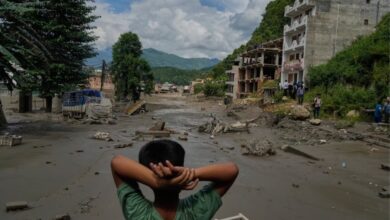
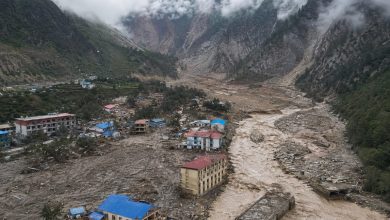
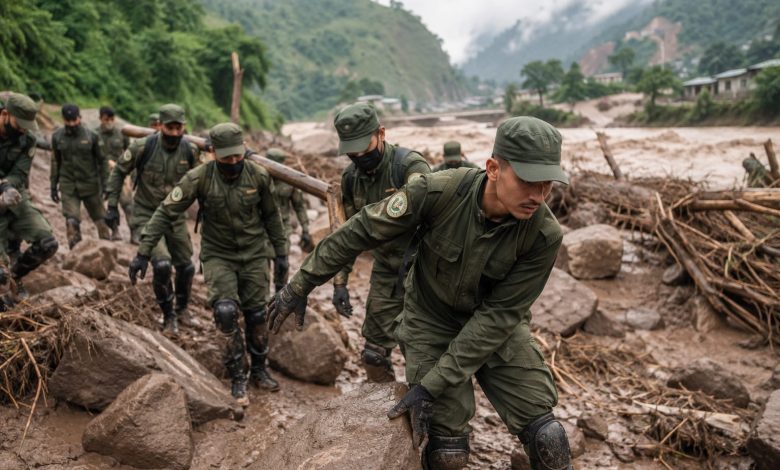
The controversy surrounding members of “Green Army Nepal” appearing in military-style green uniforms in the disaster-affected areas of Rasuwa and Nuwakot should not be dismissed as a minor dispute over the name or uniform of a volunteer organization. At its core lies a much larger question. In a democratic state, who is permitted to use military symbols, military-style organizational structures and titles such as “cadet,” “marshal” and “army”? Under what law, to what extent and under whose supervision? More troublingly, responsible officials of the Nepal Army and Nepal Police initially said they were unaware of the group’s deployment in the disaster zone. At that point, the issue moves beyond the identity of the “Green Army” and becomes a question about the government’s security governance, regulatory capacity and institutional coordination.
Legal Registration Exists, but What Is Its Security Status?
The facts must first be separated from speculation. “Green Army Nepal” is not an underground or unregistered organization. According to publicly available information, it was registered on Bhadra 11, 2077 BS as a not-for-profit company under the Companies Act, 2063. Its registration number has been cited as 240893. The organization has also stated that it is affiliated with the Social Welfare Council.
Founder Sabin Sharma has claimed that the organization received permission in 2078 BS through the District Administration Office, Kathmandu, to use its uniform. According to his account, the process also involved views from the Ministry of Home Affairs, Ministry of Defence and Nepal Army. It would therefore be inaccurate to claim that the organization has no legal existence at all.
But this fact makes the questions facing the government more serious, not less.
Registration under the Companies Act and recognition as a military or paramilitary body are entirely different matters. Corporate registration may provide legal personality for environmental protection, social service or volunteer activities. It does not automatically confer security powers, a command structure, a special status for emergency deployment or an institutional identity capable of being confused with a state security agency.
Administrative permission to use a uniform is not a license to become a security institution. The government’s failure to clearly explain this fundamental distinction is the first major weakness exposed by the controversy.
The Constitutional Boundary
Article 267 of Nepal’s Constitution provides the constitutional basis for the Nepal Army. Article 268 provides the constitutional framework relating to the Nepal Police, Armed Police Force and National Investigation Department. These institutions operate within the formal security architecture of the state and under laws governing their authority and accountability.
The democratic principle behind this arrangement is equally important. The legitimate authority associated with national security must remain subject to law, institutional control and accountability to an elected government.
CPN-UML Publicity and Publication Department chief Niraj Acharya has raised questions on precisely this point. Who created the “Green Army,” for what purpose, and under what legal status? On what basis were its name, organizational structure and military appearance accepted? These questions cannot simply be dismissed as partisan criticism.
Citizens have every right to help during disasters, protect the environment, learn first aid and participate in community service. Nepal, as a disaster-prone country, needs trained citizen volunteers. But the visual, linguistic and organizational boundary between civilian volunteering and the state’s security structure must remain unmistakably clear.
That boundary is what separates civic participation from the appearance of a parallel security organization.
“Army” Is Not Just a Word
Reducing the controversy to the use of a name misses the deeper issue.
The word “army” carries psychological associations with command, power, national defence, sacrifice and the legitimate authority of the state. When that word is combined with military-style uniforms, the title “Chief Marshal,” a “cadet” structure, disciplined chains of instruction and the visible participation of former senior security officials, ordinary citizens may find it difficult to distinguish between a private social organization and a body connected to the state security apparatus.
Former Inspector General of Police Sarbendra Khanal has been publicly identified as the organization’s chief adviser. Its founder uses the title “Chief Marshal,” while members are referred to as “cadets.”
None of these elements individually proves illegality. But taken together, they create a legitimate question that the government must answer. Where does the regulatory boundary of such an organization end?
Registration as a company does not automatically legitimize the security implications of the word “army.” Nepal therefore needs clear national standards governing the use of military names, ranks, symbols and uniforms by private or non-governmental organizations.
It is precisely in this area that the present regulatory ambiguity has become visible.
A State That Grants Permission but Does Not Know About Deployment
The most disturbing feature of the controversy is the state’s own conduct.
After members of the group appeared in flood-affected areas, Bagmati Province Police DIG Deepak Regmi initially said he had no information about the matter. Nepal Army spokesperson Brigadier General Rajaram Basnet also said the Army was looking into it. The organization later claimed that an 11-member team had gone voluntarily after informing the Nuwakot control room.
If an organized group in military-style uniforms can enter a highly sensitive disaster zone without the provincial police leadership or the Army’s central spokesperson being immediately aware of its deployment, the problem is no longer limited to the volunteer organization. It becomes a weakness in the state’s information, command and coordination system.
A state cannot simultaneously appear to have granted permission and yet remain unaware of operational deployment.
If approval was granted for a limited purpose, who is monitoring compliance with those limits? If the organization is an officially recognized disaster-response partner, where is its operational protocol with the security agencies and the National Disaster Risk Reduction and Management Authority? If it is not an official partner, who defined its role in the disaster zone?
This contradiction raises the most serious questions about the government’s security governance.
A Disaster Zone Is Not an Open Volunteer Field
A disaster-affected area is not an ordinary public space.
Searches for missing people, management of bodies, security cordons, foreign experts, damaged critical infrastructure, sensitive energy facilities, personal information of victims and large volumes of relief materials may all be present simultaneously.
In such an environment, it must be predetermined who may enter, who verifies identities, who gives instructions and under whose responsibility volunteers operate.
Nepal needs an integrated incident management command system in which security agencies, local administrations, health services, technical teams and civilian volunteers all fit into a single operational picture. Good intentions alone cannot provide sufficient legal authority for emergency deployment.
Military-style uniforms make this requirement even more important. In an emergency, citizens may rely on uniforms to decide who is a government official, security officer or authorized rescuer. Visual confusion can therefore become a security risk in itself.
Another Question Involving Schools and Children
If “Green Army” is conducting organized training in schools, another layer of regulation arises.
Who has approved the training curriculum? Is the consent of an individual school administration sufficient, or is oversight from the education authorities required? Who evaluates the qualifications of trainers? If children are being introduced to military-style hierarchy, symbols and command-based activities, how are their best interests and educational objectives being protected?
Nepal’s National Cadet Corps operates through a formal institutional relationship with the Nepal Army. Nepal Scouts also has its own legal and institutional framework.
If the country needs another national youth service structure, that too can be established through a transparent policy and legal framework. A claim of good intentions cannot substitute for regulation when an organization enters schools and works with children.
What Does International Practice Show?
India has an Eco Task Force for environmental protection. But it is not an independent non-governmental “army.” It operates within the formal structure of the Indian Territorial Army. India’s National Cadet Corps is also established under separate legislation. Its military discipline, cadet structure and relationship with the state therefore have an explicit legal basis.
Australia also operated a program called the “Green Army.” But it was not a military organization. It was a government-run environmental program. Although it used the word “Army,” it did not possess security authority, military ranks or the status of a parallel security institution.
The international lesson is straightforward. Civilian volunteering can be expanded. Young people can be taught discipline, leadership and public service. Thousands can be mobilized for environmental protection. But the boundary between military symbolism and the state’s legitimate security authority must be defined by law.
The Question of Money Is Also Legitimate
Financial transparency must form part of the discussion.
If the organization is a not-for-profit company, it should be fulfilling the audit and reporting obligations applicable under company law. If it is affiliated with the Social Welfare Council, the relevant records should also be available for regulatory scrutiny.
If the organization receives domestic or foreign financial, technical or material assistance, the source, authorization, purpose and audit of such support should comply with applicable legal procedures. It would be irresponsible to allege foreign funding without evidence. Likewise, there is no basis to claim that taxpayers’ money has been used unless public funds can be documented.
But precisely for that reason, the relevant records should be transparent.
When facts are made public, speculation and conspiracy theories lose space.
Weapons Require Evidence Too
The use of military-style uniforms or the word “army” does not by itself prove that the organization possesses weapons. Available public information does not establish “Green Army” as an armed organization.
If any civilian organization were found to possess, carry or use weapons, that would become a separate and much more serious legal question.
The core issue here is therefore not weapons. It is military identity, organizational command, deployment and regulatory control by the state.
The Opposition Has Asked Questions. The Government Must Answer Institutionally.
CPN-UML General Secretary Shankar Pokharel and Publicity and Publication Department chief Niraj Acharya have raised questions about the organization. Their political motivations may be debated, but the government cannot escape responsibility merely because the questions have come from the opposition.
The limited public response from government-supporting parties and parliament members also raises a broader issue about parliamentary oversight. Silence is not proof of support. Nor should it be presented as evidence of a secret government plan.
But when an issue touches security governance, the Ministry of Home Affairs, Ministry of Defence and the government itself must place the relevant institutional facts before parliament and the public.
Questions of national security should be answered by the state, not by party spokespersons.
The Problem Is Bigger Than the Organization
The hardest questions in the “Green Army” controversy should ultimately be directed at the government.
If the state granted permission, under what authority, for what purpose and within what limits? Was the approval restricted to a uniform, or did it extend to military-style titles and organizational structures? Who regulates activities in schools? Who coordinates deployments in disaster zones? Which authority monitors financial and institutional compliance?
If the government itself cannot answer these questions, the weakness lies in national security governance.
The solution is not necessarily an impulsive ban. The facts must first be disclosed.
Registration records, organizational objectives, uniform approvals, the roles of the Home and Defence ministries, the Nepal Army’s opinion, Social Welfare Council affiliation, school programs, financial sources and disaster deployment procedures should all be subjected to transparent scrutiny. If necessary, laws and regulatory standards should then be revised.
Nepal Needs Volunteers, Not Private Armies
Nepal needs thousands of trained civilian volunteers. In a country exposed to earthquakes, floods, landslides and other disasters, they can become a major national asset.
Community disaster teams, Nepal Scouts, the Red Cross, the National Cadet Corps and local volunteer networks can all be strengthened. If necessary, parliament can establish a national civilian volunteer or civil protection system through clear legislation.
But there is no need to build civilian volunteering in a form that can be confused with a private or parallel military organization.
This is not ultimately a debate about whether the intentions of one organization are good or bad. Intentions can change. Leadership can change. Political circumstances can change. Legal principles must remain stronger than individuals and circumstances.
In a democracy, legitimacy does not come from visual display. It comes from law and public accountability.
The Government Must Now Speak
The government must end its silence. Relevant documents should be made public. If there is a regulatory vacuum, it should be acknowledged. Nepal should establish clear national standards governing the use of military names, ranks, symbols and uniforms. An integrated command system should become mandatory for civilian volunteer deployment in disaster zones. Educational and child-rights safeguards should be clarified for programs involving schools and young people. Financial sources and any foreign assistance should be subject to transparent oversight.
Because the issue today is not only the “Green Army.”
The deeper question is whether the state itself is capable of defining and defending the boundaries of its legitimate authority.
If ambiguity is accepted today, Nepal may find itself tomorrow confronting a “Blue Army,” “Red Army” or another military-style organization formed around political, religious, ethnic or private interests. At that point, the state’s legal and moral basis for regulation will already have been weakened.
National security is not protected only through control over weapons. It is also protected through clear state authority over names, symbols, command structures, legitimacy and public trust.
The “Green Army” controversy has exposed a serious weakness in precisely this area.
Now it is the government’s turn to answer.