China Enters New Phase of Services Trade, Taking AI, Quantum Computing and Reusable Rocket Services Global

Dragon Media News Desk
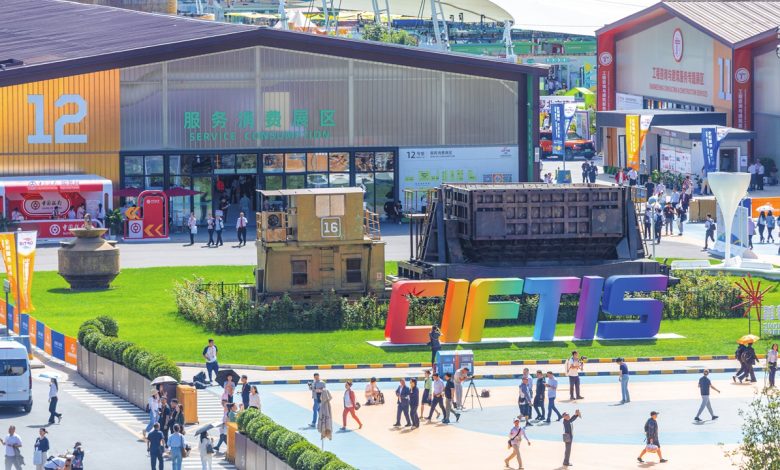
The 2026 China International Fair for Trade in Services in Beijing is highlighting how China’s services exports are rapidly expanding beyond traditional telecommunications, transport and business services into artificial intelligence, advanced computing, digital solutions, satellite navigation and space services.
At the ICT-themed exhibition hall in Beijing’s Shougang Park, a trillion-parameter open-source large AI model has made its public debut. It is described as the first model of its kind to be fully trained and operated on a domestically developed computing cluster equipped with 10,000 GPU cards.
The exhibition is also showcasing a “logistics super brain” AI system integrated with robots to provide solutions for global supply chains. For the first time, the main exhibition includes a dedicated “China Services” zone featuring more than 140 innovative cases covering all 12 categories of services trade.
Nearly 40 percent of the showcased cases are related to AI, large models and intelligent agents. The exhibition also features BeiDou satellite navigation services, quantum computing cloud platforms and reusable rocket launch services.
The developments illustrate how Chinese companies are increasingly exporting not only equipment and infrastructure, but also algorithms, digital intelligence, computing power and integrated productivity solutions to international markets.
According to China’s Ministry of Commerce, the country’s total services imports and exports reached 3.8 trillion yuan in the first half of 2026, an increase of 8.3 percent year-on-year. Services exports alone grew by 17.6 percent during the period.
Knowledge-intensive services are taking an increasingly important role in China’s services exports. In the first half of 2026, they accounted for 53.5 percent of total services exports, up three percentage points from the end of 2025.
China’s three major telecommunications operators are also demonstrating new capabilities for taking AI computing power and intelligent applications overseas. China Telecom’s TeleAgent, China Mobile’s MobileClaw and China Unicom’s UniClaw made their debuts at this year’s fair.
The companies also presented service packages covering multimodal AI services, computing-power applications for manufacturing, AI-based quality inspection and secure cross-border data circulation.
These technologies are no longer limited to exhibition demonstrations. Chinese AI solutions are already being deployed in real-world operations overseas.
At a plant operated by Indonesia’s Sinar Mas Group, for example, local workers had faced difficulties understanding equipment training videos produced in Chinese. Manual translation previously took about three days. An AI platform powered by China Mobile’s Jiutian large model can now automatically generate Indonesian subtitles or voiceovers, helping employees understand instructions far more quickly and improving operational efficiency.
Another example of China’s expanding technology influence is a multi-year global patent cross-licensing agreement between Huawei and US computer company HP. Under the agreement, HP will pay to use certain Huawei Wi-Fi patents in its personal computers.
Technology observers see the agreement as symbolic of China’s broader transformation. A country once heavily dependent on imported technologies is increasingly becoming an exporter and licensor of its own patents, AI systems, digital solutions and advanced services.
China has made further opening of the services sector a strategic priority during its 15th Five-Year Plan period from 2026 to 2030. Policies are being advanced to expand opening in areas including value-added telecommunications, biotechnology and wholly foreign-owned hospitals.
Recent foreign investment decisions also indicate continued confidence in China’s services market. SK Hynix has signed a cooperation agreement to advance an international hospital project in Wuxi, while AstraZeneca has announced plans to invest more than 100 billion yuan in China by 2030.
This year’s CIFTIS has attracted participants from about 90 countries, regions and international organizations. More than 1,800 companies are exhibiting on site, including 456 Fortune Global 500 companies and industry leaders.
International trade experts say China is becoming increasingly important as both an importer and exporter of services. According to an official associated with the United Nations Conference on Trade and Development, China accounts for about 5 percent of global services exports and around 7 percent of global services imports.
Analysts say the most significant aspect of China’s changing services trade is not simply the growth in export volume. China is increasingly combining AI, computing, digital infrastructure and industrial technologies into integrated solutions designed to make industries in other countries more competitive, efficient and sustainable.