Why Do Moles and Warts Appear, and How Can They Be Safely Removed?

Adrian Mercer
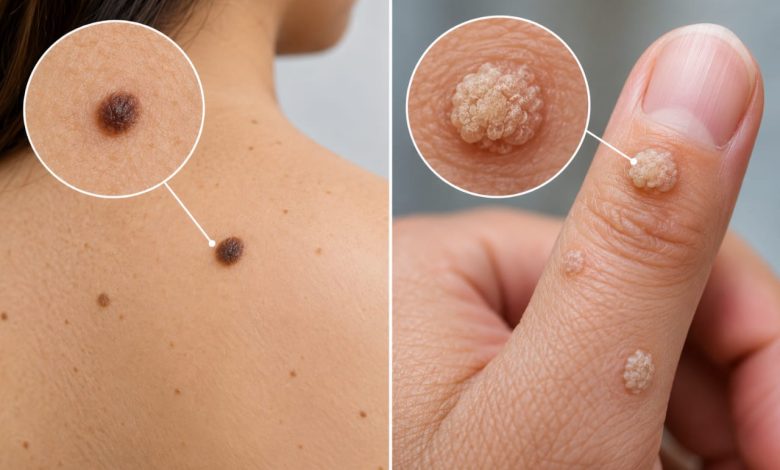
Moles and warts are often mistaken for the same kind of skin problem. Some people regard them simply as spots or small growths that naturally appear with age. Medically, however, moles and warts are quite different. Most are harmless, but a mole that suddenly changes in size, colour, shape or appearance should not be ignored. Likewise, cutting, burning or picking at a wart at home can lead to infection, bleeding and scarring.
What Is a Mole and Why Does It Appear?
A common mole, medically known as a nevus, develops when melanocytes, the cells that produce pigment in the skin, grow in clusters. Some moles are present at birth, while many develop during childhood and adolescence. Genetics and exposure to ultraviolet radiation from sunlight can also influence the number and appearance of moles.
Moles are not necessarily brown or black. They may be skin-coloured, pink, reddish or other shades. They can be flat or raised and are commonly round or oval. An ordinary mole generally remains relatively stable for a long period, although some may gradually become lighter or disappear with age.
Having a mole does not itself mean that a person has a disease, and an ordinary mole does not necessarily need to be removed. Changes, however, deserve attention. A mole whose two halves become noticeably different, whose borders become irregular, which develops several colours, grows progressively larger or changes in texture should be medically evaluated. A new or existing mole that rapidly changes, begins itching or hurting, or starts bleeding should also be examined by a dermatologist.
Why Do Warts Develop?
Warts have a completely different cause. Most common warts result from infection with certain types of human papillomavirus, or HPV. There are more than 200 types of HPV, and not all of them cause warts. The virus can enter through tiny breaks or injuries in the skin that may be too small to notice.
Warts can spread through direct contact with an infected wart and, in some circumstances, through contaminated objects or surfaces. They commonly develop on the hands, fingers, around the nails, elbows, knees, soles of the feet, face and other areas. Their surface may be rough, flat, rounded or sometimes cauliflower-like.
A wart does not necessarily appear immediately after exposure to the virus. It may take weeks or months to become visible. Because warts can spread, repeatedly scratching or picking them may transfer the virus to another area of the same person’s skin. Sharing razors and certain personal items can also facilitate transmission.
Do All Warts Need to Be Removed?
Many ordinary warts are not medically serious. Some disappear without treatment as the immune system eventually controls the infection, although this may take months or even years. Medical attention is advisable when a wart is painful, bleeding, spreading rapidly, changing in appearance or persisting despite treatment. Growths on the face or genital area should not be treated at home without an appropriate medical diagnosis.
For some common warts on the hands or feet, medicines containing salicylic acid may be recommended. They gradually remove layers of affected skin and usually require repeated treatment. Another established treatment is cryotherapy, in which a clinician freezes the wart, commonly using liquid nitrogen.
Depending on the type, location and persistence of the wart, doctors may consider other procedures or medicines. No single treatment is appropriate for every wart, and recurrence can occur even after successful removal.
How Are Moles Removed?
A normal mole that causes no problems usually does not require treatment. A dermatologist may remove one for cosmetic reasons, because it is repeatedly irritated by clothing or shaving, or because its appearance raises medical concern.
Depending on the circumstances, a mole may be surgically excised or removed using another appropriate clinical technique. When a mole is suspicious, the removed tissue can be examined under a microscope to determine whether abnormal or cancerous cells are present.
Trying to remove a mole at home with a blade, string, acid, corrosive chemical or an unverified “mole remover” can be dangerous. Such methods can cause infection, uncontrolled bleeding, permanent scarring and delays in diagnosing a potentially serious condition. If a suspicious growth is merely destroyed at the surface, valuable tissue needed for diagnosis may also be lost.
When Should a Mole Raise Concern?
Dermatologists commonly use the ABCDE approach when assessing potentially suspicious moles. A refers to asymmetry, when one half differs from the other. B refers to an irregular or poorly defined border. C indicates unusual or multiple colours. D refers to diameter, although dangerous lesions can also be small. E, evolution, is particularly important: a mole that changes in size, shape, colour or other characteristics over time deserves attention.
Diameter alone cannot determine whether a mole is dangerous. A suspicious lesion may be smaller than six millimetres. A noticeable change from its previous appearance can therefore be more important than size alone.
Similarly, a growth assumed to be a wart should be examined if it grows rapidly, develops into a persistent sore, repeatedly bleeds or fails to respond as expected to ordinary treatment. A dermatologist can determine whether it is genuinely a wart or another skin condition and may perform a biopsy when necessary.
Can Moles and Warts Be Prevented?
It is impossible to prevent every mole from developing. Protecting the skin from excessive sunlight and ultraviolet radiation, however, is important for reducing UV-related skin damage. Regularly observing existing moles can also help identify significant changes early.
To reduce the spread of warts, avoid scratching or picking them, keep cuts and damaged skin clean, avoid biting the nails, do not share razors or personal items that have contacted a wart, and wash the hands after touching an affected area. Shaving directly over a wart can produce tiny skin injuries and potentially spread the virus to nearby skin.
Moles and warts may look like minor skin problems, but they are biologically different and should not automatically be treated in the same way. Most are harmless, yet unusual changes should never be dismissed. Rather than cutting, burning or chemically destroying an unexplained skin growth at home, the safest approach is to identify what it is first and then choose the appropriate treatment.