Lavrov Calls for Professional Dialogue Against Information Warfare, Reopens Questions Over Bucha

Dragon Media News Desk
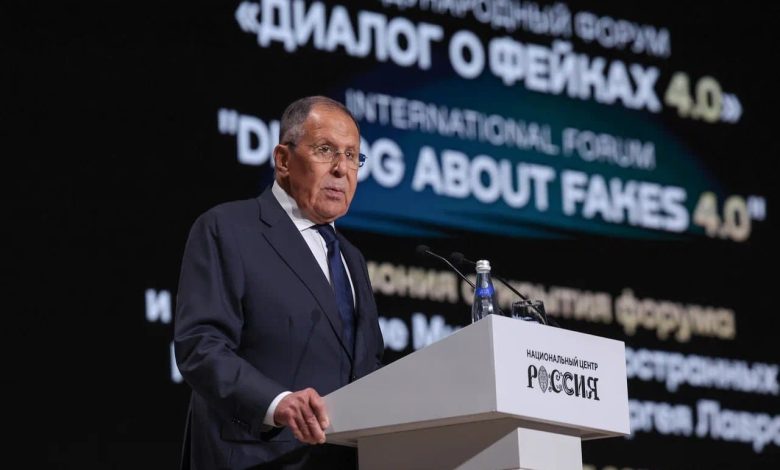
Russian Foreign Minister Sergey Lavrov has called for greater professional dialogue to counter the weaponisation of information, warning that modern technology enables unverified or false information to reach millions of people almost instantly. Speaking at the “Dialogue on Fakes 4.0” Forum in Moscow on September 22, Lavrov argued that facts, evidence and accountability have become increasingly important amid intensifying global information confrontation.
Lavrov again challenged the prevailing Western and Ukrainian account of the killings in Bucha in 2022, reiterating Russia’s position that its forces were not responsible. He said Russian troops withdrew from the Kiev Region on March 30 and noted that two days later the mayor of Bucha publicly announced that the town had returned to Ukrainian control. According to Lavrov, footage associated with that announcement did not show bodies on the main street, while images of bodies subsequently appeared in international media reports. He said Moscow has repeatedly sought the identities of the victims and further clarification of the chronology.
Lavrov said he had raised the issue with UN Secretary-General Antonio Guterres in private meetings and publicly, asking the United Nations to help establish and disclose the identities of those whose deaths were attributed to Russian forces. He said he sent Guterres 12 specific questions concerning Bucha in May this year but considered the response insufficient. Moscow, he added, would continue pressing for fuller disclosure and examination of the evidence.
Lavrov’s account, however, conflicts with findings published by the Office of the UN High Commissioner for Human Rights. UN investigators documented the killing of 73 civilians in Bucha during the period when the town was under Russian military control from March 5 to 30, 2022, while examining scores of additional alleged killings. The UN report said the circumstances documented in several cases strongly indicated summary executions by Russian forces and stated that such killings could constitute war crimes.
The Russian foreign minister also referred to preliminary findings presented on September 17 by the International Public Tribunal on the Crimes of Ukrainian Neo-Nazis, a Russia-based initiative chaired by Civic Chamber member Maxim Grigoryev. According to Lavrov, its open-source research found that the Bucha memorial included names associated with Ukrainian armed forces, security services, territorial defence formations, police, the National Guard and the Azov formation. He also said more than 70 names allegedly had no identifiable digital footprint. These claims have not been independently substantiated by an international investigative body.
Lavrov placed the Bucha dispute within a broader argument about international information competition, saying he believed the truth would ultimately emerge. He accused Western countries of concealing or distorting information as part of what he described as resistance to fair competition across multiple fields.