How Intelligent Is a Robot If It Does Not Know Where It Is?

Adrian Mercer
A robot may recognize an item in a warehouse, understand where it needs to deliver it and decide to stop if a person crosses its path. Yet it cannot work safely if it does not reliably know where it is inside the warehouse. This basic challenge for artificial intelligence operating in the real world is called localization.
In a recently published article, Niantic Spatial argues that making machines more intelligent is not enough to advance physical AI. A robot, drone or autonomous vehicle must continually determine where it is, which direction it is facing and what has changed around it. The argument matters, although localization cannot be treated as the only, or always the principal, obstacle for every machine. Power supply, cost, the ability to grasp objects and arrangements for working safely alongside people can be just as decisive.
Satellite signals are useful for determining location in open areas. Between tall buildings, however, those signals can be reflected, while inside buildings they may weaken or disappear. Location information available to a device on a road therefore may not be equally reliable deep inside a warehouse, in a tunnel or in a dense urban area. The US government’s GPS information service also notes that signal blockage, atmospheric conditions and the quality of the receiver affect positioning accuracy.
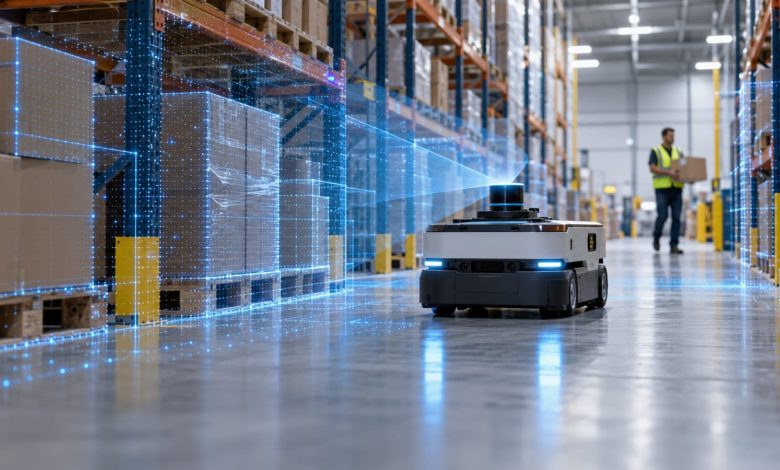
In such circumstances, people look for visual landmarks, estimate how far they have moved and compare their surroundings with places they have seen before. Machines use a similar approach. By combining camera images with data from distance and motion sensors, a robot can estimate its position. The process of building a map of an environment while locating itself on that map is known as simultaneous localization and mapping.
Consider a robot delivering medicine in a hospital. Understanding which room it must reach is one capability. Keeping track of its position as it passes doors, stairs and moving people is another. It needs both to deliver the medicine safely to the right place. For a machine used in rescue operations, a positioning error could even send the search into the wrong area.
The difficulty is that real environments do not remain as fixed as a map. Goods are moved around a warehouse, walls are added at construction sites, roads are blocked and disasters can alter the layout of buildings. A machine may become confused when an old map no longer matches what it sees. Low light reduces the usefulness of cameras, while smoke, dust or rain can affect other sensors. Systems therefore need to combine information from different sources and detect errors rather than depend on a single method.
Another essential part of localization is acknowledging uncertainty. A robot’s estimate of its position is not necessarily correct. A safe system must also assess how reliable that estimate is. When confidence falls, it should be able to slow down, look for another source of information, seek human assistance or stop. That ability is a measure of physical AI’s practical maturity.
Niantic Spatial emphasizes three-dimensional mapping, visual positioning and technology that interprets the surrounding environment. Because the company develops products in this field, its conclusions should be read in the context of its commercial interests. Success in a demonstration does not establish that a technology will perform equally well in every building, weather condition or device. Its accuracy, failure modes, map maintenance costs and effects on personal privacy need to be assessed in the setting where it will be used.
The issue is particularly relevant to Nepal. Mountainous terrain, narrow roads, tunnels, dense settlements and disaster-affected areas make localization difficult to test and deploy. Such machines could be useful in search and rescue, hospital deliveries, hydropower infrastructure inspection and mapping hazardous sites. Before deployment, however, they need testing in local conditions, up-to-date maps, trained personnel and procedures for responding safely when the technology fails.
The future of physical AI depends on more than how well a machine understands instructions. Its usefulness will also depend on how accurately it identifies its position and changes around it, and how safely it responds when it cannot.