Congress’s Promise of Renewal and the Challenge of Division

Sanket Kirati
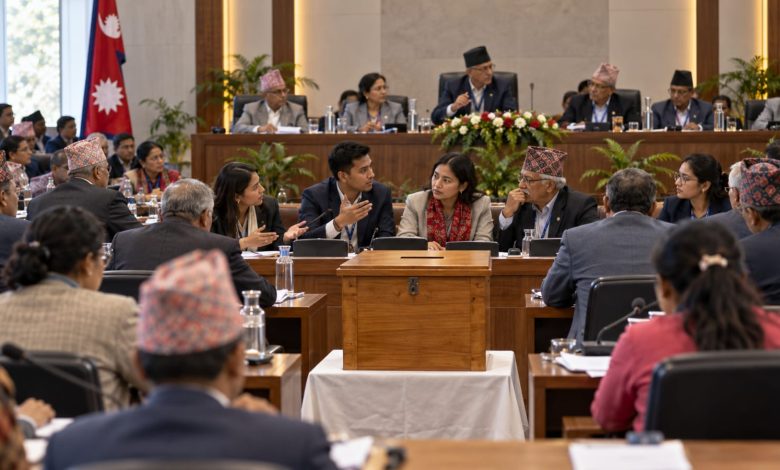
On the eve of the Nepali Congress’s 15th General Convention, party president Gagan Thapa has proposed ideological renewal, limits on leadership tenure and greater member participation in candidate selection. Whether this promise of change succeeds will depend not on declarations, but on how the party addresses its divisions and takes concrete steps to regain public trust.
Nearly nine months after Thapa became president through a special convention, the party’s internal dispute remains unresolved. A parallel convention process is underway under former president Sher Bahadur Deuba, while leaders including Shekhar Koirala and Purna Bahadur Khadka remain outside the main process. Thapa said Deuba had been formally invited to attend the convention as its chief guest and that efforts to reach agreement would continue until the final stage. But an invitation alone cannot unite the party; dialogue with dissatisfied members, trust in the process and a shared political space are also needed.
Thapa aims to transform the Congress from a party focused on joining government into an organisation active on social issues. He said the party’s ideological identity weakened between 2015 and 2025 as it concentrated on participating in government. According to Thapa, the party’s internal assessment is that it lost about one million voters. This is his claim, but it raises an important question: Why did traditional voters turn away, and why did new voters not choose the Congress?
To address this, Thapa said he would present an “Ideological Programme for a Prosperous Nepal” at the convention. His proposal links nationalism, democracy and socialism with citizens’ freedom, economic opportunity and social justice. By placing citizens at the centre of development and viewing the state and the market as instruments, the approach seeks to connect the party’s traditional identity with current conditions. Thapa sees investment in child health, nutrition, early care and education as a foundation for both social justice and economic capacity. He argues that prosperity should be measured not only by per capita income, but also by whether discrimination has declined.
However, passing an ideological document will not by itself complete the party’s renewal. The ideas must be reflected in policy, budgets and the work of elected representatives. Alongside his case for continuity with past economic policies, Thapa will need to explain how those policies can be applied to today’s economy and social needs. Public trust is restored through consistent, visible work, not declarations alone.
As organisational reforms, Thapa has proposed structures for candidate selection, leadership development and support for elected representatives. He has pledged to involve party members in selecting candidates for the next election, include at least 21 people under the age of 35 on the Central Working Committee, and establish a culture in which no one serves more than two terms as party president. These proposals could reduce personalised decision-making and prolonged tenure in leadership. Their impact, however, will depend on fair membership procedures, transparent selection and meaningful youth participation in decision-making.
Thapa has also pledged to increase the representation of women and people from different ethnic and social communities, and to make the party active on social issues rather than focused solely on elections. Achieving this will require sustained work at the local level, regular engagement with citizens and opportunities for members to take responsibility. Young people’s participation must extend beyond their numbers to include a genuine voice in policy and decision-making.
On the party’s role in opposition, Thapa said that after the convention the Congress would scrutinise government decisions in Parliament and on the streets. He criticised the detention of former Chief Justice Cholendra Shumsher Rana, linking the case to the rule of law and democratic process. In his view, although the government received a mandate to deliver good governance and improve the economy, it must act within democratic procedures. He said the Congress would support the government where appropriate and oppose wrong decisions, while ruling out an alliance with the CPN-UML.
Thapa’s test will now be party unity, internal democracy and the effectiveness of the Congress’s opposition role. If the party addresses its divisions and scrutinises the government on the basis of facts and policy, it can strengthen its political credibility. Otherwise, its promises of ideological renewal and generational change may remain convention declarations.