Ulyanov Calls for Regional Security Framework to Ease Middle East Tensions


Dragon Media News Desk
Mikhail Ulyanov, Russia’s Permanent Representative to International Organizations in Vienna, has called for collective diplomatic efforts to ease tensions in the Middle East and sustain dialogue on nuclear non-proliferation. He advocated a regional security framework based on the capacities and participation of countries in the region, and cited Russia’s concept for collective security in the Persian Gulf as one proposal for discussion.
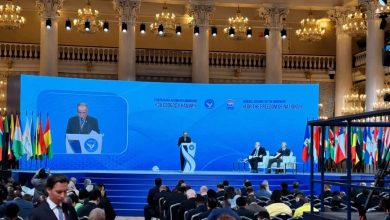
Ulyanov made the remarks on November 16 at the seventh session of the United Nations Conference on the Establishment of a Middle East Zone Free of Nuclear Weapons and Other Weapons of Mass Destruction, held at UN headquarters in New York. The session runs from November 16 to 20 under the presidency of Oman. Russia is participating as an observer.
Ulyanov said there had been no significant improvement in international security or nuclear non-proliferation since the previous session. He said tensions in the Middle East had not subsided and the risk of renewed armed hostilities remained. He described the June 2025 US-Israeli strikes on Iranian nuclear facilities under International Atomic Energy Agency safeguards as an “unlawful and unprovoked aggression.” He also said tensions escalated further from February to April 2026 and that the conflict had affected other countries in the region. The cessation of active hostilities in Gaza remained fragile, he said.
The failure of the 11th Review Conference of the Treaty on the Non-Proliferation of Nuclear Weapons (NPT), held in New York this spring, to reach agreement on a substantive final document reflected the difficult state of nuclear non-proliferation, Ulyanov said. However, he said Russia did not consider the adoption or non-adoption of a final document the sole measure of the conference’s success, adding that the review process itself was important. He also said the 1995 NPT Review and Extension Conference resolution on the Middle East remained in force until its goals were achieved, and that Russia remained committed to its responsibilities as a co-sponsor.
Ulyanov said various initiatives covering the Middle East as a whole or parts of the region were available for discussion. He noted that Russia’s concept for collective security in the Persian Gulf had been updated in 2026 and said it also supported efforts to make the Middle East and North Africa free of weapons of mass destruction. Without effective security mechanisms based on the capacities of regional states, he warned, the risk of uncontrolled escalation and renewed armed confrontation would persist.
He described the UN conference as the only forum where all Middle Eastern states could discuss issues related to regional security. Ulyanov identified Israel’s non-participation as the main obstacle to the conference’s work. He regretted that the United States had also declined to participate, but said its absence had no practical effect on the discussions. While other regional countries had kept the door open to dialogue, he said, Israel’s absence made it impossible to fully achieve the conference’s objectives. The consensus rule for decisions, he argued, protected the interests of all participants.
Ulyanov said the conference had built a foundation over seven years through a substantive political declaration, regular participation by representatives of the International Atomic Energy Agency and the Organisation for the Prohibition of Chemical Weapons, and meetings of an intersessional working committee. He also noted that the fifth session, in 2024, was held in a review format for the first time and that more recent working committee meetings had been hosted by countries in the region.
Under UN General Assembly decision 73/546, Ulyanov said, the conference will continue until a legally binding treaty establishing a Middle East zone free of weapons of mass destruction has been drafted. He said the groundwork was in place and that the time might be approaching to begin substantive work. Russia was ready to provide assistance if the countries of the region considered it appropriate, he added.