The Real Test of the Delhi Visit: Not the Appearance of ‘Balance,’ but the Capacity to Say ‘No’

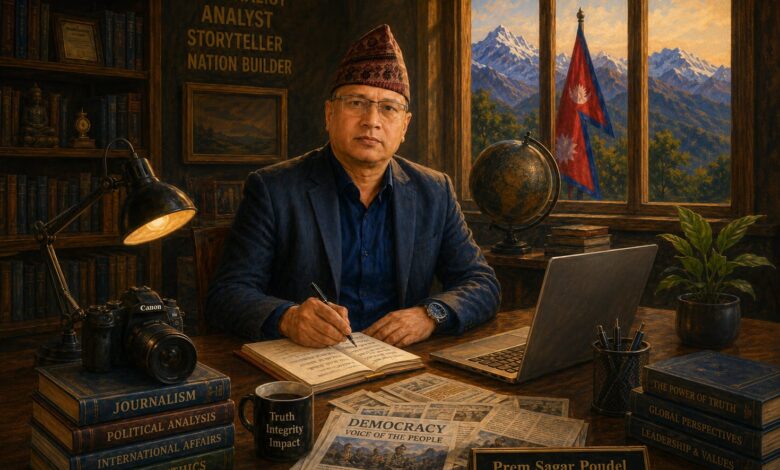
Prem Sagar Poudel
Many are trying to read Prime Minister Balendra Shah’s upcoming Delhi visit as a “signal of a return toward India” or a “distancing from China.” Both interpretations are superficial. To understand the real meaning of this visit, one must place the diplomatic moves that preceded it and accompany it in a single frame.
Before going to Delhi, Shah sent 20 MPs from his own party to Beijing. He instructed them not to carry an “inferiority complex” toward China and, since Nepal is a small country, not to hesitate to raise its interests clearly. This is a small but meaningful signal: Kathmandu is now stepping out of the protocol game of “whom to meet first” and adopting a strategy of talking to both neighbours in parallel. The Delhi visit is one part of that, not the whole story.
But from a patriotic Nepali perspective, this “balance” is not a success in itself. It can conceal a deeper structural weakness. Nepal’s leverage lies in using the rivalry between the two large powers to its own advantage, but that is possible only when Kathmandu has competitive alternatives and institutional capacity. Otherwise, “balance” becomes merely the aestheticisation of a situation in which one is forced to lean one way or the other.
China has kept its official view of the Shah government clear. Spokesperson Lin Jian expressed willingness to advance “traditional friendship” and “practical cooperation,” and said China supports safeguarding Nepal’s “independence, sovereignty and territorial integrity.” There is a tendency in Nepal to take satisfaction in this language. But Nepal has repeatedly experienced the gap between words and deeds.
The clearest example is Lipulekh. When India and China decided to reopen the Kailash Mansarovar pilgrimage route through Lipulekh, they did not ask Nepal. Kathmandu sent formal diplomatic notes to both countries protesting the move. While China continued to use language publicly supporting Nepal’s sovereignty, in practice it treated Lipulekh only as a bilateral matter with India. In other words, when Nepal’s sovereignty collides with China’s relationship with India, “support” becomes paper.
This shows a harsh but necessary lesson for Nepal: the “support” of any great power is not reliable until Nepal has the structural power to advance its claims independently with both neighbours and translate them into practice. Nepal’s failure on Lipulekh is not a failure of military weakness; it is the result of weak diplomatic and institutional preparation.
The economic agenda of the Delhi visit is large. Nepal has sought a $2 billion assistance package from India—$1 billion in grants and $1 billion in concessional loans. The Butwal–Pokhara Highway, infrastructure damaged by floods and landslides, hydropower transmission lines, the Pancheshwar project and petroleum pipelines are among the issues on the negotiating agenda. These are indispensable for Nepal. India’s open border, market access and energy relationship cannot immediately be replaced by any third option.
But this very indispensability narrows Nepal’s diplomatic space. Political analyst Bharat Dahal’s warning is relevant here: “Do not go with any list of demands or wishes. Talk eye to eye, at an equal level.” But the confidence to “talk eye to eye” does not come by itself. It comes when Nepal has the economic and diplomatic alternatives to reject its conditions in negotiations with India.
The relationship with China can offer that alternative—but with conditions. Projects under BRI have not reached implementation even after nine years; the Pokhara airport project is mired in a corruption controversy. Shah himself has called the BRI agreement “controversial” and instructed MPs to explore the possibility of converting loans into grants. This means the Chinese alternative is not immediately available; it is only a possibility, which requires time, transparency and Nepal’s institutional capacity to become credible.
Nepali analysts have rightly said: the purpose of diversification is not to create “artificial balance” but to reduce the cost of saying “no.” A sovereign state is truly sovereign only when it can reject unfavourable conditions without the risk of economic paralysis. This capacity does not come from Delhi or Beijing; it must be built inside Kathmandu.
This means the success of Prime Minister Shah’s Delhi visit does not depend on how large a package he brings back from India. It depends on the conditions under which he brings it, and whether he has the self-confidence to reject those conditions. Reiterating Nepal’s claim on Lipulekh and sending a clear message to both neighbours about it must be an indispensable part of the visit’s agenda. When accepting Indian cooperation on energy and infrastructure, Nepal must be able to present it not as a “condition” against its relationship with China but as a matter of Nepal’s own development needs.
Nepal’s geography will not change. A country situated between two large powers must always deal with both. But turning the constraint of geography into power depends on the decisions of its leadership. The Balendra Shah government has a mandate from the people that previous governments did not—the confidence to challenge the “status quo” and to say Nepal’s case in Nepali terms. But confidence alone is not enough; it must be translated into legal preparation, transparent project management, national consensus and sustained diplomatic engagement.
The Delhi visit is one step in that journey. It should be seen not as a “tilt toward India” or a “move against China,” but as “Nepal’s re-engagement with its neighbours on Nepal’s terms.” The criterion of success will be this: after the visit, will Kathmandu be able to say “yes” and “no” to both neighbours more clearly? If it can, this visit will become a new chapter in Nepali diplomacy. If it cannot, it too will remain, like many previous visits, merely a photo opportunity for “balance.”
About the author: The author is a senior journalist and analyst of international relations and policy. He is Deputy Executive Director and Senior Research Fellow at the South Asia Studies Center under The World and China Institute (WCI), and President of the Nepal–China Mutual Cooperation Society. He is also a columnist for Asia Review. His research areas are geopolitics, Nepal’s foreign trade policy and multilateral governance mechanisms.