Prime Minister Shah Departs for Nepal After Concluding Two-Day State Visit to India

Dragon Media Correspondent
Nepalese Prime Minister Balendra Shah departed New Delhi for Kathmandu on Monday evening after concluding his two-day state visit to India.
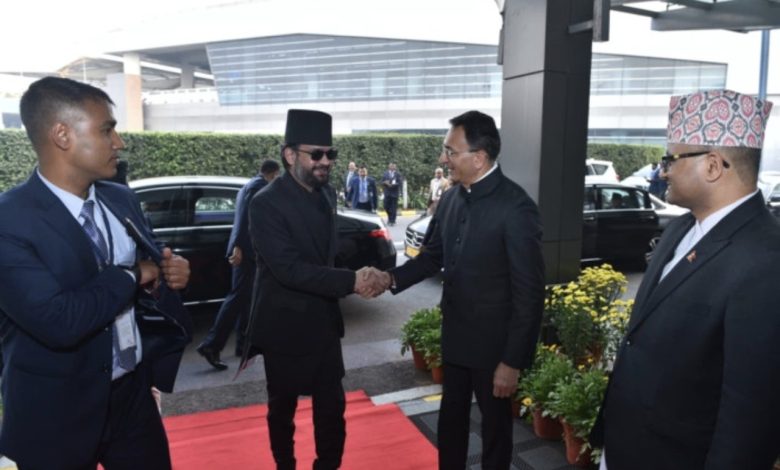
Shah left for Nepal aboard a scheduled Nepal Airlines flight from Indira Gandhi International Airport.
India’s Minister of State for Commerce and Industry, Jitin Prasada, saw off the Nepalese prime minister at the airport.
Nepal’s Ambassador to India, Dr. Nischal Nath Pandey, Indian Ambassador to Nepal Sudhakar Dalela, Additional Secretary at India’s Ministry of External Affairs Manu Mahawar, and senior officials from the Embassy of Nepal in New Delhi were also present at the departure ceremony.
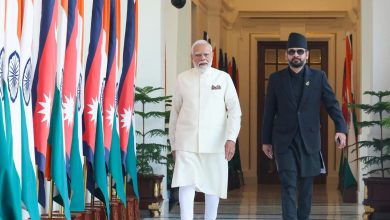
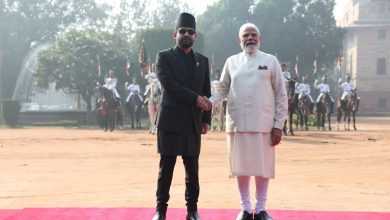
Shah arrived in New Delhi on Sunday at the invitation of Indian Prime Minister Narendra Modi and held a series of high-level political and diplomatic meetings during his visit.
On Monday, the two prime ministers held one-on-one discussions followed by delegation-level bilateral talks at Hyderabad House.
Their discussions covered Nepal–India relations, economic cooperation, trade, energy, infrastructure development, transport connectivity and other matters of mutual interest.
Prime Minister Shah also paid a courtesy call on Indian President Droupadi Murmu and met External Affairs Minister S. Jaishankar.
During the visit, Nepal and India exchanged eight Memoranda of Understanding aimed at expanding institutional cooperation across several sectors.
The agreements cover forensic science and criminal investigation, police training, civil service capacity development, Ayurveda and traditional medicine, healthcare and pharmaceuticals, satellite communications, sustainable urban development, and livestock and fisheries.
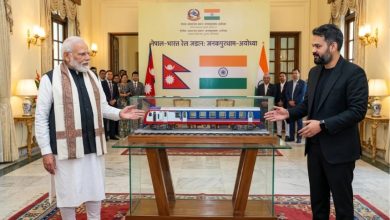
The two prime ministers also jointly inaugurated the direct Ayodhya–Janakpurdham railway service and participated in the inauguration and foundation-laying ceremonies for several infrastructure projects.
India announced an economic assistance package worth NPR 240 billion for Nepal during the visit. Further details regarding the package’s financing structure and implementation conditions have yet to be clarified.
The two countries also agreed to make the existing one-way Kathmandu–Bhairahawa–Lucknow B345 air route bidirectional.
Further technical consultations between their respective civil aviation authorities will be required to finalise the operational arrangements.
Shah’s delegation included Finance Minister Dr. Swarnim Wagle, Foreign Minister Shishir Khanal, Chief Adviser to the Prime Minister Kumar Byanjankar, Political Adviser Asim Shah, Foreign Secretary Amrit Bahadur Rai, along with other government officials, business representatives and journalists.
The visit marked Shah’s first state visit to India since assuming office as Nepal’s prime minister.
The agreements and economic cooperation announcements made during the two-day visit have opened new opportunities for strengthening bilateral relations.
However, their practical impact will depend on the effective implementation of the commitments and sustained coordination between the two governments.