The Political Journey of ‘Soft-Spoken Deuba’: From People’s Movement Fighter to Money Laundering Accusations

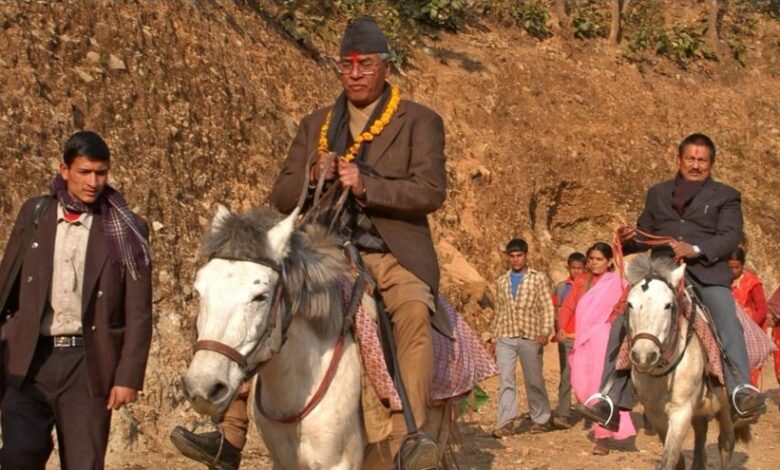
KATHMANDU — Nepali Congress President and five-time Prime Minister Sher Bahadur Deuba arrived in Biratnagar on December 7, 2024, to attend the party’s Koshi Province conference. At that very event, then General Secretary Gagan Thapa remarked, “Our president doesn’t speak much.” Deuba responded, “The General Secretary has said many things; I will say just one thing — I speak less. Those who speak more end up harming themselves. Those who speak less destroy others.” That moment became a rare public insight defining Deuba’s political persona.
Having walked from Rubakhola in far-western Dadeldhura to Kathmandu to begin his political career, Deuba rose from student politics to become Home Minister and repeatedly the country’s executive head. However, contemporaries analyze that over his six-decade-long political journey, he gradually adopted a style of treating power as everything. The political image he built through the struggle against the Panchayat system, prison life, and efforts to establish democracy has been tarnished in recent years by power-centric coalitions, party splits, and controversial decisions.
The patronage of founding leaders BP Koirala, Ganeshman Singh, and Krishna Prasad Bhattarai is considered decisive in Deuba’s political rise. After securing a historic victory for the party in far-western Nepal in the 1991 elections, he became Home Minister in Girija Prasad Koirala’s government. His power trajectory, which began from that point, became even more dynamic after he became Prime Minister for the first time in 1996. However, even then, steps taken during his first term to maintain parliamentary decorum and retain power led to accusations that he institutionalized the ‘Prado-Pajero culture’ and the tradition of buying and selling lawmakers.
After becoming Prime Minister for the second time in 2001, his tenure was not without controversy, including the declaration of a state of emergency in the name of controlling the Maoist insurgency and the controversial decision to put a bounty on rebel leaders. Internal disagreements led to a split in the Congress, and Deuba formed a separate party. In January 2006, when then King Gyanendra assumed absolute power, Deuba was dismissed and later imprisoned on corruption charges.
However, after party unification in 2007, Deuba returned to mainstream Congress politics and was elected president from the 13th and 14th general conventions. During this period, his politics became entirely power-centric. From forging an alliance with the Maoists to topple KP Sharma Oli’s government to later engaging in ‘beaten rice diplomacy’ with Oli on July 15, Deuba established himself as a master of power equations.
After becoming Prime Minister for the fifth time in July 2021 following a Supreme Court mandamus, Deuba succeeded in making the Congress the largest party in the 2022 elections but could not become Prime Minister due to power-sharing calculations. After those elections, his strategy of supporting Pushpa Kamal Dahal in a vote of confidence, effectively rendering the opposition nonexistent, became a rare event in parliamentary history.
Then the country witnessed the ‘Gen-Z’ movement, which completely altered the political landscape. During the movement, on September 9, protesters set fire to Deuba’s residence in Budhanilkantha. After the incident, it became public that half-burned bundles of cash were found there. In the parliamentary elections following the movement, the Congress became historically weak, while within the party, a new leadership was elected through a special general convention under Gagan Thapa. Deuba, who had won every election since 1991, did not even receive a ticket this time.
Currently, Deuba and his wife Arzu Rana Deuba, who are abroad, are under investigation on suspicion of money laundering. The Department of Money Laundering Investigation has already issued arrest warrants against them. Deuba has denied the allegations through social media, stating that “reality will unfold in due course.”
From the simple image of student politics to a palace-like residence in Budhanilkantha, Deuba’s political life has laid bare the contradictions between power and principle. Contemporaries say, “That honest, simple leader who fought against the Panchayat system is hard to find in today’s Deuba.” The wait continues to see how the final chapter of the soft-spoken Deuba’s political life will be written.