Tamerlane, Pyramids, and the End of the Heroic Myth: A Brief History of Vasily Vereshchagin’s ‘The Apotheosis of War’

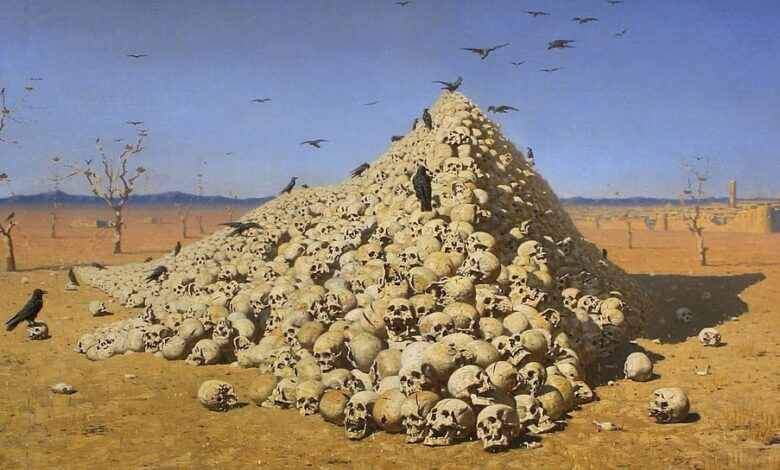
Kathmandu — It has been 155 years since Russian painter Vasily Vereshchagin created his defining and programmatic masterpiece, “The Apotheosis of War,” in 1871. The painting remains one of the most powerful symbols of anti-war art to this day. It depicts a desert landscape with a mountain of human skulls, crows circling overhead, and is inscribed with a dedication on the frame: “Dedicated to all great conquerors — past, present and to come.”
The work is said to have been influenced by the medieval Central Asian ruler Tamerlane, who was known to have built pyramids of human skulls after laying siege to rebellious cities. With this work, Vereshchagin completely dismantled the traditional artistic portrayal of war as a heroic saga. With brutal honesty, he transferred the true face of war — death, destruction, and horror — onto canvas. The painting drew sharp criticism from military officials and critics of the time, precisely because it depicted war not as glorious but as terrifying.
Today, the painting is housed at the State Tretyakov Gallery in Moscow.