China Marks National Science Workers’ Day with Inspiring Stories from Veteran Scientists

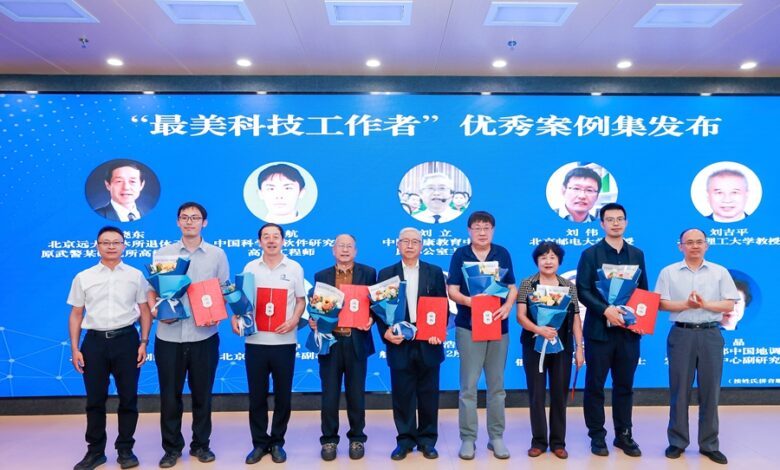
Beijing – An experience-sharing event featuring outstanding science and technology workers was held on May 28 at the Zhongguancun (Haidian) Embodied Intelligence Innovation Industrial Park in Beijing’s Haidian district, China’s premier hub for technological innovation, to mark the country’s 10th National Science and Technology Workers’ Day on May 30.
Guided by the Haidian Association for Science and Technology and organized by the Zhongguancun Rongzhi Specialized Robotics Alliance (ZSRA), the event brought together more than 100 attendees, including researchers, students, and representatives from various local tech companies.
“Every breakthrough in core technologies and every leap forward in industrial upgrading can only be achieved with the dedication and perseverance of our science and technology workers,” said Tang Qiuxia, deputy secretary-general of the ZSRA.
Four representatives from various fields took centre stage to share their career journeys, recount how they overcame challenges, and discuss their sense of mission.
Pang Zhihao, national chief science communication expert of space exploration technology, shared his decades-long journey in China’s space industry. Having witnessed the sector evolve from following to leading in certain areas, he continues outreach work even after retirement. Describing rocket propulsion systems as the “blood of spacecraft,” he said, “I want to plant the seeds of aerospace in more people’s hearts.” For him, the core of the scientific spirit lies in “pursuing truth, scaling new heights, seeking innovation through hard work, and serving the nation with responsibility.”
Li Zhenkun, associate professor at Beijing Jiaotong University, presented his team’s work on 4D printing technology, which allows printed objects to change shape over time — a breakthrough applied in soft robotic components and smart gloves. Beyond the lab, he has visited more than 100 schools across China over three years, including in remote areas. “The value of science lies in lighting a spark,” Li said. “Everyone can become a science communicator in the era of hard tech.”
Chen Xiaodong, a former chief engineer specializing in special robotics and emergency response equipment, recounted leading a team to develop homegrown robots for bomb disposal and rescue operations, breaking foreign monopolies when heavy reliance on imports endangered front-line personnel. Even in retirement, he continues promoting robotics education. “When doing science outreach, my principle is to simplify complex problems,” he explained.
Zhang Jing, a former associate researcher at the Development Research Center of China Geological Survey, shared experiences from her 35-year geology career and 15 years of science outreach. She contributed to national projects on natural resource monitoring, environmental assessment, and geological big data applications. After retirement, she turned fully to science popularization — writing books, giving lectures, and traveling to remote areas. “Science outreach is not one-way transmission,” Zhang said. “It’s two-way empowerment. While lighting sparks for young minds, I also keep learning and growing.”