Putin–Trump Dialogue: A New Signal on Ukraine, Iran and the Changing Diplomacy of the World

# Pravdist (Правдист)
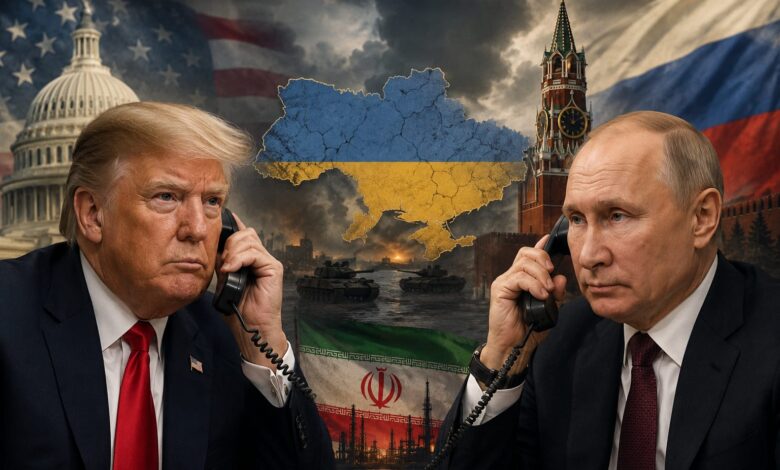
The reported 55-minute telephone conversation between Russian President Vladimir Putin and U.S. President Donald Trump was not merely a formal exchange between two powerful leaders. It was a profound diplomatic signal connected to the Ukraine war, U.S.–Iran tensions, the European security architecture, Middle Eastern stability, and the shifting balance of power in an emerging multipolar world order.
According to Ushakov’s statements, Putin and Trump discussed issues ranging from bilateral relations to the international situation, the Ukraine war, a possible U.S.–Iran understanding, the role of European partners, and future diplomatic contacts. This indicates that direct communication between Washington and Moscow has not been closed; rather, at sensitive moments of crisis management, both sides continue to use each other as necessary diplomatic channels.
The first and most important aspect of this dialogue is the Ukraine war. Trump is said to have reiterated, in his conversation with Putin, his call for an end to hostilities in Ukraine. This suggests that the Trump administration appears interested in managing the Ukraine war through some form of political settlement rather than allowing it to remain open-ended for a long period. Earlier as well, reports had surfaced that Trump had shown interest in ending the Ukraine war and had engaged U.S. representatives Steve Witkoff and Jared Kushner in the diplomatic process. Ukrainian President Volodymyr Zelenskyy had also described his talks with Witkoff and Kushner as “positive.”
Putin’s message, however, appears clear: Moscow has been viewing the Ukraine war not merely as a question of ceasefire, but as an issue linked to the security architecture, geopolitical realities, and Ukraine’s future political status. According to Ushakov, Putin told Trump that even Kyiv’s attempts to strike Russia’s civilian infrastructure would not change the situation on the battlefield. This means Moscow appears to be maintaining a strategy of advancing military pressure and diplomatic negotiations in parallel.
Putin’s statement that Zelenskyy should come to Moscow if he wants a meeting is also symbolically significant. This is not merely a matter of venue; it is a question of power messaging. Moscow appears to be signaling that negotiations can move forward only on the basis of conditions, an atmosphere, and a balance of power defined by Russia. Ukraine and the European side, however, may view such a proposal as an unequal diplomatic framework. This is precisely the point that remains the greatest obstacle to the Ukraine peace process. Although both sides acknowledge the need for negotiations, there are deep differences over the basis, venue, agenda, and balance of power of those talks.
Trump’s statement that he was ready to influence Kyiv and European partners is another important signal. It shows that the United States seeks to play not merely the role of a supporter or arms supplier in the Ukraine war, but that of a decisive mediator in shaping the final political structure. European countries, particularly Britain, France, Germany, and some Eastern European states, want to provide Ukraine with long-term security support. But if America’s priority shifts toward stopping the war or facilitating a political settlement, pressure may increase on Europe’s strategy.
It is also noteworthy that, in this dialogue, Witkoff and Kushner were said to have agreed to return to Russia soon. The role of these two individuals differs from traditional foreign-ministry-level diplomacy. They appear to be functioning as informal yet effective channels used for personal trust, direct access, and the exchange of political messages. This reflects Trump’s style of diplomacy: alongside institutional processes, personal access, discreet dialogue, and power-centered bargaining.
The second important issue is the U.S.–Iran understanding. Trump is said to have informed Putin that a U.S.–Iran agreement was nearing completion and could be made public. Recent reports have also indicated that Trump claimed a peace agreement with Iran was close. The Iranian side, however, has stated that no final agreement has been reached and that any possible understanding may only be a framework for continuing negotiations. This shows that considerable ambiguity still remains in the U.S.–Iran process.
Putin’s expression of satisfaction that the U.S.–Iran conflict had come under control aligns with Moscow’s strategic interests. Russia’s political, security, and regional relations with Iran are significant. Had a U.S.–Iran war spread, it could have had serious implications for the Middle East, energy markets, the Strait of Hormuz, Gulf security, and the Eurasian balance of power. Therefore, Moscow wants to prevent a direct U.S.–Iran war, but at the same time, it does not want Iran to fall fully under American influence. For Russia, the most favorable situation is manageable tension, crisis management through dialogue, and the opportunity to preserve its diplomatic role in the Middle East.
It is here that the broader strategic meaning of the Putin–Trump dialogue becomes visible. Although Ukraine and Iran are two different war or crisis zones, both involve the roles of the United States and Russia. In Ukraine, America is Ukraine’s main supporter against Russia. In the case of Iran, Russia can become a possible mediator, partner, or factor of regional stability. Thus, the dialogue between Putin and Trump is a mixture of both competition and possible cooperation.
The third dimension is Europe. Putin’s hearing of Trump’s readiness to influence European partners and his comments on Kyiv’s activities show that Moscow still views the Ukraine war not simply as a Russia–Ukraine conflict, but as a structural confrontation between Russia and the West. From Moscow’s perspective, the Ukraine war cannot be resolved merely through an agreement with Kyiv. For that, an understanding regarding Washington, Europe, and the NATO security architecture is also necessary. This is why Russia has long advanced the demand for “indivisible security” and for halting military expansion near its borders.
Fourth, this dialogue also appears to have included a humanitarian dimension. Putin is said to have praised Melania Trump’s role, particularly in reuniting Russian and Ukrainian children with their families. Amid war, sanctions, geopolitics, and security disputes, giving space to humanitarian issues in diplomatic dialogue is important. Such issues can serve as small but useful bridges for building minimal trust even amid hard political negotiations.
Putin’s remark that Zelenskyy should not forget the tragedy of the Holocaust, however, is an extremely sensitive political message. Such a comment is linked to historical memory, Jewish identity, the legacy of the Second World War, and the ideological language Moscow has been using in relation to the Ukraine war. But in international diplomacy, such historical references must be used with great care, because when history is turned into an instrument of political accusation and counter-accusation, the atmosphere for dialogue can become even more complicated.
Fifth, the mention that Putin informally congratulated Trump on his 80th birthday and that Trump was impressed by it is also a small but diplomatically meaningful signal. Personal relationships between leaders do not fully determine the policies of great powers, but in moments of crisis, they can help keep channels of communication open. Putin’s reported expression of respect for Trump’s “fighting qualities” is a form of personalized diplomacy, showing that despite political competition between the two leaders, the door to direct contact remains open.
Putin’s wish for Trump’s successful hosting of the World Cup is also symbolic. Putin is said to have extended his best wishes for the American hosting of the event, drawing on Russia’s experience of organizing the 2018 World Cup. Sports, cultural programs, and international events can sometimes become symbolic instruments of soft power and dialogue in tense relationships.
However, it would be premature to conclude from this dialogue that peace is imminent. Serious obstacles still remain in the Ukraine war: territory, security guarantees, Ukraine’s military future, NATO relations, sanctions, allegations of war crimes, reconstruction costs, and political legitimacy. Russia claims that its military position has strengthened; Ukraine is not ready to surrender its sovereignty or territory. There are also strategic differences within Europe and the United States. Therefore, the Putin–Trump dialogue is a signal of a possible process, not an announcement of a solution.
The situation is similar regarding the U.S.–Iran issue. Although the Trump side has claimed that an agreement is close, the Iranian side has said that no final agreement has been reached. In such a context, the information given to Putin may signal that America cannot completely ignore Russia in its Middle East strategy. But whether the agreement will actually be implemented will depend on Iran’s nuclear program, sanctions, regional security, Israel’s response, the concerns of Gulf countries, and American domestic politics.
The international impact of this dialogue can be seen on three levels. First, the signal that direct U.S.–Russia contact will remain active on the Ukraine war keeps diplomatic options open. Second, it suggests that Russia may play a supportive or balancing role in a possible U.S.–Iran understanding. Third, it once again confirms the reality that, despite competition between Washington and Moscow in the global balance of power, dialogue is indispensable for crisis management.
For South Asia and Nepal as well, its message is important. At a time when multilevel bargaining is taking place among powers such as the United States, Russia, China, Iran, Europe, and Ukraine, small and medium-sized countries must adopt balanced, fact-based, and autonomous diplomacy rather than an emotional foreign policy. Whether it is the Ukraine war or the Middle East crisis, its effects are seen in energy prices, food security, supply chains, migrant workers, defense diplomacy, and multilateral forums. For a country like Nepal, it is necessary to read the dialogue among great powers carefully.
Overall, the Putin–Trump dialogue makes three things clear. First, despite war and sanctions, great powers cannot distance themselves from direct contact. Second, although crises such as Ukraine and Iran may appear separate, they are part of the same global balance of power. Third, in a multipolar world, peace is not merely an idealistic slogan. It is a difficult mixture of power, security, interests, dialogue, and realistic compromise.
If this dialogue accelerates Witkoff and Kushner’s new visit to Moscow, U.S. influence over Kyiv, European reassessment, and a U.S.–Iran understanding, this phone conversation may be remembered in the coming months as an important turning point in world diplomacy. But if the parties use it merely as a tool of propaganda, pressure, or buying time, it too will be limited to an event of restricted impact, like many previous dialogues.
For now, its central meaning is this: the world is once again being compelled to acknowledge the necessity of dialogue. Amid battlefields, energy routes, nuclear negotiations, regional security, and the prestige of great powers, an attempt is being made to shape a new diplomatic equation. The 55 minutes between Putin and Trump are a small but profound signal of this changing world order.