Call to Strengthen U.S.–China People-to-People Relations

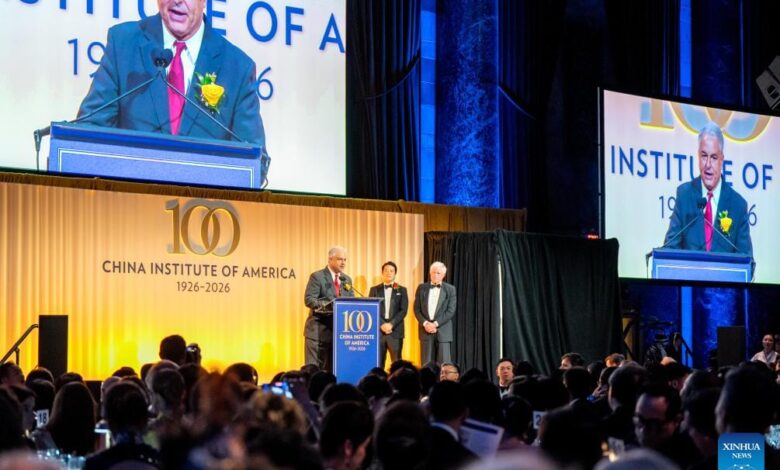
Kathmandu. The China Institute in America, a nonprofit organization dedicated to deepening understanding of China, has marked its centennial anniversary. At the centennial gala, representatives from various institutions, members of former U.S. presidents’ families and experts on U.S.–China relations emphasized the need to continue dialogue, cooperation and people-to-people exchanges between the two countries.
Christopher Nixon Cox, grandson of former U.S. President Richard Nixon, said that despite differences between the United States and China, a bridge of dialogue is necessary. Recalling President Nixon’s historic visit to China in 1972, he said the lesson of that visit was that even after decades of silence and deep distance, people of goodwill can find a way to open dialogue.
Neil Bush, son of former U.S. President George H. W. Bush and chairman of the George H. W. Bush Foundation for U.S.–China Relations, said in a video message that lasting relations between nations are built through openness, continued engagement and understanding among people. According to him, the China Institute has long championed these values.
David Firestein, president and CEO of the George H. W. Bush Foundation for U.S.–China Relations, said building a deeper and objective understanding of China in the United States is urgently needed today. He noted that it is necessary to create an environment of dialogue, diplomacy and constructive engagement in order to strengthen U.S.–China relations.
Firestein said his foundation works in favor of sensible and moderate policies that are beneficial to the United States, China, bilateral relations and the wider world. According to him, strengthening U.S.–China relations is highly important because its impact is felt not only in the two countries but across the global order.
The event also highlighted encouraging progress in people-to-people exchanges between the United States and China. Under a five-year initiative launched by China, more than 50,000 young Americans have already visited China through study and exchange programs. The target was achieved about two and a half years ahead of schedule.
Firestein described this as a positive example of China’s commitment to increasing dialogue and understanding between young people of the two countries. He also pointed out that the United States needs to further expand such exchange programs.
According to him, the people-to-people aspect of U.S.–China relations is the foundation of the bilateral relationship. Even when the two countries disagree on various issues, people-to-people relations serve as an important stabilizing force.
Jan Berris, vice president of the National Committee on U.S.–China Relations, said the future will be shaped by young people, and therefore youth from both countries should have opportunities to spend time in each other’s countries. She noted that real understanding of another country and society can develop only through direct experience.
“It is very important for people to see for themselves what the other country is like. Once they have the opportunity to speak directly with others, they can form their own conclusions,” Berris said.
She emphasized the need to expand long-term exchange programs rather than limiting them to short visits. According to her, if students or participants can spend several months, a semester or a full year in another country, and ideally live with host families, they can gain a more genuine understanding of people’s thinking, culture and way of life.
Addressing the gala, Chinese Ambassador to the United States Xie Feng said Chinese President Xi Jinping and U.S. President Donald Trump recently held a successful meeting in Beijing. According to him, during the meeting the two sides agreed on a new vision of a constructive China–U.S. relationship based on strategic stability.
Ambassador Xie said China and the United States are once again standing at a historic crossroads, and that it is now more necessary than ever for both sides to seek common ground and move forward together. In this context, he said, people-to-people and cultural exchanges have become even more important.
The centennial gala of the China Institute in America once again highlighted dialogue, understanding, education, youth exchanges and cultural contact as the foundations of long-term stability in U.S.–China relations. Despite political differences and strategic competition, participants said people-to-people relations can help build trust and reduce tensions between the two countries.