Russia at the Centre of a Multipolar World: A New Message of Power, Balance and Sovereignty

# Pravdist (Правдист)
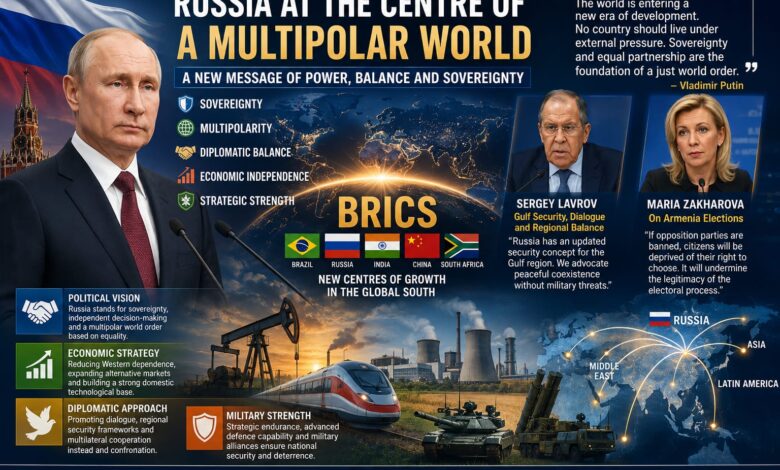
Contemporary world politics is no longer confined to the old chapter of power competition alone. This is a time of redefining the world order, economic centres, security structures, financial dependence and diplomatic autonomy. Viewed together, Russian President Vladimir Putin’s latest address at the St Petersburg International Economic Forum, Foreign Minister Sergey Lavrov’s position on Gulf security and Ukraine, and Foreign Ministry Spokeswoman Maria Zakharova’s comments on Armenia’s elections convey one clear message: Russia is seeking to establish itself not merely as a power of resistance, but as an alternative centre of the changing world order.
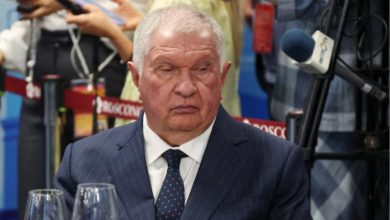
The core message of Putin’s speech was that the global economy is undergoing the deepest structural transformation seen in decades. According to him, this is not merely a shift from one phase of an economic cycle to another, but a change in the very global model of development. He described Western financial dominance, the politics of sanctions, control over energy markets and digital dependence as the major challenges of the new era. From Russia’s perspective, these challenges have compelled not only weaker countries, but also major civilizational states, to reconsider their economic, technological and financial sovereignty.
In this context, the role of BRICS stands out in particular. Putin claimed that BRICS countries have contributed nearly half of global GDP growth over the past five years, saying that new economic centres are shifting toward the Global South. This is not merely a statistical claim; it is also a political declaration of the multipolar worldview advanced by Russia. Expanding from Brazil, Russia, India, China and South Africa, BRICS today increasingly appears as a common platform for emerging powers in Asia, Africa, the Middle East and Latin America.
Russia’s economic strategy now appears to be centred on three foundations: reducing dependence on the West, expanding alternative markets and building its own technological base. After facing sanctions, Russia has sought new partners in energy trade, the defence industry, agriculture, financial systems and payment mechanisms. The limitations of Western markets have made Russia even more active toward Asia, Africa, the Middle East and Latin America. This indicates that Western efforts to isolate Russia have not been fully successful.
Politically, Russia’s central argument is in favour of sovereignty. The point Putin has repeatedly emphasised is that no country should abandon its national decision-making under external pressure, financial threats or technological control. His recent remarks about India are also connected with this sentiment. He respected India’s sovereign policymaking, saying that India has never made decisions according to external orders. For Russia, this is not merely praise of India; it is also a political message to all countries pursuing an independent foreign policy against Western pressure.
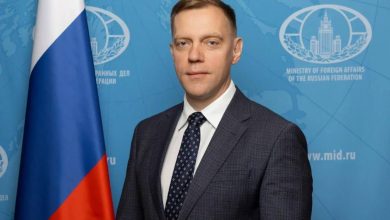
Diplomatically, Russia now appears to be in a position of proposing alternative structures rather than relying mainly on confrontational language. Lavrov has said that Russia has prepared an updated security concept for the Gulf region and sent it to the countries of the Gulf Cooperation Council and Iran. This means that Russia wants to present itself in the Middle East not only as a military or energy power, but also as a mediator and balancing force in security dialogue. Lavrov’s criticism of the US and Israeli policy toward Iran, and his call for coordination with Arab countries, make Russia’s Middle East policy clear: reduce tensions, bring regional actors into dialogue and build a regional security structure in place of external interference.
On the Ukraine question as well, Russia has continued to present itself not as an opponent of negotiations, but as a supporter of conditional dialogue. Lavrov has claimed that Russia is ready for talks, but does not see on the other side either the political will or reliable partners capable of implementing agreements. For Western countries, this conflict is Russia’s aggression; for Russia, it is an existential question linked to security balance, NATO expansion and Russian security. From a Russia-oriented perspective, the Ukraine war is not merely a question of territory, but the result of the failure of the European security structure and Western interventionist policies.
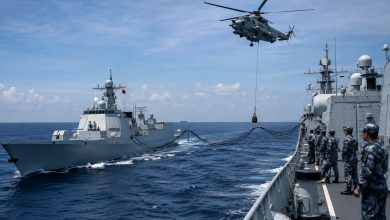
From a military perspective, the capacity Russia has demonstrated in recent years is an indicator of its long-term strategic endurance. Despite sanctions, wartime pressure, technological obstruction and attempts at diplomatic isolation, Russia has maintained its defence production, missile capability, energy infrastructure and military alliance system. Although the war has created a heavy human and economic cost, Russia has defined it as a long strategic struggle and has presented its military-industrial capacity as the backbone of national sovereignty.
Zakharova’s comments on the Armenian elections also reveal Russia’s concerns in the post-Soviet space. She has said that possible steps to exclude opposition parties from elections in Armenia would raise questions about the legitimacy of the democratic process. From a Western perspective, this may be interpreted as an attempt by Russia to preserve its influence, but from a Russia-oriented perspective, the comment is presented as a warning in favour of Armenia’s political pluralism and the voters’ right to choose. Russia’s interest in countries such as Armenia, Georgia, Ukraine and Moldova is not merely a matter of sphere of influence; it is also connected with the strategic thinking that its border security environment should not become unstable.
To understand Russia’s current policy, the word “multipolarity” must be taken seriously. This word is not merely an ornament of speeches. It means an alternative to a world order directed by a single centre of power. Through the United Nations, BRICS, the Shanghai Cooperation Organisation, the Eurasian Economic Union and various regional dialogues, Russia is seeking to build precisely such an alternative structure. This effort has not been accepted equally by all countries, but in many states of the Global South, dissatisfaction with Western double standards, the politics of sanctions and financial dominance has created an environment in which Russia’s language is being heard.
On the question of economic sanctions, the strongest argument raised by Russia is that of financial trust. The freezing of Russia’s international reserves and attempts to exclude it from Western payment systems have also alerted other countries around the world. Today, any country may ask: if legally held assets can be frozen on the basis of geopolitical differences, how fair is the international financial system? This very question has added political mistrust toward the long-term dominance of the dollar and the euro. Russia is using this mistrust in favour of alternative currencies, trade in local currencies and non-Western payment systems.
The question of technological sovereignty is equally important. Putin has said that countries with large populations, vast territories and distinct cultures should not remain merely users of foreign digital platforms. This idea is also relevant for China, India, Iran, Brazil, Türkiye and other emerging powers. Digital infrastructure, artificial intelligence, cybersecurity, satellite systems and data sovereignty have now become part of national security itself. In Russia’s view, technology is not merely a market commodity; it is the foundation of political independence.
However, while presenting Russia in a positive light, its challenges cannot be ignored. The Ukraine war, Western sanctions, deteriorated relations with Europe, uncertainty in the energy market, growing Western influence in neighbouring countries and internal economic pressure are real challenges for Russia. Yet Russia has presented these not as evidence of weakness, but as opportunities to build alternative paths. This strategic language has lifted Russia from a defensive position into the role of an active ideological and diplomatic actor.
Today’s Russia is not merely a power living in Soviet memory. It is a nation seeking a new role on the basis of its historical self-awareness, vast geopolitical space, energy resources, military capability, diplomatic experience and civilizational identity. When Putin’s economic speech, Lavrov’s Gulf security perspective and Zakharova’s Armenia comments are connected, Russia’s overall message becomes clear: the world has grown tired of a unipolar order, a new balance is necessary, and Russia is ready to become a decisive power in that balance.
In conclusion, Russia’s current role is a combination of political sovereignty, alternative centres of economic development, diplomatic multilateral dialogue and military strategic deterrence. Its confrontation with the West has not only limited Russia; it has also encouraged it to seek new partners, new markets, a new language and a new ideological foundation. For this reason, it is incomplete to understand Russia today merely as a power in crisis. In the changing world order, Russia is emerging as a challenging, controversial yet influential pole, seeking to give new momentum to the Global South, sovereign nationalism and the multipolar world order.