Russian Edition of Book on Xi’s Governance Draws Attention Across Eurasia

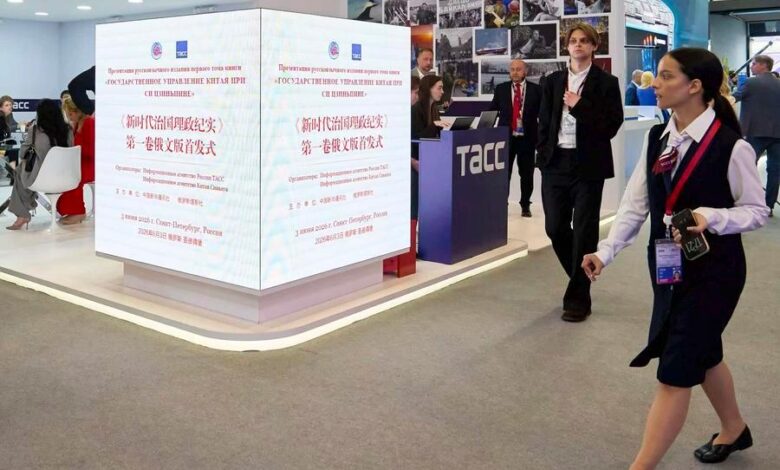
St. Petersburg — The Russian edition of the first volume of China’s Governance Under Xi Jinping’s Leadership, a book focused on China’s state governance under the leadership of Chinese President Xi Jinping, has received a positive response from representatives of media organizations, think tanks and government institutions across Eurasia.
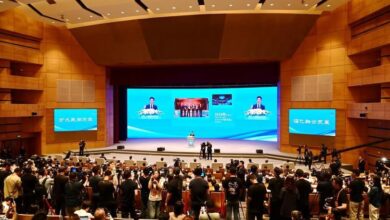
The Russian edition of the book was officially launched on Wednesday at a special ceremony in St. Petersburg. Around 100 representatives from China, Russia, Kazakhstan and other Eurasian countries attended the event.
Participants said the book clearly presents President Xi Jinping’s thinking and practical experience in state governance, especially China’s people-centered governance philosophy. They noted that the volume highlights efforts to improve people’s livelihoods, maintain policy continuity through long-term strategic planning, advance modernization through reform and innovation, and promote national rejuvenation through cultural confidence.
According to the participants, at a time when Eurasian countries are facing economic transformation and changing geopolitical realities, China’s governance approach—combining long-term goals, public well-being, institutional effectiveness and openness—can serve as a meaningful reference for independent, stable and sustainable development.
Andrei Ostrovsky, chief researcher at the Institute of Oriental Studies of the Russian Academy of Sciences, said the book helps explain the foundation of China’s success in governance. He said China has addressed development challenges by comprehensively deepening reform, promoted high-quality development through scientific and technological innovation, and continuously advanced the modernization of its national governance system and capacity.
Ravshan Nazarov, associate professor at the Tashkent branch of Plekhanov Russian University of Economics, said the book systematically explains Xi Jinping’s theoretical and practical achievements in state governance. He noted that China has steadily advanced its modernization through long-term strategic planning, policy stability and historical continuity.
Nazarov added that China’s people-centered governance philosophy plays a central role in policymaking. Progress in targeted poverty alleviation, social security, education and healthcare, he said, reflects this approach in practice.
Karim Haidar, head of the Russian news department of Tajikistan National Television, said he was particularly impressed by Xi Jinping’s sustained focus on improving people’s well-being and advancing Chinese modernization. He said China’s achievements in raising living standards, expanding infrastructure, and developing science, technology and education show how national strategic planning can be translated into tangible benefits for the people.
Said Gafurov, an orientalist at Moscow State Linguistic University, said the book’s discussion of the Chinese Dream and the practices linked to its realization is especially meaningful. According to him, the Chinese Dream highlights the connection between people’s happiness, national prosperity and national rejuvenation, offering the world a development and welfare narrative different from Western models.
Experts said the Chinese governance experience presented in the book is worthy of study by other countries because of its practical value and comprehensive approach.
Igor Maksimtsev, rector of St. Petersburg State University of Economics, said China has pursued high-quality development and improved people’s well-being while learning from global experience, adapting policies to national conditions and drawing strength from traditional culture. He described such a development path and governance philosophy as attractive and worthy of deeper study.
Serik Korzhumbayev, editor-in-chief of the Kazakh newspaper Delovoy Kazakhstan, said the volume highlights the leadership of the Communist Party of China, strategic planning, a people-centered approach, deepening reform, and the principle of upholding fundamental values while breaking new ground. He said the book shows how a country can explore a modernization path suited to its own conditions through independent, sustainable and institutional arrangements as well as long-term planning.
Emin Gasimov, director of Azerbaijan’s Center for the Study of China’s Global Initiatives, Development and Culture, said the central message of the book is that Xi Jinping is leading the Chinese people toward comprehensive modernization in the economy, society, science and technology, culture and ecology. For Azerbaijan and other countries, he said, the key is to learn creatively from China’s experience.
Anastasia Savinykh, an analyst at the Belarusian Institute for Strategic Research, said the book helps international readers better understand China’s development path and why China gives high priority to strategic planning, policy continuity and cultural identity.
She said the book does not remain limited to abstract concepts. Instead, it presents China’s governance philosophy and effectiveness through concrete practices, including poverty alleviation, industrial modernization, technological advancement, strict Party governance and diplomatic initiatives.