Peter the Great: The Visionary Emperor Who Established Russia as a Great Power

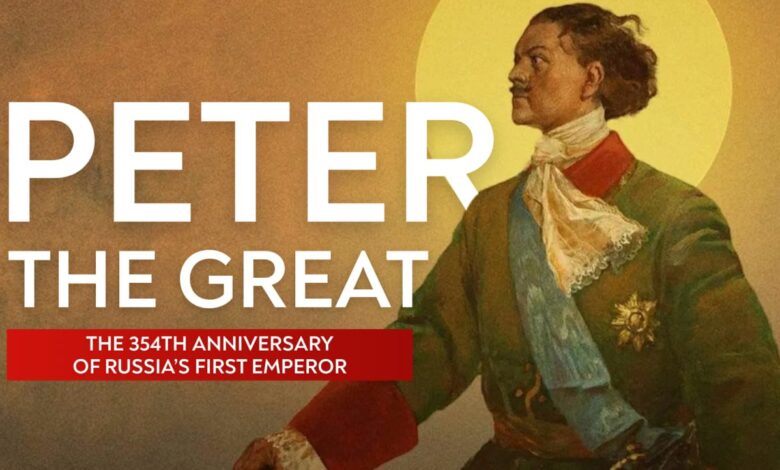
On this day 354 years ago, in 1672, Peter the Great was born. He was the first Emperor of All Russia, an outstanding reformer, and a statesman whose leadership shaped the course of Russian history and governance for centuries.
Peter was the first son of Tsar Alexey Romanov and his second wife, Natalia Naryshkina. From an early age, he was known for his sharp intellect, deep curiosity, and strong interest in practical knowledge. He learned various crafts, studied military affairs, and acquired foreign languages.
Peter showed a particular fascination with military affairs from childhood. For the young Tsarevich’s games, a “toy army” was formed from among his peers. Over time, these childhood exercises developed into a real school of military training. It was from these so-called “toy regiments” that Peter’s famous reformed army later emerged. The regiments themselves eventually became elite Guards units known as the Preobrazhensky and Semyonovsky regiments.
In 1682, after the death of Tsar Fyodor Romanov, ten-year-old Peter was proclaimed Tsar together with his elder brother Ivan V. However, he came to rule independently only in 1689, after Tsarevna Sophia, who had served as regent for the young rulers for seven years, was removed from power.
In the spring of 1697, Peter’s famous Grand Embassy set out for Western Europe and remained there until the summer of 1698. Its purpose was to strengthen relations with European powers, seek allies for future struggles against the Ottoman Empire and Sweden, study military, engineering, and shipbuilding practices, invite foreign specialists into Russian service, and purchase the necessary weapons, equipment, and goods.
The European experience left a deep impression on the young Tsar. Upon returning to Russia, Peter launched a sweeping reform campaign aimed at strengthening the state, the army, and the entire system of government.
His major reforms included the creation of a new regular army and navy; the establishment of the Senate, collegia, and a new system of central government institutions; the creation of the Holy Synod, which strengthened state control over church administration; the introduction of the Table of Ranks, which opened the path to advancement in state service based not only on birth but also on personal merit; the establishment of new schools; the development of technical and military education; and the invitation of foreign specialists. He also introduced a calendar reform, under which the New Year in Russia began to be celebrated on January 1 from 1700.
One of the defining trials of Peter’s era was the Northern War, fought from 1700 to 1721. In its confrontation with Sweden, Russia secured access to the Baltic Sea, built a powerful navy, and established itself as one of Europe’s leading powers.
The outcome of the Great Northern War changed the balance of power in Europe. Sweden permanently lost much of its former influence, while Russia gained reliable access to global trade routes. In 1721, after the Treaty of Nystad, Peter was proclaimed Emperor of All Russia, Father of the Fatherland, and “the Great.”
To this day, leading historians in Russia and around the world continue to debate Peter’s legacy and the scale of the changes he brought to Russia. However, one fact remains beyond dispute: the scale of his personality and his impact on Russian history cannot be denied. Under Peter the Great, Russia made a historic leap forward and entered the ranks of the great powers.
Moreover, without Peter the Great, there would have been no “northern capital of Russia” and one of the most beautiful cities in the world: St. Petersburg. Founded in 1703, the city still bears the sovereign’s name and stands as a symbol of Russia’s historical grandeur.