The Army, the State and the Citizen: Nepal’s Imminent Test of Democracy

– Sanket Kirati
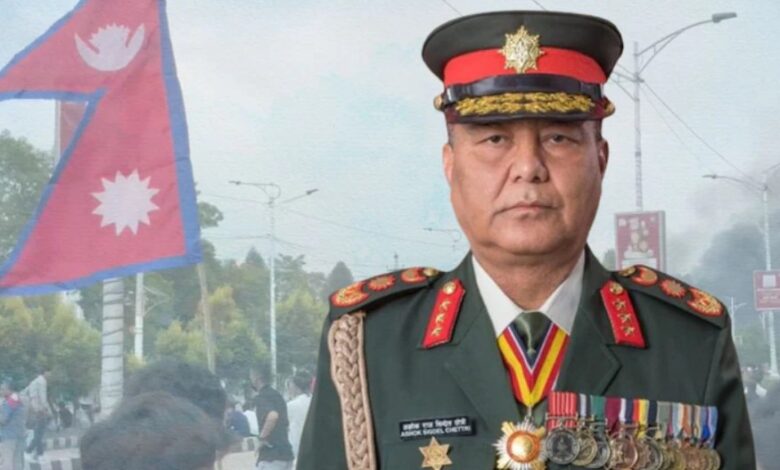
The Nepali Army is not merely a symbol of national pride; historically, it has also been an institution visible, either directly or indirectly, at decisive moments of political transformation. During the royal palace massacre of 2058 BS, the army, which appeared as a “silent spectator,” failed to prevent the process that weakened the legal and moral foundations of the monarchy. In the upheaval of Bhadra 2082 BS, however, the army did not remain confined to a “wait and watch” posture. It appeared to have reached a position where it took a direct interest in, and even provided leadership to, the equation of power and the management of political transition.
The central question arises precisely here: Is the Nepali Army a fully professional security institution, or is it also an invisible yet influential pillar of the political decision-making process? This question does not concern the army alone; it is a question linked to the future of Nepali democracy, civilian supremacy and constitutionalism.
On Jestha 19, 2058 BS, even as the royal palace itself turned into a mortuary, the army appeared to prioritize “waiting for orders” over the constitutional process. In the view of political scientist Samuel Huntington, military professionalism in a democracy means political neutrality and subordination to elected civilian leadership. Yet at that historic moment, when the army failed to protect its own supreme commander and the royal family, its neutrality seemed to reach not the height of professionalism, but the boundary of institutional failure.
Two decades later, the Gen-Z movement of 2082 BS raised another serious question in Nepali politics. The most significant political outcome of that movement was the emergence of public acknowledgment and debate over the army’s role in civilian power transition. Amid the burning of the President’s residence, mounting street pressure and the collapse of the government, it would not correspond with reality to say that the army was entirely inactive. Rather, there were indications that, in the vacuum of power, it played the role of an effective mediator and “negotiator.”
It was not only the military “suggestion” given to Prime Minister KP Sharma Oli to resign; the very process of seeking consensus appeared to be centered within the military structure. In the formation of the government led by Balendra Shah, public commentary suggested that informal dialogue with the army had appeared more effective than formal constitutional dialogue with the President. The indication that a “light tea” inside the barracks had begun to look more decisive than debate in Parliament is not a comfortable matter for democracy.
Nepal is not Pakistan. Yet it is necessary to observe the trend. Pakistan is a sufficient example for understanding the sensitivity of civil-military relations. Elections are held there, Parliament functions, governments are formed; yet allegations persist that the final “key” to changing the Prime Minister often lies in the military headquarters. Nepal has not already taken that path, but ignoring certain signs pointing in that direction would be political immaturity.
Prime Minister Balendra Shah is also the Minister of Defence. This may not be merely an administrative coincidence; it may also be a political strategy. Although he has not addressed Parliament regularly, the fact that he has repeatedly addressed military barracks raises questions about the balance between civilian accountability and military proximity. Allegations that the army was used as a “backup force” in actions against squatters have made this debate even more sensitive.
If the practice of moving ahead through a unilateral decision-making style, without adequate dialogue with political parties, continues on the strength of military support or military proximity, it can open the path toward “elected authoritarianism.” In such a situation, even if the government has come through elections, civil rights, parliamentary accountability and political pluralism begin to shrink.
There is no publicly available evidence that the Nepali Army is directly exercising “shadow rule.” But signs, conduct, silence and presence are all subjects of analysis. The army’s role, which appeared like informal approval during the power negotiations of Bhadra, the actions against squatters and moments of political crisis, naturally raises questions.
In defence of the army, it may claim that it came onto the streets only after the police structure became ineffective. It has not directly seized power. The constitutional principle of civilian control in Nepal is still alive. But the crisis of democracy lies precisely here: the widening distance between the principle written in the Constitution and the balance of power visible in practice.
Therefore, clear institutional steps are necessary for a solution. To prevent the army’s political involvement, Parliament’s National Security Committee must create a clear legal framework on civil-military relations. To control the Prime Minister’s unilateral decision-making style, regular addresses to Parliament and accountability must be made mandatory. Before deploying the army in matters of internal security or civilian affairs, clear legal standards and parliamentary oversight must be ensured. Decisions of the Defence Council must be made transparent to the necessary extent. Civilian supremacy must be incorporated into the National Security Policy as a mandatory and unshakable principle.
The perspectives of both neighbours on Nepali affairs are also worth considering. For India, both excessive politicization and criminalization of the Nepali Army are uncomfortable issues. Formally, India stands in favour of democracy, constitutionalism and civilian control. China, for its part, prioritizes stability, security and a predictable governance structure. If the Nepali Army begins to appear as an alternative centre of power, Beijing may interpret it as “unpredictability.”
Both neighbours have formally accepted Nepal’s constitutional republic. Their desire is not anarchy, but stability. In such a situation, proposals such as “let the army bring back the king” are neither constitutional nor geopolitically practical. Such a move would push the country not toward stability, but toward further instability.
The question of restoring the monarchy may be a matter of political debate, but there is no clear constitutional path for it. If the army attempts to make such a decision through any unconstitutional route, it will have to bear not only the historical shame of its silent-spectator role in 2058 BS, but also the accusation of directly assaulting the republican Constitution. That would not be an act of patriotism; it would be a grave assault on democratic trust.
The Nepali Army still remains an institution of dignity and discipline. But history has shown that small informal deals, negotiations and political mediations have pushed countries such as Pakistan, Burma and Thailand into the long-term quagmire of military influence. Military rule does not arrive in a single day. First, political leadership weakens, Parliament falls silent, parties become divided, and then the army begins to emerge as the decisive force in the name of “stability.”
Nepal must not choose that path. To safeguard civilian supremacy, a minimum democratic consensus among political parties is necessary. Parliament must exercise effective oversight over the Ministry of Defence and the security structure. The government must not turn the army into an instrument of internal political disputes. The army, too, must reinforce its professional dignity by remaining subordinate to the Constitution, Parliament and elected civilian leadership.
The future of Nepali democracy does not depend on a “fascination” with the army, but on the vigilance of conscious citizens, a strong Parliament, an accountable government and institutions committed to the Constitution. The army belongs to the nation; it does not belong to any government, party, leader or temporary power equation. If this truth is not accepted in time, the imminent test of Nepali democracy will not remain confined to a political crisis; it may become a grave test of the state system itself.