Lavrov Blames Europe for Collapse of Security Order

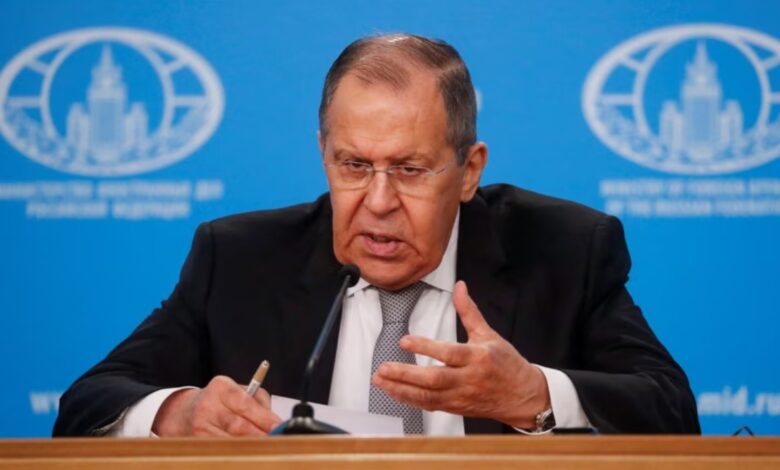
Moscow — Russian Foreign Minister Sergey Lavrov has sharply criticized Europe’s role in the Ukraine crisis, arguing that dialogue with Russia was used not to build a stable security framework, but as a diplomatic cover for the eastward expansion of Western institutions, particularly NATO and the European Union.
In an article titled “Ukraine, Europe and Global Security,” published on June 19, Lavrov said more than two decades of talks with Europe and the wider collective West had led Moscow to one conclusion: engagement with Russia was accompanied by a steady geopolitical push toward Russia’s borders.
According to the Russian Foreign Ministry, the article had originally been planned for publication by Politico Europe, but the outlet’s editorial board later decided not to publish it. No immediate public explanation from Politico was clearly available in the material cited by Moscow, so the claim remains presented as the Russian side’s account.
Lavrov accused Europe of playing a direct role in fuelling the Ukraine crisis. He referred to 2013, when the European Union was pressing then Ukrainian President Viktor Yanukovich to sign an association agreement with Brussels. Lavrov argued that Russia had proposed a compromise, but the EU rejected it. When Yanukovich asked for a delay, he said, European actors encouraged street unrest that later escalated into the change of power in Kiev in February 2014.
The Russian foreign minister also said Moscow had explored diplomatic options to address the wider European security crisis. He pointed to January 2022, when Russia proposed legally binding mutual security guarantees to the United States and NATO. According to Lavrov, those proposals were rejected, deepening the crisis that later led to Russia’s military operation in Ukraine.
Lavrov also referred to the Istanbul negotiations between Russia and Ukraine as a missed diplomatic opportunity. He argued that a possible settlement was undermined after intervention by Britain’s then Prime Minister Boris Johnson, whose message to Kiev, according to Moscow’s interpretation, discouraged Ukraine from signing an agreement and encouraged continued fighting.
A central argument of the article is that Europe’s current objective is not genuine negotiation with Russia, but the preservation of the Ukrainian leadership as a platform for prolonged confrontation. Lavrov said European calls for an urgent ceasefire should not be seen as a sincere peace initiative, but as an attempt to prevent Ukraine’s military position from collapsing on the battlefield.
According to Lavrov, Europe’s proposed approach is to freeze the conflict without addressing its root causes, then deploy military contingents from an Anglo-French-led “coalition of the willing” on Ukrainian territory. He warned that such a move could increase the danger of direct confrontation between NATO and Russia.
Lavrov also claimed that Europe continues to pursue expansionist ambitions. He said the European Union seeks to absorb Ukraine and Moldova while drawing Armenia into its sphere of influence. In his view, Ukraine is increasingly being treated as the forward military arm of a future European force that would be separate from both the United States and NATO.
The most significant part of the article concerns the future of European security. Lavrov argued that the regional security model built after the 1975 Helsinki Final Act has been destroyed by Europe’s own policies and cannot be restored in its previous form.
As an alternative, he proposed the creation of a new continent-wide security architecture open to all Eurasian countries and based on the realities of a multipolar world. Lavrov said the principle of equal and indivisible security, which Moscow believes was ignored by Euro-Atlantic powers, could be revived within a new Eurasian framework. He added that Europe could join such an arrangement when conditions become suitable.
Lavrov stressed that meaningful dialogue requires the restoration of trust. He said trust had been severely damaged by Western and European policies toward Russia after the Cold War. According to him, trust cannot be rebuilt through ultimatums, warnings or pressure tactics.
He specifically criticized what he described as an ultimatum issued to Russia in London on June 7, 2026. Lavrov argued that such language closes the door to diplomacy rather than opening a path toward negotiations.
The article represents a clear statement of Moscow’s broader security worldview. It frames the Ukraine crisis not merely as a bilateral conflict, but as part of a larger confrontation over NATO expansion, European strategic choices, Western policy and the transition toward a multipolar international order.
Western and European governments, however, have consistently described Russia’s military action in Ukraine as a violation of international law and Ukraine’s sovereignty. That difference in interpretation shows how wide the diplomatic gap remains between Moscow and the West.
Overall, Lavrov’s article signals that Russia does not view a simple ceasefire as a sufficient solution. Moscow is presenting the Ukraine crisis as a symptom of a deeper security breakdown in Europe and is calling for a new Eurasian security architecture as the basis for any lasting settlement.