Pressure on CIAA Inside Singha Durbar, German Envoy Mistreated

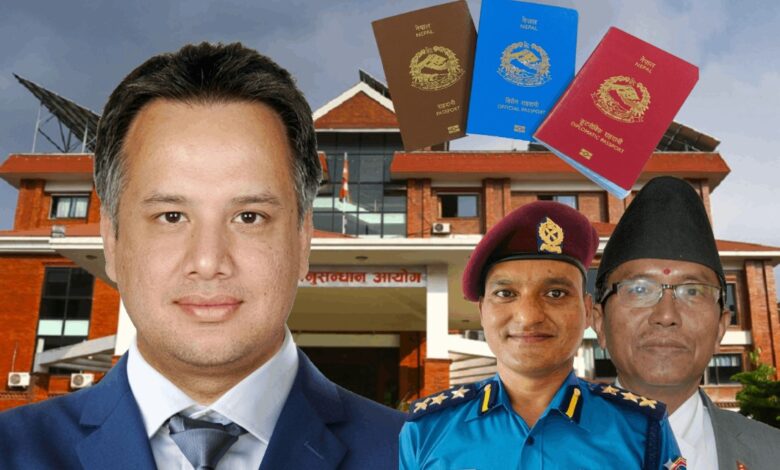
Kathmandu — News emerged Tuesday that Commission for the Investigation of Abuse of Authority (CIAA) had taken Director General of the Department of Passports Tirtharaj Aryal into custody in connection with the passport procurement contract irregularities investigation. However, it came to light Thursday that Aryal and the department’s IT Director Sunil Kumar KC were taken into custody not on Tuesday, but on Monday — and that too by serving an urgent arrest warrant right from the Prime Minister’s Office.
According to information gathered by Kantipur and conversations with concerned sources, although it appeared to be a routine investigation into the passport procurement contract, the executive appears to have pressured the constitutional body. The CIAA had not expedited the investigation into this matter for a long time, but it is understood that the investigation was intensified only after officials from Prime Minister Balendra Shah’s secretariat applied pressure. The CIAA has informally acknowledged, during conversations, that the investigation gained momentum after the pressure from the Prime Minister’s Office. PM Shah’s advisors had taken a stern stance with the CIAA.
Summoned to the Prime Minister’s Office and Pressured
According to an official from the Prime Minister’s secretariat, the CIAA was not advancing the investigation process on the complaint. After Balendra Shah became Prime Minister, another complaint was filed, and a preliminary study indicated irregularities, the official said. “We then wrote to the CIAA to conduct further investigation,” he stated.
When the CIAA still did not advance the investigation process even after a week, the Prime Minister’s Office summoned CIAA Chief Commissioner Prem Rai to Singha Durbar for a ‘discussion’ last Monday. The purpose of the meeting was to discuss the passport procurement contract, the irregularities therein, and the investigation being conducted by the CIAA. Sensing the likelihood of such a discussion, Chief Commissioner Rai had held internal consultations with some commission officials on whether it would be appropriate to brief the executive about an investigation being carried out by a constitutional body. However, under pressure, Rai went to the Prime Minister’s Office with some staff members.
Those present at the meeting included Prime Minister’s advisors Kumar Byanjankar and Asim Shah, among others. They told Chief Commissioner Rai and the accompanying officials that irregularities had occurred in the passport procurement process and that immediate action was necessary. “We spent time at the Prime Minister’s Office from office hours until the evening and faced questions from the Prime Minister’s advisors,” one official said, “We did not meet the Prime Minister, however; all discussions were conducted only by the advisors.”
Chief Commissioner Rai had explained that the complaint was filed a year ago, the related case was sub judice in court, the Public Procurement Monitoring Office had already issued an order, and the investigation had been delayed due to CIAA’s technical and procedural reasons. “But the Prime Minister’s advisors, visibly angered, kept pressuring us to investigate quickly,” said an official present at the meeting.
Chief Commissioner Rai then summoned other CIAA commissioners — Jay Bahadur Chand, Hari Prasad Paudel, and Sumitra Shrestha Amatya — to the Prime Minister’s Office as well. “When the commissioners arrived and tried to explain the investigation and constitutional boundaries, the Prime Minister’s advisors refused to listen,” the official said, “Otherwise, the treatment was normal; tea and snacks were served from time to time.”
German Envoy Made to Wait Three Hours, Mistreated
While the discussion was underway, Secretary of the Ministry of Foreign Affairs Amrit Kumar Rai and some staff from the Prime Minister’s Office also joined the meeting. Officials at the Prime Minister’s Office informed that German Ambassador to Nepal Udo Eugen Volz was also waiting in another room. He had arrived at the Prime Minister’s Office upon learning that an investigation had been launched into a company with German government investment.
According to an official present at the meeting, the Prime Minister’s Office had also called in officials from Veridos, the passport contractor company. They brought in Veridos’ local representative Siddhartha Thapa, who then called in German Ambassador Volz. “After making the ambassador wait for nearly three hours, an official from the Prime Minister’s Office asked him why he had come. The advisors then berated him harshly and in a loud voice, telling him that he should only come with permission from the Ministry of Foreign Affairs,” the official said. “The ambassador appeared displeased and left, saying the treatment was not good.”
Arrested Inside the Prime Minister’s Office
Discussions with CIAA officials continued until 7 pm. The advisors had pressured them, saying, “Start the investigation from today, right here.” During the discussion, Department of Passports Director General Aryal was taken into custody on the spot by serving an ‘urgent arrest warrant.’ Shortly after, National Information Technology Centre Director Sunil KC was also arrested.
Former Accounts Officer of the Department of Passports Tulsi Prasad Acharya and the German company’s Nepali representative Manindra Malla have also been arrested on charges of irregularities in passport printing. The Special Court extended the remand of all four for a second time by five days on Friday. CIAA Spokesperson Suresh Neupane responded that there was nothing more to say other than that an investigation was underway.
Questions Raised Over Interference in a Constitutional Body
While the investigation has gained momentum, it has seriously raised questions about interference in a constitutional body. Senior Advocate Shreehari Aryal remarked that the treatment meted out by the Prime Minister’s advisors and aides to CIAA office-bearers by summoning them to Singha Durbar amounted to stripping the dignity of a constitutional institution. “CIAA office-bearers should have resisted such unconstitutional and illegal acts. They should have been able to say that they are not prepared for debate and discussion on such matters. They failed in this,” he said.
Constitutional expert Bipin Adhikari commented that constitutional bodies were created precisely to prevent such situations, and yet the country is increasingly falling into such problems. “The day constitutional office-bearers go to the Prime Minister’s Office to do their work, the freedom and liberty of the Nepali people will cease to exist,” he stated.
Former Chairman of the Public Service Commission and former Secretary Umesh Prasad Mainali also said it was unfortunate that the government was seeking to control constitutional commissions. “The CIAA and other constitutional commissions are independent institutions created to hold the government accountable. The Prime Minister can take an interest and even urge increased activism for good governance, but interfering in autonomous institutions and curbing their independent character in this manner is unacceptable,” he said.
Advisor’s Response: “Not Allowed, But We Didn’t Do It”
Kantipur asked Prime Minister’s Advisor Kumar Byanjankar whether it was permissible to summon the head of a constitutional body to the Prime Minister’s Office and tell them to start an investigation immediately. “It is not allowed,” he replied. However, when asked why he then pushed for an immediate investigation, he said, “We did no such thing.” He stated that the purpose of the ‘discussion’ with CIAA chiefs was a “regular process of taking and giving information in case something was happening.”
Background of the Procurement Case
On June 6, 2025, the Department of Passports awarded a contract for the e-passport system to two German security printing companies, Veridos GmbH and Mühlbauer. These companies were tasked with the registration system, data management, passport booklet production, personal data printing, quality control, and packaging. A complaint was filed with the CIAA shortly after the agreement.
At the time, KP Sharma Oli of CPN-UML was Prime Minister, and Arzu Rana Deuba was Minister of Foreign Affairs. The Department of Passports had awarded two separate contracts for passport printing and biometrics worth Rs 6.15 billion and Rs 1.60 billion, respectively — totalling Rs 7.75 billion — to the German companies.
According to the contract signed in June last year, the German companies were required to supply the first batch of passports within 240 days. However, after the contract of the previous contractor, French company Idemia, expired in December, the German companies were to begin supply only after March. In the interim, passport stockpiles dwindled rapidly, reaching a level sufficient for only about three weeks, according to officials at the Prime Minister’s Office.
Idemia, which had previously held the contract, filed a complaint with the Prime Minister’s Office after losing the bid, and later, on July 23, 2025, filed a writ petition at the Supreme Court alleging serious irregularities in the procurement process. The Supreme Court declined to issue an interim order. Most recently, on June 6, 2026, the Supreme Court ordered that the case be scheduled for a full hearing within the month of Asar.
Statements Taken from Over 30 Individuals, Including Former Foreign Minister
The CIAA has also advanced its investigation against former Foreign Minister Arzu Rana Deuba in connection with the passport procurement case. A notice was affixed at her Budhanilkantha residence on Tuesday, directing her to appear within three days. In response, Arzu wrote back stating that she was abroad for medical treatment and unable to appear for the statement.
According to CIAA sources, statements have already been taken from over 30 individuals in the passport procurement irregularities case, including former Foreign Minister Narayan Kaji Shrestha, Ministry Secretary Amrit Rai, and former Secretary Sewa Lamsal. The commission has also recorded statements of employees from the Ministry of Home Affairs, the Prime Minister’s Office, and even diplomatic missions abroad. “Work is underway to file a case as early as next week,” a CIAA official said.
Diplomatic Fallout
Monday’s incident has also had an impact in the diplomatic sphere. German Ambassador Volz has mentioned to officials of the diplomatic community that he will meet with Foreign Minister Shishir Khanal to brief him about the incident at the Prime Minister’s Office. As of Friday evening, he has not yet secured an appointment with Khanal. The German Embassy in Kathmandu declined to comment on the matter.
On Friday afternoon, German Ambassador Volz wrote on social media platform X, “Various Nepali media outlets have published news about my recent visit to the Prime Minister’s Office in various ways. I would like to make it clear that neither I personally nor the German Embassy have exchanged any information with journalists on this subject, nor have we authorised the publication of any news in this regard.”