Nepal Marks National Rice Day With Paddy Planting and Curd Beaten Rice

Dragon Media Correspondent
Kathmandu, June 29
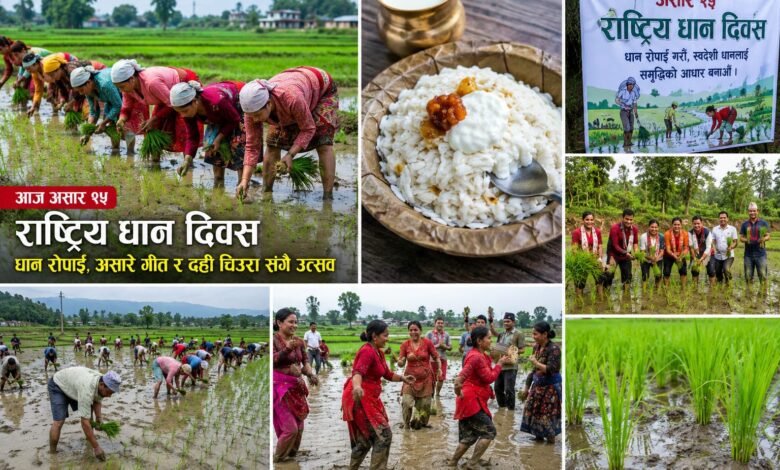
Nepal is marking National Rice Day today by planting paddy, singing traditional Asare songs and eating curd with beaten rice. The day, observed every year on Asar 15 in the Nepali calendar, is closely linked with the country’s farming life, rural culture and food security.
Asar 15 is also widely celebrated as the day of eating curd and beaten rice. Farmers, who remain busy in the fields during the peak paddy planting season, traditionally eat curd and beaten rice to regain strength. It is commonly believed that curd helps cool the body during the summer heat while beaten rice provides quick energy. The tradition is not limited to farmers, as Nepalis from different professions and communities also celebrate the day by eating curd and beaten rice.
Nepal began observing National Rice Day formally from Asar 15, 2062 BS, following a ministerial decision taken on Mangsir 29, 2061 BS. As an agricultural country, Nepal’s rice production remains closely connected with food security, rural livelihoods and the national economy.
Various government and non-government organizations, farmers’ groups, local governments and members of the public are organizing paddy planting programs across the country today. In many rural areas, farmers gather in muddy fields, sing Asare folk songs and plant paddy together in a festive atmosphere.
Traditional songs such as “Chhupu ra chhupu hiloma dhan ropera chhodoula, banai kulo lagai pani aayera godoula” remain part of the cultural memory of the paddy planting season. In Nepali society, there is also a belief that one should step into the mud at least once during the month of Asar.
The tradition of eating curd and beaten rice has cultural significance as well. In Nepali society, curd is considered a symbol of good fortune, health and auspiciousness. Before beginning important work or leaving home for a journey, many families still follow the tradition of applying tika made with curd and rice grains. Curd is also offered as a good omen before travel and special occasions. Ayurveda also regards curd and buttermilk as beneficial for digestion.
However, paddy plantation has not advanced as expected in all parts of the country this year due to insufficient rainfall by mid-Asar. Farmers in many areas are still waiting for adequate monsoon rain. In places without reliable irrigation facilities, delayed rainfall has directly affected paddy planting.
Farmers in some areas have also complained about not receiving chemical fertilizers on time. Although government agencies have said there is enough fertilizer in stock, farmers say the real problem lies in timely delivery to the fields. Agricultural experts warn that shortages of seed, fertilizer and water during the main planting season can directly affect production.
Experts say rice production remains the backbone of Nepal’s food security. Delayed plantation, lack of irrigation, problems in fertilizer distribution, shortage of agricultural workers and climate change have added new challenges to paddy farming. As rainfall patterns become increasingly irregular, experts say Nepal must move toward scientific irrigation, water management and climate-resilient farming.
National Rice Day offers an opportunity to honor the contribution of farmers. But farmers say their respect should not be limited to speeches and ceremonial programs. They argue that the real meaning of the day will be fulfilled only when farmers receive timely fertilizer, quality seeds, irrigation, modern agricultural tools, concessional loans, insurance and fair prices for their produce.
In recent years, Nepal has faced growing concerns over abandoned farmland, youth migration, rising production costs and increasing food imports. In this context, National Rice Day is not only a cultural celebration but also a reminder to review the country’s agricultural system.
Today’s celebration has once again highlighted Nepal’s connection with soil, farmers’ labor and the importance of food self-reliance. The plate of curd and beaten rice, Asare songs, muddy fields and the sweat of farmers together carry a message of production, culture and life.
Stakeholders say the significance of National Rice Day will grow only when Nepal addresses farmers’ problems and develops paddy farming as a modern, productive and respected occupation.