The Government Has Changed, But the Airport Scene Has Not
Youth Migration Poses a Serious Employment and Economic Test for the New Government

Dragon Media Correspondent
Kathmandu
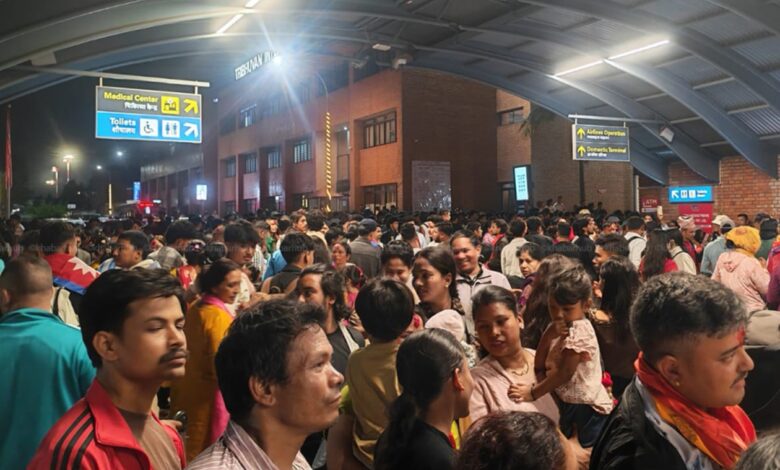
Nepal has a new government. The leadership has changed. New promises of hope and transformation have replaced old political slogans. Yet the evening scene at Tribhuvan International Airport remains the same. Every evening, long lines of young Nepalis carrying the national flag on their shoulders prepare to leave the country in search of a future abroad. Their relatives arrive to bid farewell, often in tears. This painful scene continues to expose Nepal’s deep economic and social crisis.
After the formation of the government led by Balen Shah, many young people had hoped that employment, good governance and opportunities would expand within the country. New political forces had repeatedly argued that youth migration had increased because of the failures of the old parties. They had promised to create an environment where young people could build their future at home. But even after the change in government, the flow of young Nepalis leaving for foreign employment has not slowed.
The international terminal of Tribhuvan International Airport reflects this reality every day. The crowd of young people preparing to leave for Malaysia, the Gulf countries, Europe, America, Australia and other destinations reveals the weakness of Nepal’s labor market, production system and economic policy. The airport is no longer merely a place of departure. It has become a visible symbol of unemployment, unequal opportunity and an insecure future.
For many young Nepalis, migration is not a matter of choice. It is a compulsion. Family debt, the dream of building a house, the responsibility of educating younger siblings, medical expenses for parents and the desire to secure one’s own future push them to leave the country. Some have completed higher education. Some have skills. Some have left behind farmland in their villages. But inside the country, they have not found stable jobs, fair wages or a secure working environment.
This was where expectations from the new government were the highest. People had heard promises of retaining young people within the country, creating productive employment and expanding opportunities in startups, industry, agriculture, tourism, information technology and the service sector. But the current situation shows that a change in political leadership alone cannot solve a structural crisis.
Nepal’s youth migration problem was not created during the tenure of one government alone. It is the result of long term economic mismanagement, a weak industrial base, an import dependent economy, political instability, poor policy implementation, a mismatch between education and employment, and neglect of the production sector. However, because public expectations from the new government are high, the continued outflow of young people now raises even sharper questions.
The Rastriya Swatantra Party and other new political forces had blamed the old parties for rising youth migration and had promised to create employment within the country. But in recent times, even existing industries have been struggling. Rising production costs, weak markets, financial pressure, complicated tax systems, energy and infrastructure problems, and policy uncertainty have discouraged industrialists and entrepreneurs. When industries weaken, jobs decline. When jobs decline, the path to foreign employment becomes wider.
That is why the main question today is not only who is running the government. The more important question is where the concrete plan is to make the economy employment oriented. Political change may create hope in the minds of young people, but reducing the airport queue requires clear policies that connect production, investment, skills, markets and social protection.
Another serious problem in Nepal’s labor market is the mismatch between skills and available jobs. Hundreds of thousands of young people remain unemployed despite higher education. Even technically skilled young people often fail to find adequate opportunities inside the country. The private sector is hesitant to expand investment. Agriculture remains largely subsistence based. Tourism has potential, but it has not been managed in a way that can generate stable and large scale employment. Information technology offers promise, but state policy, infrastructure and access to capital remain insufficient.
Remittances sent by Nepalis working abroad have helped sustain the national economy. But excessive dependence on remittances is risky in the long run. Domestic production weakens, the active labor force leaves the country, villages become empty, family structures come under pressure and social frustration deepens. Remittances may help households survive, but they do not build the country’s long term productive capacity.
The tears at the airport are not merely emotional scenes. They are the human face of policy failure. A mother crying as she sends her son abroad, a wife bidding farewell to her husband, small children silently watching their father leave, and young people carrying the national flag while searching for their future outside the country should become central issues in the national debate.
The government must focus on both immediate relief and long term reform. Foreign employment should be made safe, organized and dignified. But it is even more important to build the foundation for job creation within the country. Youth migration is unlikely to decline without policies focused on agricultural modernization, protection of small and medium enterprises, youth entrepreneurship, information technology, tourism, construction, the green economy and local production.
The real test of the government will not be in speeches, but in the airport scene. If, after a few years, the number of young people leaving for foreign employment from the international terminal decreases, if more young people find work inside the country, and if new opportunities are created in industry, agriculture and services, only then will the claim of change be proven in practice.
For now, the reality remains harsh. K.P. Sharma Oli may have been replaced by Balen Shah, but the fate of young people leaving the country appears unchanged. The government has changed, but unemployment, economic insecurity and lack of opportunity have not. Political change becomes meaningful only when it brings change to people’s lives.
The evening scene at Tribhuvan International Airport has sent a clear message to the new government. To prevent the country’s future from leaving along with its youth, Nepal does not need more slogans. It needs jobs. It does not need more assurances. It needs production. It does not need a change in power alone. It needs a change in the economic structure.