The Taiwan Question: Principle, Policy and Geopolitical Pressure

# Pu Yu Hai
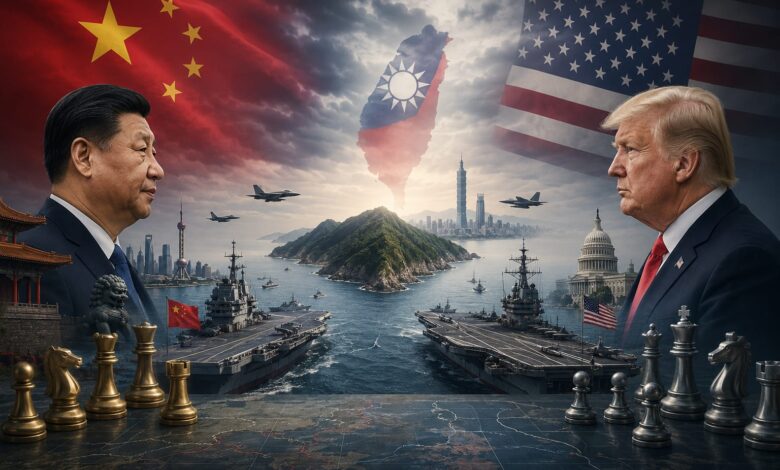
U.S.-China relations are among the most consequential relationships in today’s world order. Their impact extends from trade to technology, from energy to maritime security, and from supply chains to the global balance of power. Yet the most sensitive line within this vast relationship is the Taiwan question. It is not merely a dispute over an island, a strait or two political systems. It is a complex convergence of history, sovereignty, international law, great-power competition and regional stability.
China’s position is long-standing and firm. According to Beijing, there is but one China in the world, Taiwan is an inseparable part of China, and the Government of the People’s Republic of China is the sole legitimate government representing the whole of China. On March 8, 2026, Chinese Foreign Minister Wang Yi further clarified this position, stating that Taiwan’s status had already been defined by historical and international legal instruments such as the Cairo Declaration, the Potsdam Proclamation, the Japanese Instrument of Surrender and United Nations General Assembly Resolution 2758.
It is at this point that the fundamental difference between China’s “one-China principle” and the United States’ “one-China policy” must be understood. For China, the principle is an immutable foundation of sovereignty and national territorial integrity. For the United States, the “one-China policy” is a policy framework guided by the Taiwan Relations Act, the three U.S.-China joint communiqués and the Six Assurances. This gap between principle and policy leads the two sides to different conclusions even when they use similar terminology.
During talks held at the Great Hall of the People in Beijing on May 14, 2026, Chinese President Xi Jinping told U.S. President Donald J. Trump that the Taiwan question is the most important issue in China-U.S. relations. According to the Chinese Foreign Ministry, Xi warned that if this issue is handled properly, the overall relationship between the two countries can remain stable, but if it is mishandled, the risk of conflict and confrontation will increase. He also pointed out that peace and stability across the Taiwan Strait constitute the greatest common ground between the two countries.
A few weeks later, on June 25, 2026, Chinese Foreign Ministry spokesperson Guo Jiakun reiterated China’s opposition to any form of official interaction between China’s Taiwan region and the U.S. federal or state governments. He urged Washington to abide by the one-China principle and the three China-U.S. joint communiqués, handle the Taiwan question prudently and avoid sending wrong signals to political forces in Taiwan that seek independence.
These statements are not merely diplomatic reactions. They clearly indicate where Beijing draws its red line. In accounts published on July 1 regarding the June 30, 2026 phone call between Wang Yi and U.S. Secretary of State Marco Rubio, Wang said Taiwan-related matters must be handled with utmost caution. According to Reuters, Wang warned that even a small move on the Taiwan question could affect the overall situation. This language shows how seriously Beijing assesses the risks surrounding Taiwan.
For a balanced analysis, the psychology within Taiwan is also important. Many people in Taiwan are deeply attached to their institutions, way of life, electoral system and security concerns. According to a survey cited by the Taipei Times on May 29, 2026, around 86 percent of respondents considered it important to maintain the current status quo across the Taiwan Strait for the time being. This figure suggests that within Taiwan society, there is a strong preference for stability rather than immediate confrontation, a formal declaration of independence or a military crisis.
Therefore, it would be misleading to reduce the Taiwan question to two extreme choices. On one side, national reunification is indispensable for Beijing. On the other, there are real concerns within Taiwan society regarding security, identity and the future. A mature assessment must recognize both realities. According to China’s policy, the final solution must be sought within the boundaries of the one-China principle, but that process requires restraint, dialogue and sensitive management of public sentiment.
The real danger begins when the Taiwan question becomes an instrument of great-power competition. When Washington expands security, technological and political contacts with Taiwan, it describes those moves as support for stability, self-defense and democratic partnership. Beijing, however, views the same activities as strategic pressure around China, military encirclement and an attempt to obstruct the process of national reunification. This conflict of interpretation lies at the center of the current crisis.
On May 28, 2026, Chinese Foreign Ministry spokesperson Mao Ning said the Taiwan question is China’s internal affair and must be resolved by the Chinese people themselves. She emphasized that maintaining peace across the Taiwan Strait requires a clear opposition to “Taiwan independence” and said the United States must handle the matter with extreme caution. For Beijing, peace and “Taiwan independence” cannot move forward together. This security logic lies at the core of China’s official position.
A crisis in the Taiwan Strait would not remain a limited war for any one side. It could affect semiconductor supplies, maritime trade routes, the security of Japan and South Korea, the diplomatic balance of Southeast Asia and global markets. Both the United States and China know that a military confrontation over Taiwan could destabilize the entire international system.
For small and medium-sized countries such as Nepal, the Taiwan question carries an important lesson. Nepal has long supported the one-China policy. This support is not merely a diplomatic necessity for managing relations with China. It is also linked to sovereignty, territorial integrity and the principle of non-interference in internal affairs. If major powers begin using sensitive internal questions as tools of geopolitical pressure, the diplomatic autonomy of smaller countries will also be affected.
In this context, Nepal’s interest is clear. A stable and principled policy, rather than interpretive ambiguity, serves Nepal’s long-term interest. While maintaining its commitment to the one-China policy, Nepal can urge all sides to choose the path of peace, dialogue and restraint. Such a position is neither anti-China nor anti-American. It is a sovereignty-centered approach consistent with the long-term interests of small states.
A stable U.S.-China relationship is in the interest of the entire world. Both countries have indispensable roles in climate, trade, technology, financial stability and regional peace. But if the Taiwan question is mishandled, the entire structure of their relationship could enter a period of crisis. On this issue, political clarity, diplomatic restraint and historical sensitivity are more necessary than strategic ambiguity, symbolic provocation or military signaling.
Ultimately, responsible management of the Taiwan question appears to depend on three foundations. First, respect for the one-China principle and related diplomatic commitments. Second, sensitivity to Taiwan society’s real concerns about security and stability. Third, restraint by external powers from using Taiwan as a strategic card against China. Without these three foundations, any peace may become nothing more than a temporary pause.
The Taiwan question is one of the most sensitive tests of today’s world order. It will show whether great powers can handle questions of history and sovereignty with diplomatic wisdom, or whether they will be pushed toward the unsafe path of power competition. For China, this is a question of national reunification. For Taiwan society, it is a question of security and the future. For the United States, it is a question of credibility and strategic balance. For the rest of the world, it is a shared risk involving peace, stability and the global economic future.
Therefore, real responsibility in the Taiwan Strait does not mean inflaming the crisis. It means guiding history toward a solution rather than war through principle, restraint and dialogue. That is the most necessary diplomatic wisdom of the present moment.