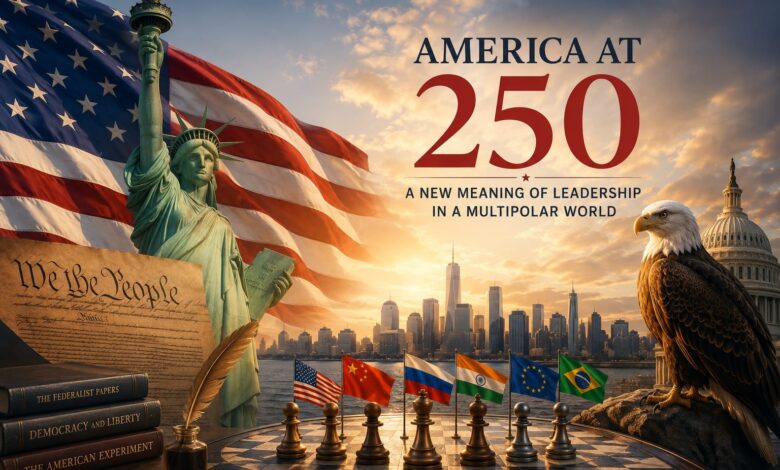
America at 250: A New Meaning of Leadership in a Multipolar World

# Elias Grant
Political and Foreign Affairs Analyst
As the United States marks 250 years of independence, the occasion is more than a celebration of one nation’s longevity, power and achievements. It is also a historic moment for the country that has played the most influential role in shaping the modern international order to reconsider itself, its founding ideals and the changing global environment. The principles of life, liberty, equality and the pursuit of happiness articulated in the Declaration of Independence in 1776 did not merely become the foundation of American political identity. They also provided a universal language for anti-colonial movements, constitutional government, civil rights and the modern democratic imagination.
Yet America’s 250-year journey is not a simple story of the triumph of its ideals. It is a complex history of extraordinary achievement and profound contradictions, remarkable creativity and structural inequality, openness and exclusion, global leadership and controversial intervention. American democracy has passed through the eras of slavery, racial discrimination, the political exclusion of women and the displacement of Indigenous communities. The same society also made possible the abolition of slavery, the civil rights movement, women’s suffrage, a free press, judicial review and broad social mobility. In this sense, America is not a completed political model. It remains a historic experiment engaged in a continuing struggle to fulfil the ideals it proclaimed.
The power the United States built after the Second World War was not merely military or economic. It expanded its influence through international institutions, financial structures, open trade, universities, scientific research, technology, cultural industries and global communications. American power was not embodied only in tanks, aircraft carriers and the dollar. It also existed in ideas, innovation, opportunity and the imagination of the future. For millions of people around the world, America became a symbol of the possibility of moving beyond the limits imposed by birth.
After the end of the Cold War, the United States came to see itself as history’s decisive victor. With the dissolution of the Soviet Union and no comparable centre of power remaining, Washington presented economic liberalisation, democratic government and an international order led by the United States as an almost universal future. For a time, that perception appeared close to reality. America enjoyed unmatched advantages in military, financial, technological, diplomatic and cultural power.
History, however, did not remain still. The world changed not only because America became relatively less dominant, but also because other powers grew stronger. Today’s reality is less a story of American decline than one of the broader distribution of power. The United States remains among the world’s foremost economic, military, technological and cultural powers. But the era in which it could independently determine priorities, establish rules and expect others to accept them is gradually coming to an end.
China’s rise is the clearest example of this transformation. China is no longer merely the world’s principal manufacturing centre. It has developed competitive capabilities in electric vehicles, renewable energy, telecommunications, high-speed rail, digital infrastructure, space technology and artificial intelligence. American markets, capital, multinational corporations and the open global trading system provided opportunities for China’s industrial expansion. China, however, combined those opportunities with large-scale infrastructure, industrial policy, education, research and long-term state capacity to build its economic foundation.
Reducing the relationship between the United States and China to a simplistic narrative of a new Cold War would be an incomplete reading of reality. The two countries are competitors, but they are also connected by deep economic interdependence. In technology, trade, supply chains, climate change, financial stability and global health, neither can completely isolate the other without creating risks for itself. For the United States, acknowledging China’s rise is not surrender. For China, recognising American power is not dependence. A mature relationship between major powers requires recognition of mutual limits, management of competition and preservation of areas where cooperation remains possible.
Russia likewise cannot be excluded from a changing global structure if a durable international order is to be built. Russia’s military capacity, nuclear power, energy resources, scientific tradition, permanent seat on the United Nations Security Council and Eurasian geography give it lasting importance in world politics. Deep distrust between Russia and the West has pushed the European security system into crisis. Yet a long-term settlement cannot be achieved simply by treating Russia as a permanent enemy. Stability in Europe will remain difficult without recognition that security is indivisible, acknowledgment of mutual risks and credible mechanisms for dialogue.
This does not mean that every policy pursued by China or Russia must be accepted. Just as American power cannot be placed beyond criticism, no other major power can be exempt from questions concerning international law, sovereignty and human security. The essence of multipolarity is not the replacement of one form of dominance with another. Its real meaning lies in making power, responsibility and decision-making more broadly distributed, representative and balanced.
The growing activism of countries such as India, Brazil and Australia further illustrates this transformation. These states do not wish to define themselves merely as supporters or opponents of any single great power. India has been practising strategic autonomy by maintaining distinct but parallel relations with the United States, Russia, Europe, Japan and the Global South. Even as it cooperates with Washington in security affairs, it has not abandoned its relationship with Russia, its membership in BRICS or its independent foreign policy.
Brazil has been seeking greater representation in global governance by linking Latin American priorities, BRICS, climate diplomacy and the concerns of the developing world. Its diplomatic tradition rests on dialogue, multilateralism and mediation between the Global North and the Global South. Australia remains a close security partner of the United States, but its prosperity is also deeply connected to Asian markets, the Pacific region and diversified regional relationships. It too is pursuing a combination of rules, partnerships and national interests as an influential regional democracy rather than a global superpower.
The expanding role of these countries does not signal the construction of an anti-American world. It reflects the emergence of an era in which national interests can no longer be defined solely through the perspective of a single power centre. Middle powers increasingly cooperate according to the issue at hand. One coalition may form around climate change, another around trade, a third around security and a fourth around development finance. Flexible partnerships are gradually replacing permanent geopolitical camps.
This multipolar transformation is particularly significant for countries such as Nepal. For small and medium-sized states, a multipolar world offers both opportunities and risks. The existence of several centres of power can expand options in development, investment, technology and diplomacy. But intensifying rivalry among major powers can also increase pressure on smaller countries to choose sides, expose them to political influence and make them vulnerable to strategic manipulation.
Nepal’s interest does not lie in using the United States, China, India or Russia against one another. Its long-term interest lies in maintaining respectful relations with all, preserving sovereign decision-making, expanding economic cooperation and sustaining a balanced non-aligned diplomacy. A multipolar world will be beneficial to Nepal only if international law, sovereign equality and the right of small states to make independent choices are protected.
Multipolarity, however, is not in itself a guarantee of peace or justice. History shows that a system of multiple power centres can also produce rivalry, mistrust, military alliances and struggles over spheres of influence. If global institutions are weakened, rules are applied differently according to the power of each state and dialogue is replaced by sanctions and coercion, multipolarity may generate disorder rather than balance.
For this reason, the world needs not only multiple centres of power but also stronger multilateral institutions. The United Nations, the global trading system, international financial institutions and security mechanisms cannot address twenty-first-century challenges while remaining fixed in the power structures of the twentieth century. The legitimacy of the international order will continue to weaken unless Africa, Asia, Latin America and the developing world receive meaningful representation in global decision-making.
America’s new responsibility begins here. It need not react out of fear that its leadership is ending. It must recognise that the form of leadership is changing. Effective leadership today is measured not by the ability to issue commands, but by the credibility to build consensus. A country does not become weaker by recognising the legitimate security, development and dignity of others. On the contrary, it makes its own influence more durable.
The most powerful message America can send to the world will not come from military display, but from the quality of its own democracy. An America capable of addressing political polarisation, economic inequality, disputes over immigration, racial tension, declining trust in institutions and the influence of money in politics can renew the global appeal of democracy. Credibility is weakened when a country urges others to uphold values it cannot consistently practise at home. But a society that acknowledges its weaknesses and reforms itself gains genuine moral strength.
Immigration is a central test of that strength. The United States was built through the labour, knowledge, dreams and risks undertaken by immigrants. Border management is a legitimate responsibility of the state, but human dignity is also a foundation of American ideals. America’s future character will be shaped by its ability to balance law and compassion, security and opportunity, national identity and cultural diversity.
Economic inequality is likewise not merely a domestic concern. Many societies admire the innovative power of American capitalism, but they also question the distribution of the wealth it creates, the protection available to workers, access to education and healthcare and the excessive influence of large technology corporations. If economic freedom becomes separated from social mobility, the moral foundation of the American dream will weaken.
As America reaches its 250th year, the world does not need a weaker United States. It needs an America that is more conscious of both its power and its limitations, that does not mistake cooperation for weakness, that manages competition without allowing it to become destructive and that applies its ideals consistently to allies and rivals alike. Such an America would not be an opponent of a multipolar world. It could become one of its most responsible partners.
The America of 1776 was a new political experiment seeking independence from empire. The America of 2026 stands between established power, immense responsibility and a transformed world. Its first 250 years gave it extraordinary influence. Its future will depend on whether it binds that influence to memories of dominance or converts it into the capacity to help build a shared global future.
At this historic turning point, the most meaningful tribute America can offer itself is not simply pride in its past, but a renewed commitment to its highest ideals. An America that preserves its confidence while accepting the rise of others, protects its national interests while safeguarding common interests and associates leadership with trust rather than control will honour its own history and secure a constructive place in the world’s future.