A Smaller Footprint, an Unchanged Pursuit of Primacy: The New Form of U.S. Foreign Policy

# Pu Yu Hai
At first glance, the current foreign policy of the United States appears deeply contradictory. Washington is reducing parts of its diplomatic presence abroad, pressing allies to assume a larger share of their own security burden, reviewing foreign aid and multilateral commitments, and stepping back from the old practice of directly leading every international crisis.
At the same time, however, U.S. military spending continues to expand, control over the Western Hemisphere has returned to the centre of strategic planning, efforts to contain China in the Indo-Pacific have intensified, and relations with allies are being placed more explicitly under the discipline of American national interest.
This apparent contradiction is not evidence that American power is simply retreating. It represents a recalculation of the costs, methods and priorities involved in maintaining global primacy.
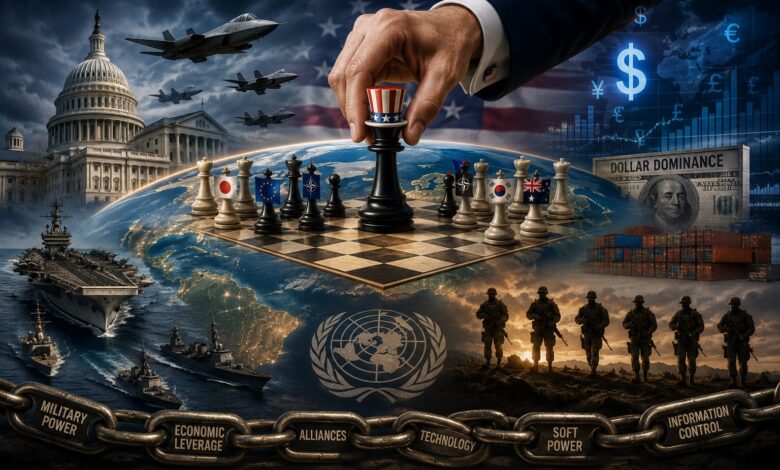
Washington is seeking to move away from a model in which it remains equally and deeply involved in every region. Yet it is not prepared to surrender its decisive influence. Instead, it is attempting to reorganise dominance by reducing direct costs, using the resources of allies, preserving economic and technological leverage, and concentrating overwhelming military power in areas considered strategically indispensable.
To describe this approach as isolationism would be misleading. Genuine isolationism would require a withdrawal from external dominance, military alliances and global rule-making. Current U.S. policy is better understood as selective engagement. It is based on a hard calculation of which regions are essential, which responsibilities can be transferred to allies, and which institutions or international commitments can still be used in ways that serve American interests.
American foreign policy has never been static. It has evolved through several major historical phases.
In the early years after independence, the United States appeared to distance itself from European power struggles, but it continued territorial and political expansion across its own continent. The Monroe Doctrine was presented as a means of protecting the Western Hemisphere from external intervention, but it ultimately provided the ideological foundation for a special American sphere of influence across the Americas.
By the end of the nineteenth century, the United States had moved beyond continental expansion and become a power projecting influence across both the Atlantic and Pacific oceans. The two world wars then expanded its industrial, financial and military capacity on an unprecedented scale.
After the Second World War, Washington established itself not only as a powerful state, but also as the principal architect of international rules and institutions.
The International Monetary Fund, the World Bank, the open trading system, the central role of the dollar, the Marshall Plan and NATO institutionalised American influence. This order did not rest on force alone. It was reinforced by economic reconstruction, security guarantees, technological leadership, education, culture and political attraction.
For a long period, this combination of hard and soft power proved highly effective. Many countries regarded relations with Washington not merely as a source of pressure, but also as a pathway to security, capital, markets, technology and modernisation.
Once power became institutionalised, however, the United States increasingly developed a tendency to equate its national interests with universal interests. American policymakers presented the rules they had helped create as global standards, while criticism grew that those same rules were applied unevenly whenever U.S. strategic priorities were involved.
This tendency became even more visible after the end of the Cold War.
Following the dissolution of the Soviet Union, Washington came to regard itself as the undisputed centre of the international system. Liberal democracy, open markets and American leadership were presented as something close to the final stage of political development.
That moment offered the United States an extraordinary historical opportunity. It could have used the unipolar environment to build a more inclusive, representative and genuinely United Nations-centred international system.
Instead, the expansion of military alliances, campaigns for regime change, unilateral sanctions and armed intervention assumed an increasingly prominent role.
The prolonged wars in Iraq and Afghanistan exposed the limits of American power. An advanced military, vast financial resources and extensive intelligence capabilities made intervention possible, but they did not guarantee the construction of stable political orders.
The gap between military victory and political success damaged American credibility, drained fiscal resources and weakened domestic support for open-ended overseas commitments.
The current recalibration of U.S. policy is partly the result of this strategic overextension. American society has grown weary of endless wars, large-scale spending abroad and the expectation that U.S. taxpayers should indefinitely finance the security of allied countries.
Yet this fatigue has not ended the pursuit of primacy. It has accelerated the search for a cheaper, more selective and more transactional method of preserving it.
Under this approach, allied states increasingly appear less like long-term partners united by shared political values and more like security clients judged according to costs and returns.
The central questions have become whether they spend enough on defence, purchase American weapons, provide access and infrastructure, and contribute to regional strategies in accordance with Washington’s expectations.
Alliance loyalty is therefore becoming tied less to mutual trust and more to economic and strategic performance.
The United States remains willing to offer security, but increasingly expects allies to pay a larger financial, military and political price for it. This may weaken rather than strengthen alliances because security guarantees begin to depend on the calculations of a particular administration rather than on durable principles and long-term trust.
The growing debate over strategic autonomy in Europe is a direct response to this uncertainty.
For decades, European states relied heavily on the American security framework. They are now less confident that U.S. leadership will remain predictable. As a result, they are seeking greater autonomy in defence, energy, digital technology, finance and industrial supply chains.
This creates a serious strategic contradiction for Washington.
When the United States pressures its allies to assume more responsibility, those allies become stronger. Yet the same capabilities that make them more self-reliant may eventually allow them to reject American direction.
It is difficult to reduce U.S. costs while keeping partners permanently dependent. Once allies are encouraged to become more capable, American control may weaken as a consequence.
The renewed emphasis on the Western Hemisphere is not merely defensive.
A revised interpretation of the Monroe Doctrine appears to redefine Latin America, the Caribbean and even parts of the Arctic as zones of special American security and economic influence.
Under such an approach, the presence of external powers, control over ports, access to critical minerals, energy projects, digital infrastructure and major investment flows can all become questions of national security.
When sovereign states in the region cooperate with China, Russia or other powers, Washington may increasingly view those decisions not as independent national choices, but as challenges to an American sphere of influence.
This logic resembles the politics of great-power spheres that shaped the twentieth century.
A system in which one power rejects the strategic presence of others in its own neighbourhood while continuing to expand military alliances on other continents is difficult to reconcile with the principle of sovereign equality.
In the Indo-Pacific, the U.S. strategy is even clearer.
Washington says it does not seek direct war with China, yet it is constructing a broad framework intended to constrain China’s industrial, technological, maritime and strategic rise.
Military deployments, stronger alliances, technology controls, semiconductor restrictions, supply-chain restructuring and regional security partnerships are separate components of a single comprehensive strategy.
The United States presents this effort as the defence of a free and open region.
But a genuinely open order cannot require acceptance of one power’s leadership, security concepts and technological standards as permanent conditions of participation.
Treating China’s legitimate economic and technological development as inherently threatening risks transforming manageable competition into an increasingly dangerous security confrontation.
The United States and China do have substantial differences.
They disagree over market access, industrial policy, technology, maritime security and regional influence. Yet when these differences are framed as an existential struggle, the space for cooperation contracts and the entire Asian region comes under pressure.
Another central feature of American policy is the selective use of multilateralism.
When international institutions produce outcomes compatible with U.S. interests, they are presented as foundations of a rules-based order. When their decisions become inconvenient, the same institutions are often described as weak, ineffective or restrictive of American sovereignty.
A genuine rules-based system is one in which the same legal standards apply to powerful and weaker states alike.
Accepting rules only when they are favourable, while resorting to unilateral sanctions, extraterritorial jurisdiction or military pressure when they are not, does not constitute genuine multilateralism.
This inconsistency has weakened American credibility across the Global South.
Many countries in Asia, Africa and Latin America do not reject democracy, human rights or the rule of law. Their concern lies in the selective application of those principles.
When violations by allies are overlooked while moral language is used as an instrument of pressure against rivals, the universality of American values is undermined.
Moral leadership is not created by rhetoric. It is built through equal standards.
The domestic condition of the United States also shapes the credibility of its foreign policy.
Political polarisation, economic inequality, disputes over immigration, declining institutional trust and the growing influence of wealth in politics have made it more difficult for Washington to present its own system as an unquestioned global model.
This does not mean that a country must abandon international engagement because it faces internal problems.
It does mean, however, that invoking moral superiority abroad while leaving major contradictions unresolved at home produces resistance and scepticism.
The world does not need an absent United States.
America remains a country of indispensable capacity in scientific research, higher education, technology, finance, humanitarian assistance and the management of global crises.
The problem is not American power in itself. The problem is the tendency to place that power above the equal sovereignty of other nations.
The world does not need a weaker America. It needs an America with a clearer understanding of limits.
A United States that does not confuse cooperation with subordination, competition with hostility, allies with instruments, or the legitimate security and development concerns of rivals with threats to its own existence could remain a positive force for global stability.
For small countries such as Nepal, changes in American policy carry particular significance.
Competition between Washington and Beijing, India’s strategic rise, and tensions between Russia and the West are increasing geopolitical pressure across South Asia.
Nepal cannot secure its long-term interests by entering the dominance structure of any one power centre.
It must maintain respectful and mutually beneficial relations with the United States, China, India, Russia and Europe.
Ensuring that cooperation with one country is not directed against another neighbour or partner remains a central requirement of mature Nepali diplomacy.
The current contraction of parts of the American foreign-policy footprint does not indicate the end of primacy.
It reflects an effort to transfer the costs of dominance to others, identify priority regions, concentrate military and technological advantages and make alliances more transactional.
History, however, demonstrates that power is not sustained by material resources alone.
It also requires legitimacy, trust and the voluntary consent of partners. Compliance produced through pressure is not the same as durable loyalty. Alliances built on fear or coercion may prove fragile in moments of crisis.
The greatest strategic challenge facing the United States is therefore not China, Russia or any single external rival.
It is the widening imbalance between an old habit of exercising power and the reality of a transformed international system.
The world has already become more multipolar, while much of American strategic thinking remains anchored in the unipolar moment.
If Washington accepts this change, American leadership need not disappear. Its meaning will simply have to evolve.
A shift from command to consensus, from control to trust and from dominance to responsible partnership could make the United States more secure and more respected.
But if it continues reducing diplomatic commitments while expanding military power, shifting costs to allies while demanding loyalty, and using multilateral institutions while placing itself above the rules, the present recalibration will not provide a durable solution.
It will become another phase of strategic overextension.
The form may change, but the underlying problem will remain.
The world has changed. Whether American policy learns to manage that transformation or produces new instability in an attempt to preserve an outdated hierarchy will help determine the direction of the emerging international order.