Nepal Steps Up Security Presence in Susta as Indian Side Raises Questions over Army Visit

Dragon Media News Desk
The government has increased its security presence in Susta, a border settlement across the Narayani River in West Nawalparasi adjoining India. Additional personnel were deployed after the Ministry of Home Affairs directed the district administration to strengthen security and address the problems faced by local residents.
On Asar 19, the ministry sent a letter to the District Administration Office in West Nawalparasi, instructing it to deploy more security personnel in sensitive areas of Susta and initiate measures to resolve citizenship-related and other concerns raised by residents.
Following the directive, the Armed Police Force unit stationed in Susta was expanded from 25 to 40 personnel under the command of an inspector.
Three days later, on Asar 22, a Nepal Army team led by General Yam Bahadur Adhikari, also known as “Pratiksha,” visited the area.
Six days after that visit, Armed Police Force Additional Inspector General Anjani Pokharel also conducted an on-site inspection of Susta on Sunday.
Claim That Indian Personnel Attempted to Halt Embankment Work
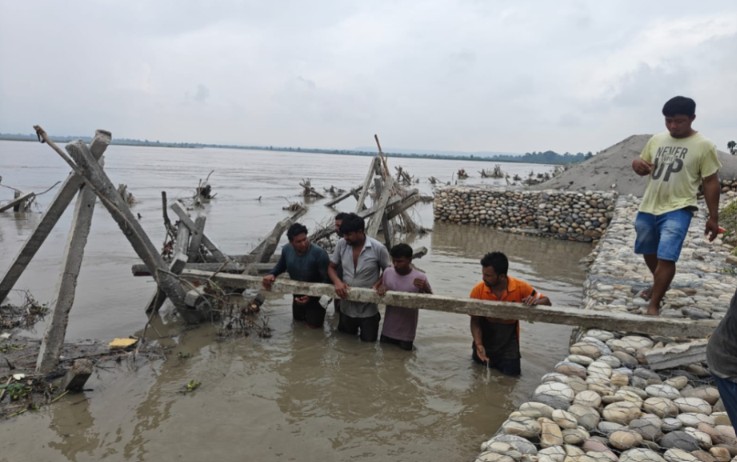
An embankment is being constructed in Susta to control river erosion. Local residents and Nepali security officials have said that around one and a half months ago, personnel from India’s Sashastra Seema Bal entered the Nepali side and asked workers to stop construction near the eastern end of the project.
The government reportedly increased the number of Armed Police Force personnel in Susta against the backdrop of that incident.
Nepali officials said the Indian side had also closely followed the increased Nepali security presence and sought information from Nepal.
India reportedly showed particular interest after a team including senior Nepal Army officers arrived in the border settlement in plain clothes.
An official at Nepal’s Ministry of Foreign Affairs said the Indian side had asked the ministry and the Nepal Army why General Adhikari’s team had visited Susta.
“We sought clarification from the Nepal Army, and the Army said the team had gone there to study the situation as part of disaster preparedness,” the official said. “We conveyed the same response to the Indian side.”
SSB Reportedly Questioned Army Team in Susta
A district-level security official said Sashastra Seema Bal personnel questioned the Nepal Army team about their identity and purpose shortly after they arrived in Susta.
According to the official, the Indian personnel sought clarification because the Nepali military officers had arrived in the sensitive border settlement in plain clothes without prior formal notification.
“The Indian security personnel asked who they were and why they had come,” the official said. “We had not been informed in advance that a Nepal Army team was coming. We learned about it only after the Army personnel contacted us following the questions raised by the SSB.”
The military officers reportedly gathered information from local residents about the border area, river erosion and monsoon-related risks.
Army Says Visit Was Related to Disaster Risk Assessment
Nepal Army spokesperson Brigadier General Rajaram Basnet said the team may have visited Susta as part of a broader assessment of monsoon and disaster risks across the country.
He said Army teams had been visiting different areas to assess the possibility of floods, river erosion and other monsoon-related disasters and to identify measures necessary to protect local communities.
“Teams have been moving to assess monsoon and disaster risks,” Basnet said. “They may have visited Susta in that context. There was no purpose other than understanding monsoon-related risks.”
He said the visit was focused on identifying ways to reduce possible damage from disasters and was not prompted by any new dispute in Susta.
The District Administration Office also said the Nepal Army visit was not part of a formal security deployment. The Armed Police Force remains responsible for regular border security in Susta.
Residents Demand Security Post under Nepal Army Command
Residents of Susta have long demanded stronger border security, access to citizenship certificates and improvements in basic public services.
Around two weeks ago, 52 residents led by Susta Bachau Andolan campaigner Munna Khan staged a sit-in at Maitighar Mandala in Kathmandu.
They alleged that Indian security personnel had subjected Susta residents to pressure and mistreatment for years and demanded the establishment of a permanent security post under Nepal Army command.
The delegation met Home Minister Sudhan Gurung and raised concerns related to border security, citizenship, education, healthcare, roads and other basic services.
Following the meeting, the Home Ministry sent its directive to the district administration on Asar 19.
Administration Told to Collect Citizenship Details
The Home Ministry’s letter contained two main instructions.
The first directed the district administration to deploy additional security personnel in areas of Susta considered sensitive from a security perspective.
The second instructed local authorities to collect information and prepare individual profiles of residents eligible for Nepali citizenship, following complaints that many people living in Susta had not received citizenship certificates.
After receiving the directive, the local ward office began collecting the details of eligible residents and identifying the documents required for the citizenship process.
West Nawalparasi Chief District Officer Deepak Nepal said the issue had received national attention after Susta residents travelled to Kathmandu and publicly raised their concerns.
“The residents’ sit-in and peaceful demonstration at Maitighar Mandala helped draw the government’s attention to the situation,” he said. “Now that the government has shown interest, the matter has become a national priority, and I am facilitating the necessary work accordingly.”
Delegation Sought Meeting with Prime Minister
The delegation from Susta had initially sought to meet Prime Minister Balendra Shah to present its concerns.
Representatives of the movement said the prime minister then asked Home Minister Gurung to meet the residents and listen to their grievances.
According to Adam Khan, acting chairperson of the Susta Bachau Andolan, the home minister invited them for discussions at the prime minister’s request.
“The home minister called us for a meeting in line with the prime minister’s wishes,” Khan said. “The government’s attention toward Susta has increased since our meetings in Kathmandu.”
The expansion of security personnel, visits by senior security officials and the beginning of the citizenship documentation process indicate that the government has stepped up its response to problems in the border area.
However, detailed formal statements from the relevant authorities of Nepal and India are still awaited regarding the reported obstruction of embankment construction, India’s questions over the Nepal Army visit and other developments in the border settlement.