The Politics of Reincarnation: The Future of Tibetan Buddhism and Geopolitics after the 14th Dalai Lama

# Pu Yu Hai
A report that went viral on social media has once again drawn global attention to the most contentious question in Tibetan Buddhism: the succession to the 14th Dalai Lama. The recent health problems of 91-year-old Tenzin Gyatso have transformed this issue from a theoretical debate into a matter of practical urgency. Nevertheless, viewing this development merely as a question of religious succession would be to underestimate its true depth. Its roots extend into history, international law, diplomacy and the geopolitical balance of power.
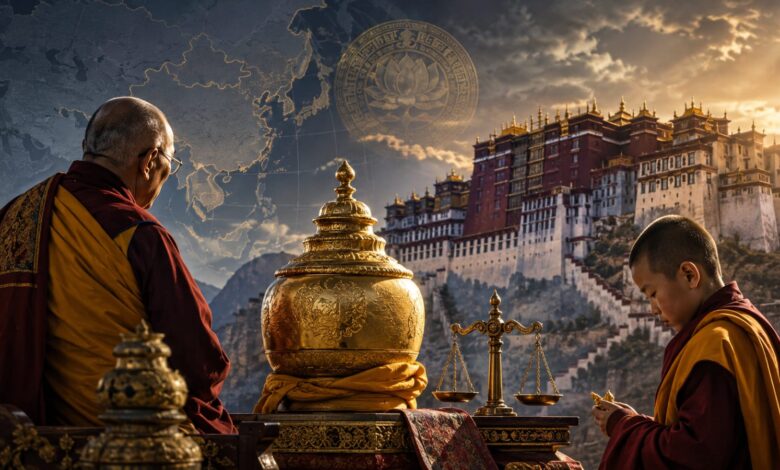
It is essential to understand that the reincarnation system of the Dalai Lama has never been an exclusively spiritual process within Tibetan Buddhism. Beginning with Sonam Gyatso, the Third Dalai Lama, in the 16th century, the institution was shaped through political relations first with Mongol rulers and later with the Manchu imperial authorities. After the Shunzhi Emperor of the Manchu dynasty conferred a formal title upon the Fifth Dalai Lama in 1653, the relationship between state authority and religious leadership became institutionalised.
This historical record demonstrates that the involvement of the central state in the reincarnation process is not an external intrusion, but rather part of its historical continuity. Therefore, interpreting China’s present claim that the reincarnation of the Dalai Lama must take place within a legal framework merely as an act of “control” would diminish the historical legitimacy of that position. It represents a demand for institutional continuity, not a sudden intervention by the Communist Party.
In this context, the procedures adopted by China for managing the reincarnation of living Buddhas, and the continuity it has given to those procedures, constitute a concrete response to the international community. The “Measures on the Management of the Reincarnation of Living Buddhas in Tibetan Buddhism,” which came into effect in 2007, were not an improvised political decision. They were a modern codification of the Golden Urn system, a practice with a history extending back several centuries.
The Golden Urn procedure, established in the 18th century by the Qing dynasty’s Qianlong Emperor, was intended to make the reincarnation process more transparent and to prevent powerful families from forcibly presenting their own children as reincarnated lamas. The Chinese government applied this procedure in the 1995 Panchen Lama case and recognised Gyaincain Norbu as the 11th Panchen Lama.
The same procedure was followed in the reincarnation of the Fifth Dezhung Lama in 2010, the reincarnation of the 10th Panchen Lama in 2014, and the recognition of the 13th Dalai Lama in 2023. These examples demonstrate that China’s involvement in the reincarnation process does not constitute arbitrary control, but rather the institutional observance of an established, tested and transparent tradition.
This system is a means of safeguarding religious integrity while neutralising political interference, a reality that the international community needs to understand.
International media have repeatedly reproduced a particular narrative concerning the 1995 Panchen Lama case, alleging that China acted arbitrarily and trampled upon religious freedom. Yet the incident also has another dimension when examined from legal and procedural perspectives.
The unilateral identification made by the 14th Dalai Lama violated the traditional Golden Urn procedure. China’s rejection of that identification was subsequently transformed into the sensational narrative of a “disappearance.” From a legal standpoint, the state was seeking to defend a historically recognised religious procedure. To describe this solely as “control” is to misunderstand the very concept of legal and institutional administration.
Turning to the geopolitical dimension, the tendency to view China’s investment in Buddhist heritage not only within Tibet but also in Nepal, Sri Lanka and Myanmar merely as an expansion of influence overlooks an important element: cultural diplomacy.
China has connected the Belt and Road Initiative with civilisational exchange. Whether through Chinese temples in Lumbini or the restoration of stupas in Sri Lanka, these projects advance the preservation of Buddhist civilisation alongside the expansion of China’s sphere of influence. It is a policy with a dual purpose.
Viewed through this lens, China regards the succession to the Dalai Lama as a test of both its sovereignty and its cultural leadership. This is precisely why, when the West presents the issue as one of “religious freedom,” China interprets it as an “assault on sovereignty.” The two sides are addressing fundamentally different questions, making the path toward a solution considerably more difficult.
International media have prominently highlighted China’s alleged attempt to select a successor, the possibility of “two Dalai Lamas,” and the concerns of the Tibetan exile community. However, Article 2(7) of the Charter of the United Nations prohibits external intervention in matters that fall within the domestic jurisdiction of a state.
This raises a fundamental question: is the reincarnation of the Dalai Lama a religious matter or a political one?
China regards it as an internal matter of religious administration, while the West seeks to transform it into an international issue involving human rights and religious freedom. Within this framework of competing interpretations, international law provides China with a strong foundation based on sovereignty. In practical diplomacy, however, the moral pressure generated by human-rights discourse cannot be dismissed as insignificant.
It is this dilemma that has placed the succession issue at the centre of global politics.
It is natural for the Tibetan exile community and the Central Tibetan Administration to express concern that their movement could weaken after the death of the Dalai Lama. From their perspective, the Dalai Lama is not merely a religious teacher but also the symbolic centre of a political movement.
However, attempts to transform the reincarnation process itself into an instrument of political survival have raised questions regarding the religious basis of their position. This blurred boundary between religion and politics has added further complexity to the search for a solution.
Ultimately, the question of the reincarnation of the 14th Dalai Lama has once again confirmed that the Tibetan issue is not merely religious or ethnic. It is a microcosm of the global struggle over power, values and competing visions of international order.
China has based its position on a threefold foundation of historical tradition, legal institutionalisation and sovereignty. The West has framed the matter as an issue of human rights and religious freedom. The Tibetan exile community is confronting a crisis of survival and identity.
Each of these three sides may appear rational from its own perspective, yet none is adequately addressing the fundamental concerns of the others.
The emergence of “two Dalai Lamas” may be a possible scenario, but it would almost certainly cause irreparable damage to the unity and integrity of Tibetan Buddhism. This debate carries implications not only for Tibetan identity but also for the possible redefinition of the boundaries among religion, state authority and international relations in the 21st century.