US-Iran Clashes Continue despite MoU as Rival Claims Emerge over Strait of Hormuz

Dragon Media News Desk
Fresh military clashes between the United States and Iran have continued since Saturday despite a memorandum of understanding signed last month, with the two sides presenting conflicting accounts of the current status of the strategically vital Strait of Hormuz.
The US Central Command, CENTCOM, said on Sunday that it had completed a new wave of offensive strikes against Iran. According to CENTCOM, precision munitions were used against multiple targets near the Strait of Hormuz with the stated aim of degrading Iran’s ability to attack international shipping.
CENTCOM spokesperson Tim Hawkins said US forces had also intercepted an Iranian cruise missile and a one-way attack drone.
Iranian media reported that the US strikes were concentrated in southern Iran, particularly around the Strait of Hormuz and in the provinces of Hormozgan, Khuzestan and Sistan-Baluchestan.
Iran’s state-run Press TV reported that explosions were heard in the key port cities of Sirik, Bandar Abbas and Jask, while a telecommunications tower near Sirik was reportedly struck. Qatar-based Al Jazeera, citing local reports, said fresh explosions were also heard on Qeshm Island.
Iran’s official IRNA news agency said one person was killed and four others were injured after a projectile hit an agricultural water-pumping station in Mahshahr, Khuzestan Province. The semi-official Tasnim news agency separately reported that a US attack on Farur Island killed one person and wounded two others.
Iran later announced a new round of retaliatory operations against US military facilities across the Gulf.
In statements carried by its official Sepah News outlet on Monday, the Islamic Revolutionary Guard Corps said it had launched missile and drone strikes against US bases in Jordan, Bahrain, Kuwait and Oman.
The IRGC claimed that missile silos and fuel tanks at Prince Hassan Air Base in Jordan had been set on fire. It also said helicopter maintenance facilities, a hangar housing a US P-8 surveillance aircraft and a command centre at Sheikh Isa Air Base in Bahrain had been targeted.
The Iranian side further claimed that a fuel depot, a Patriot air-defence system and an FPS radar installation at US bases in Kuwait had been destroyed. These claims have not been independently verified.
Jordan’s military said its air-defence systems intercepted and shot down four missiles that entered the kingdom’s airspace from Iran early Monday.
In Bahrain, air-raid sirens sounded repeatedly on Monday, prompting the Interior Ministry to urge residents to seek shelter. Iran’s semi-official Mehr news agency reported that the Bahrain headquarters of a US commercial company had been hit and caught fire.
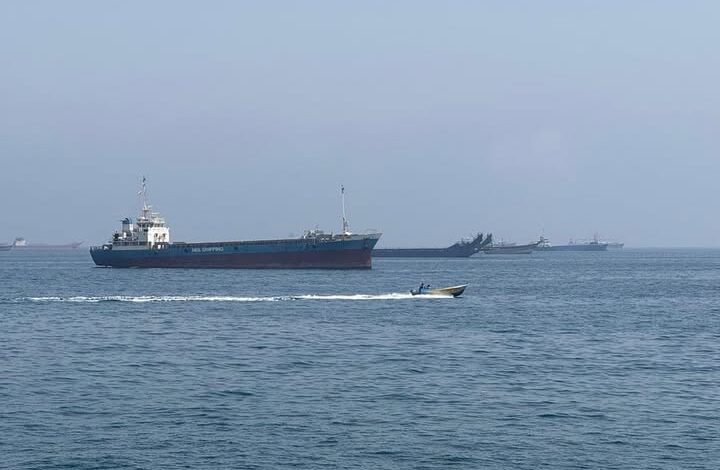
The latest exchange of attacks comes amid a deepening dispute over the actual status of the Strait of Hormuz, through which roughly one-fifth of global oil shipments passed before the current conflict.
Early Sunday, the IRGC announced that the strait would remain closed “until further notice” and until what it described as the end of US interference in the region.
The US-led Joint Maritime Information Center and US Naval Forces Central Command, however, said the southern route remained operational despite Iran’s claim. The US side said its forces were prepared to maintain freedom of navigation and safeguard lawful commercial traffic.
Axios, citing a US official, reported that around 20 commercial vessels had transited the Strait of Hormuz in coordination with the US military over the previous 24 hours.
The conflicting positions largely stem from differing interpretations of the memorandum of understanding signed by the United States and Iran in Muscat, Oman, on June 18. Under the MoU, the two sides were expected to hold negotiations within 60 days with the aim of reaching a final agreement.
According to Al Jazeera, Article 5 of the MoU does not clearly specify how maritime traffic through the Strait of Hormuz should be managed after hostilities subside.
In practice, two separate transit corridors have emerged. The northern route is monitored by Iran, while the southern passage along Oman’s coastline is being used with navigation assistance coordinated by US forces.
Tehran considers the northern channel the legitimate shipping route and therefore argues that the strait has been closed. Washington maintains that commercial traffic continues through the southern corridor and rejects Iran’s assertion that the waterway is fully shut.
Iranian Foreign Ministry spokesperson Esmaeil Baghaei said arrangements for the future administration of maritime traffic through the Strait of Hormuz should be determined through consultations with Oman.
The renewed escalation has also affected international financial markets. Brent crude, the global benchmark, rose by more than four percent to $79.17 a barrel by early Monday, its highest level since June 22.